Brain Anatomy: Major Parts of the Brain and Their Functions
What Are the Major Parts of the Brain?
Introduction
The human brain is the control center of the nervous system. Every thought, memory, movement, emotion, and sensation depends on billions of neurons communicating through highly organized brain structures.
Although the brain appears as a single organ, it is composed of multiple regions with specialized functions. Some areas control conscious thought and voluntary movement, while others regulate breathing, heart rate, balance, sleep, and hormone release.
Understanding the major parts of the brain provides the foundation for learning brain anatomy, neuroscience, and neurological diseases. Before studying individual structures such as the frontal lobe, hippocampus, or basal ganglia, it is important to understand how the brain is organized as a whole.
The brain is divided into four major anatomical regions:
- Cerebrum – responsible for thinking, sensation, voluntary movement, language, and memory.
- Diencephalon – contains the thalamus and hypothalamus, which relay sensory information and regulate homeostasis.
- Brainstem – controls vital automatic functions such as breathing, heart rate, and consciousness.
- Cerebellum – coordinates movement, balance, posture, and motor learning.
Each region has specialized functions but works together continuously to control the body and mind.
Overview of Brain Anatomy
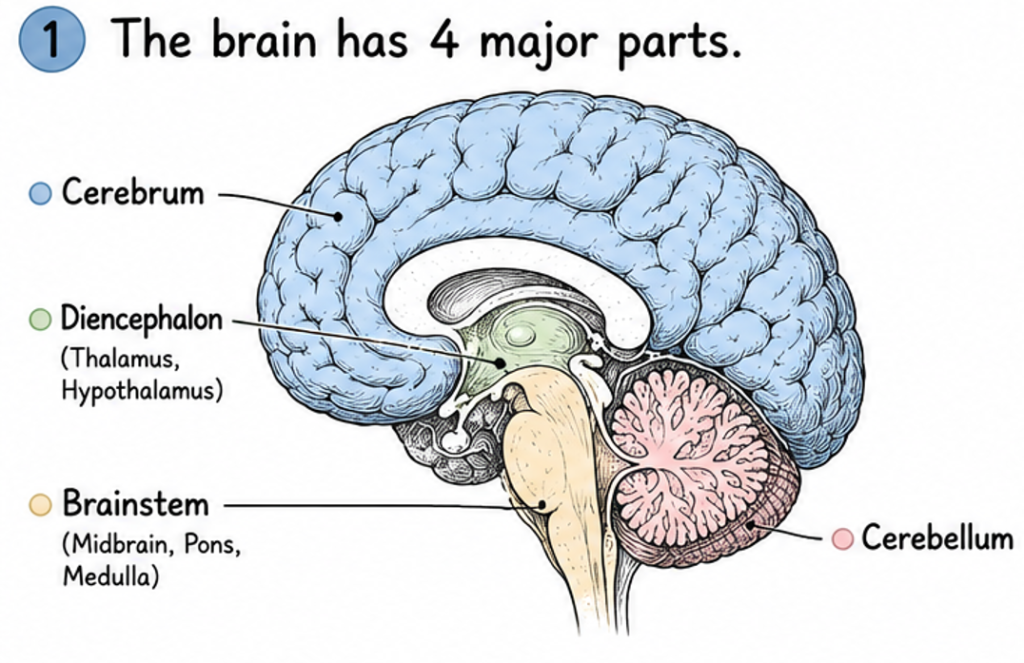
From an anatomical perspective, the brain can be divided into four major regions.
Brain
│
├── Cerebrum
├── Diencephalon
├── Brainstem
└── Cerebellum
Each region contains multiple specialized structures that communicate through extensive neural networks.
1. Cerebrum
The cerebrum is the largest part of the human brain, accounting for approximately 80–85% of total brain volume.
It consists of two cerebral hemispheres connected by the corpus callosum.
The cerebrum is responsible for higher brain functions, including:
- Conscious thought
- Voluntary movement
- Language
- Learning
- Memory
- Problem solving
- Decision making
- Emotion
The outer layer of the cerebrum is called the cerebral cortex, which contains billions of neurons arranged in highly folded gyri and sulci.
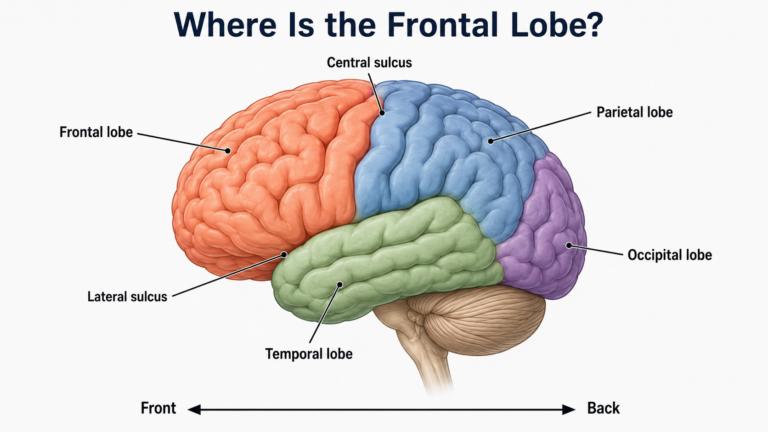
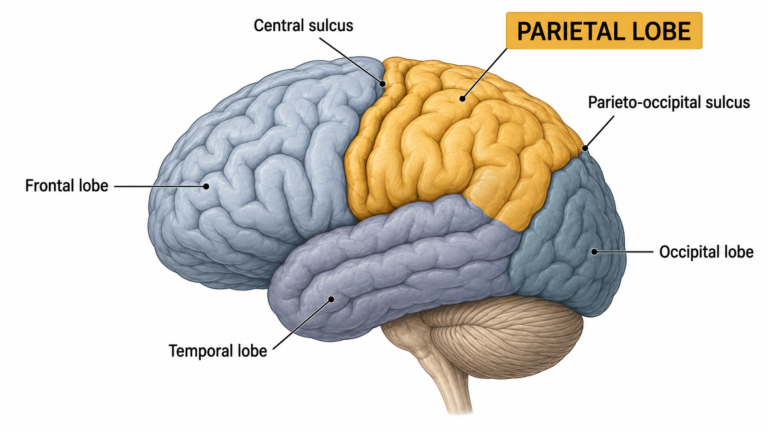
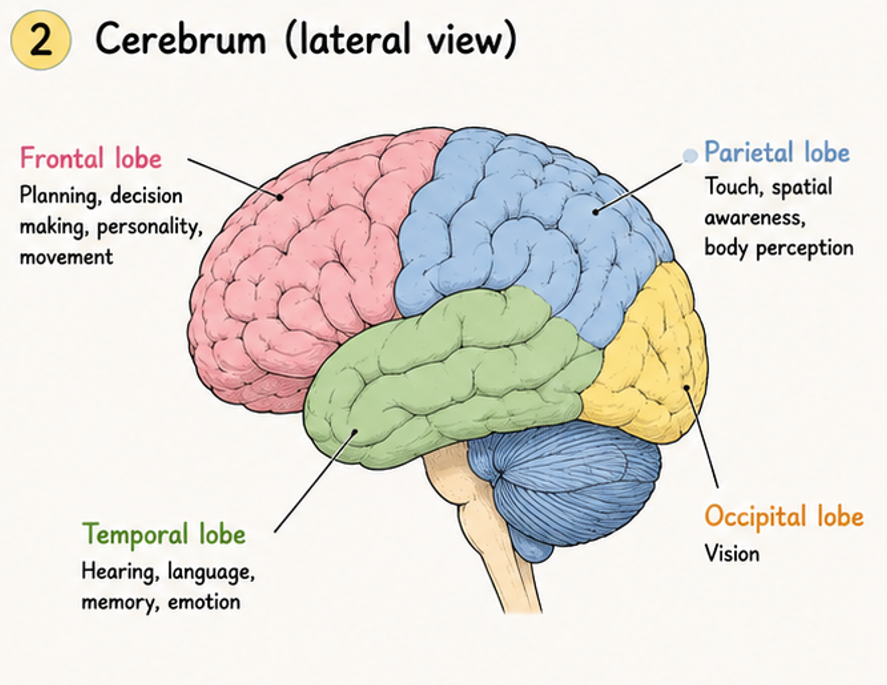
The cerebrum is divided into four major lobes:
- Frontal lobe
- Parietal lobe
- Temporal lobe
- Occipital lobe
2. Diencephalon
The diencephalon lies deep within the center of the brain between the cerebrum and the brainstem.
Although relatively small, it plays essential roles in sensory processing and homeostasis.
Its major components include:
Thalamus
The thalamus acts as the principal relay station for most sensory information traveling to the cerebral cortex.
Nearly all sensory pathways—except olfaction—pass through the thalamus before reaching the cortex.
Hypothalamus
The hypothalamus regulates many automatic body functions, including:
- Body temperature
- Hunger
- Thirst
- Sleep-wake cycles
- Endocrine function
- Autonomic nervous system activity
It maintains the body’s internal balance, a process known as homeostasis.
3. Brainstem
The brainstem connects the brain with the spinal cord.
It consists of three regions:
- Midbrain
- Pons
- Medulla oblongata
The brainstem performs several life-sustaining functions, including:
- Breathing
- Heart rate regulation
- Blood pressure control
- Swallowing
- Eye movements
- Consciousness and arousal
Many cranial nerve nuclei are also located within the brainstem.
Because of its essential functions, severe brainstem injury is often life-threatening.
4. Cerebellum
The cerebellum is located behind the brainstem beneath the occipital lobes.
Although it represents only about 10% of the brain’s volume, it contains more than half of all neurons in the human brain.
The cerebellum is essential for:
- Balance
- Coordination
- Motor learning
- Posture
- Precision of movement
- Timing of muscle activity
Rather than initiating movement, the cerebellum continuously compares intended movement with actual movement and makes rapid corrections.
How the Major Brain Regions Work Together
The four major brain regions function as an integrated system rather than independently.
For example, picking up a cup involves multiple brain regions:
- The cerebrum plans and initiates the movement.
- The brainstem carries signals between the brain and spinal cord.
- The cerebellum fine-tunes the movement for accuracy.
- The diencephalon helps regulate sensory input and internal physiological state.
Everyday behaviors depend on continuous communication among these regions.
Why Understanding Brain Anatomy Is Important
Knowing the major parts of the brain helps explain how different neurological disorders produce different symptoms.
For example:
- Stroke affecting the frontal lobe may impair speech or movement.
- Damage to the cerebellum may cause poor coordination.
- Injury to the brainstem can affect breathing and consciousness.
- Disorders of the hypothalamus may disrupt body temperature or hormone regulation.
Understanding basic anatomy provides a framework for learning more advanced neuroscience topics.
Common Misunderstandings
“The brain works as one single unit.”
Not true.
Different brain regions perform specialized functions while communicating continuously through complex neural networks.
“The cerebellum only controls balance.”
Incorrect.
The cerebellum contributes to balance, but it is also essential for motor coordination, timing, precision, and motor learning.
“The thalamus is only a sensory relay.”
Not entirely.
Although the thalamus is the major relay for most sensory information, it also participates in motor circuits, attention, consciousness, and cognitive processing.
- The brain consists of four major anatomical regions.
- The cerebrum controls higher cognitive functions and voluntary movement.
- The diencephalon regulates sensory processing and homeostasis.
- The brainstem controls vital automatic functions.
- The cerebellum coordinates movement, balance, and motor learning.
- These regions work together to produce normal brain function.
Related Articles
- What Is the Cerebrum?
- What Is the Cerebral Cortex? Structure and Function
- What Is the Brainstem?
- What Is the Cerebellum?
References
- Standring S, ed. Gray’s Anatomy: The Anatomical Basis of Clinical Practice. 42nd ed. Elsevier; 2020.
- Bui T, Das JM. Neuroanatomy, Cerebral Hemisphere. StatPearls. NCBI Bookshelf.
- Basinger H, Hogg JP. Neuroanatomy, Brainstem. StatPearls. Updated July 4, 2023.
- Jimsheleishvili S, Dididze M. Neuroanatomy, Cerebellum. StatPearls. NCBI Bookshelf.
Written by: MedMaru Editorial Team
Reviewed for medical accuracy by:
S. Chang, KMD