Parietal Lobe: Function, Location, and Damage Explained
What Is the Parietal Lobe?
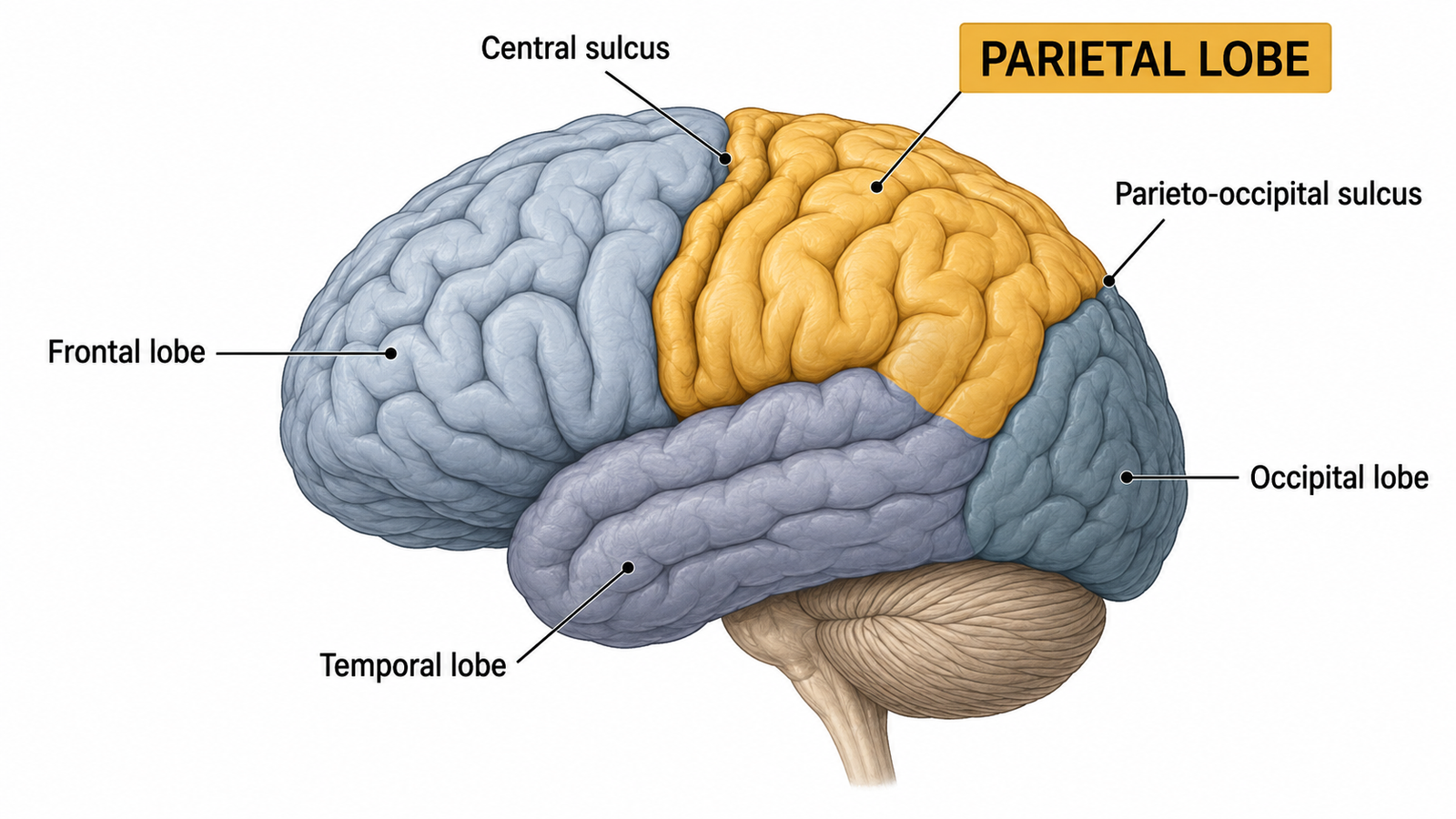
The parietal lobe sits under the top and back of your skull, between your ears and the back of your head. Its main job is taking in feelings from your body — touch, pressure, where your limbs are in space — and combining that with what you see, so your brain can build one working picture of your body and its surroundings. Doctors call this body-sensation processing somatosensation.
If this region is damaged, you don’t lose the ability to feel touch — the nerves and spinal pathways still carry the signal fine. What’s lost is the brain’s ability to interpret that signal: to know which finger was touched, or to notice a limb at all with your eyes closed. That gap between “the signal arrives” and “the brain can’t make sense of it” is the thread running through everything below.
One Region, Three Working Zones
The parietal lobe isn’t one uniform patch of tissue — it’s built like a small assembly line, with each zone handling a different step.
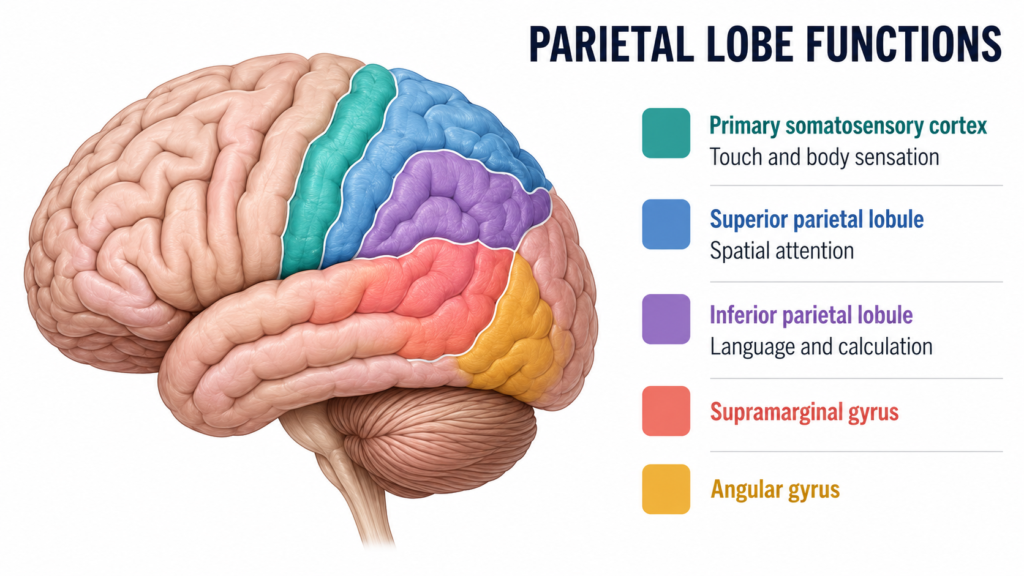
Postcentral gyrus — the ridge right behind the central sulcus, and the first stop for incoming sensation. This is the primary somatosensory cortex (Brodmann areas 3, 1, and 2). It’s organized as a “sensory homunculus,” a distorted body map where the space devoted to a body part matches how sensitive that part is, not how large it physically is — which is why your fingertips can tell apart two very close points of touch while your upper back can’t. Damage limited to this strip causes reduced or distorted touch, pressure, and position sense on the opposite side of the body, since most sensory pathways cross sides on their way to the brain.
Superior parietal lobule — just behind the postcentral gyrus (Brodmann areas 5 and 7). It takes that raw sensory map and combines it with the body’s position in space, which is what lets you reach for something accurately while looking at it.
Inferior parietal lobule — below the superior lobule, split into two parts: the supramarginal gyrus (area 40), tied to language comprehension, and the angular gyrus (area 39), tied to number processing and spatial awareness. These sit right where the parietal, temporal, and occipital lobes meet, which is part of why damage here tends to produce mixed, complicated symptoms rather than one clean deficit.
| Sub-region | Brodmann area(s) | Main role |
|---|---|---|
| Postcentral gyrus | 3, 1, 2 | Raw touch, pressure, temperature, pain, position |
| Superior parietal lobule | 5, 7 | Integrating sensation with spatial/body position |
| Supramarginal gyrus | 40 | Language comprehension |
| Angular gyrus | 39 | Number processing, spatial awareness |
Where It Sits
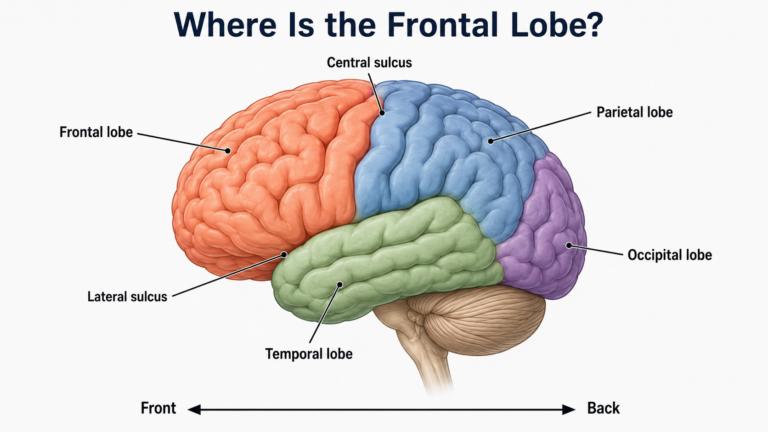
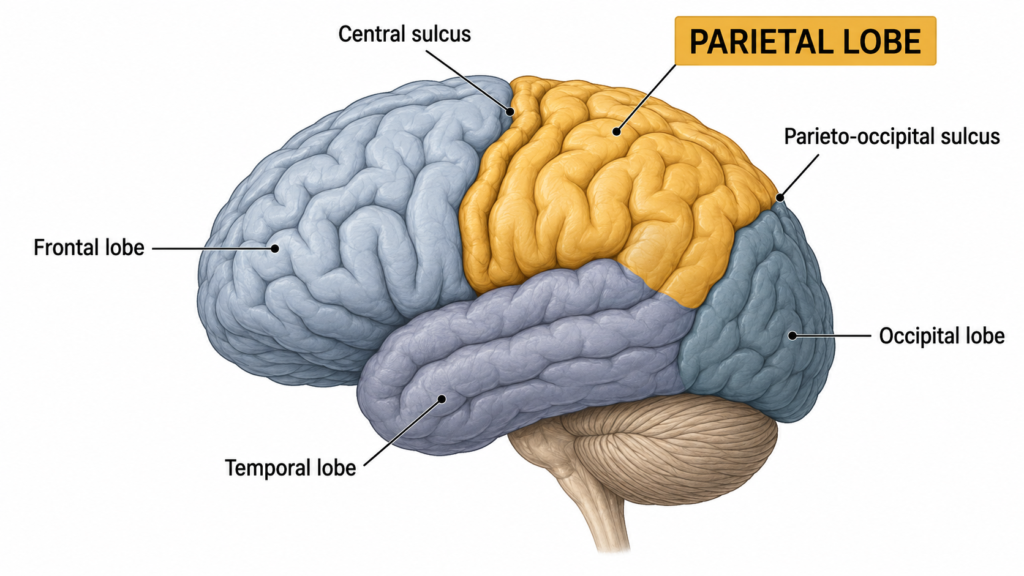
The parietal lobe sits behind the frontal lobe, in front of the occipital lobe, and above the temporal lobe. Three grooves mark its borders: the central sulcus (frontal lobe), the parieto-occipital sulcus (occipital lobe), and the lateral sulcus, or Sylvian fissure (temporal lobe). Sensory information reaches it mainly through the thalamus — a deep relay structure that routes touch, pressure, and position signals from the spinal cord and face straight to the postcentral gyrus.
When It’s Damaged
Because the left and right parietal lobes aren’t functionally identical, damage to one side tends to look different from damage to the other.
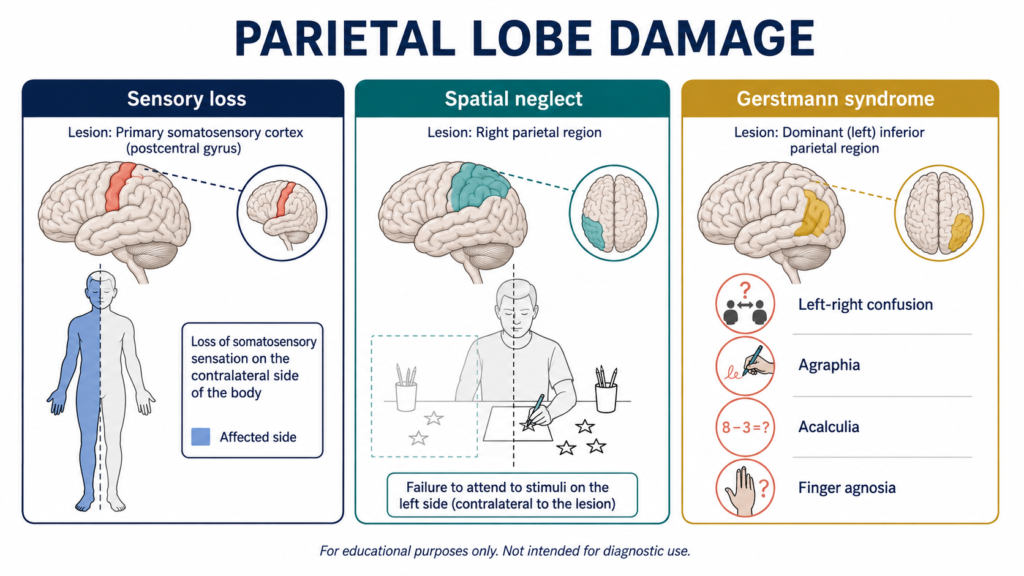
Left (dominant) side damage, especially around the angular gyrus, can produce Gerstmann syndrome: trouble with calculation, trouble writing by hand, trouble telling which finger is which, and left-right confusion — occurring together. In practice, finding two or three of these together is common; the full four-symptom set is rare, and its presence points to needing further neurological workup rather than one specific diagnosis.
Right (non-dominant) side damage, especially near the temporo-parietal junction, more often produces hemispatial neglect: the person stops attending to one side of space — usually the left — even though their eyes and nerves are working fine. Neglect shows up in a large share of people after right-hemisphere stroke, and it’s disproportionately more common after right-sided strokes than left-sided ones, even though left-hemisphere strokes are slightly more frequent overall. Someone with neglect might eat food from only one half of a plate, or miss people approaching from their neglected side — this is a problem of attention, not blindness or paralysis.
Damage to both sides is rarer but produces Balint syndrome: an inability to voluntarily shift gaze (ocular apraxia), an inability to perceive more than one object in a scene at once even though each one is seen fine individually (simultanagnosia), and an inability to accurately reach for something under visual guidance (optic ataxia).
None of this substitutes for an actual exam — real lesions rarely respect textbook boundaries, and several of these symptoms can come from causes that have nothing to do with structural brain damage.
Common Myths
“The parietal lobe is where touch happens.” Touch receptors are in your skin; the signal travels through the spinal cord and thalamus before it ever reaches the parietal lobe. The parietal lobe is where that signal gets interpreted, not where it starts.
“Damage here always causes numbness.” Depending on which sub-region is hit, damage can affect calculation, language comprehension, spatial awareness, or attention to one side of the body — with basic touch sensation completely intact, because the sensory pathway itself can remain undamaged even when its interpretation isn’t.
“Left-brain/right-brain differences mean each side works alone.” The two sides specialize on average but stay constantly connected — reading a map, for instance, draws on both at once, not one working in isolation.
Sudden numbness or weakness on one side of the body, sudden confusion or trouble speaking, sudden trouble seeing, sudden trouble walking or loss of balance, or a sudden severe headache with no known cause are stroke warning signs. Don’t wait to see if they pass — call emergency services right away.
Key Terms
- Somatosensation — the combined sense of touch, pressure, temperature, pain, and body position.
- Postcentral gyrus — the ridge just behind the central sulcus; the primary somatosensory cortex.
- Homunculus — a body map drawn onto a cortical strip, distorted so more sensitive body parts take up more space.
- Gerstmann syndrome — acalculia, agraphia, finger agnosia, and left-right disorientation from damage near the dominant angular gyrus.
- Hemispatial neglect — failure to attend to one side of space or body despite intact senses, usually from right-sided parietal damage.
- Balint syndrome — ocular apraxia, simultanagnosia, and optic ataxia from bilateral parietal-occipital damage.
FAQ
What does the parietal lobe do, in simple terms?
It takes in feelings from your body and combines them with what you see, building one clear sense of your body and what’s around it.
What happens if it’s damaged?
It depends on the side and the exact spot — from reduced touch sensation, to trouble with calculation or writing (more common on the left), to ignoring one side of space entirely (more common on the right).
Is the left parietal lobe different from the right?
On average, yes — the left leans toward language and calculation, the right toward spatial awareness — but this is a general pattern, not a strict rule, and the two sides work together on most everyday tasks.
Related Reading
References
- StatPearls, “Neuroanatomy, Postcentral Gyrus” — https://www.ncbi.nlm.nih.gov/books/NBK549825/
- StatPearls, “Gerstmann Syndrome” — https://www.ncbi.nlm.nih.gov/books/NBK519528/
- StatPearls, “Spatial Neglect” — https://www.ncbi.nlm.nih.gov/books/NBK562184/
- StatPearls, “Balint Syndrome” — https://www.ncbi.nlm.nih.gov/books/NBK544347/
- National Institute of Neurological Disorders and Stroke, “Stroke: Signs and Symptoms” — https://www.ninds.nih.gov/health-information/stroke/signs-and-symptoms
Written by: MedMaru Editorial Team
Reviewed for medical accuracy by:
S. Chang, KMD