Four Lobes of the Brain: Location, Function, and Anatomy
What Are the Four Lobes of the Brain?
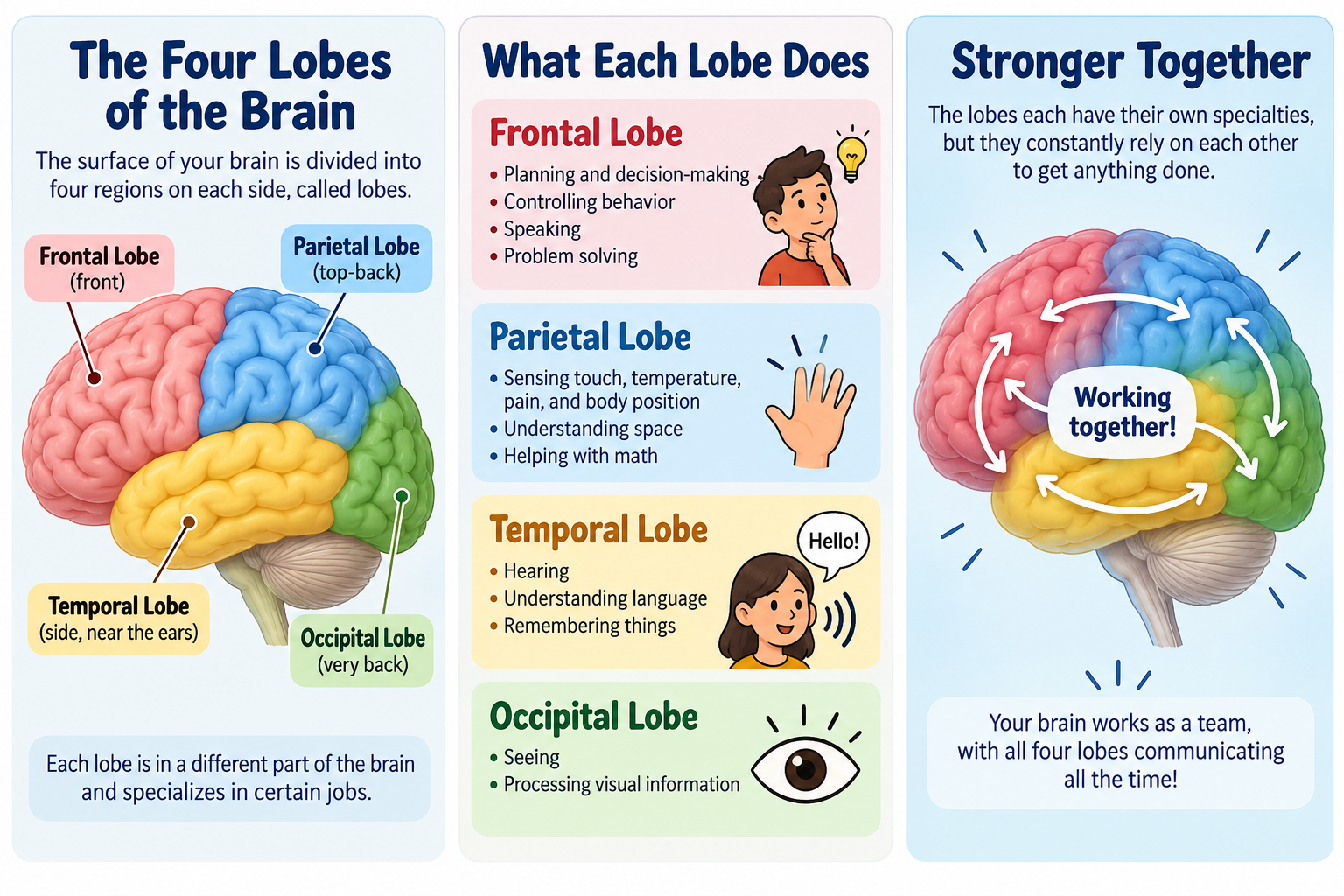
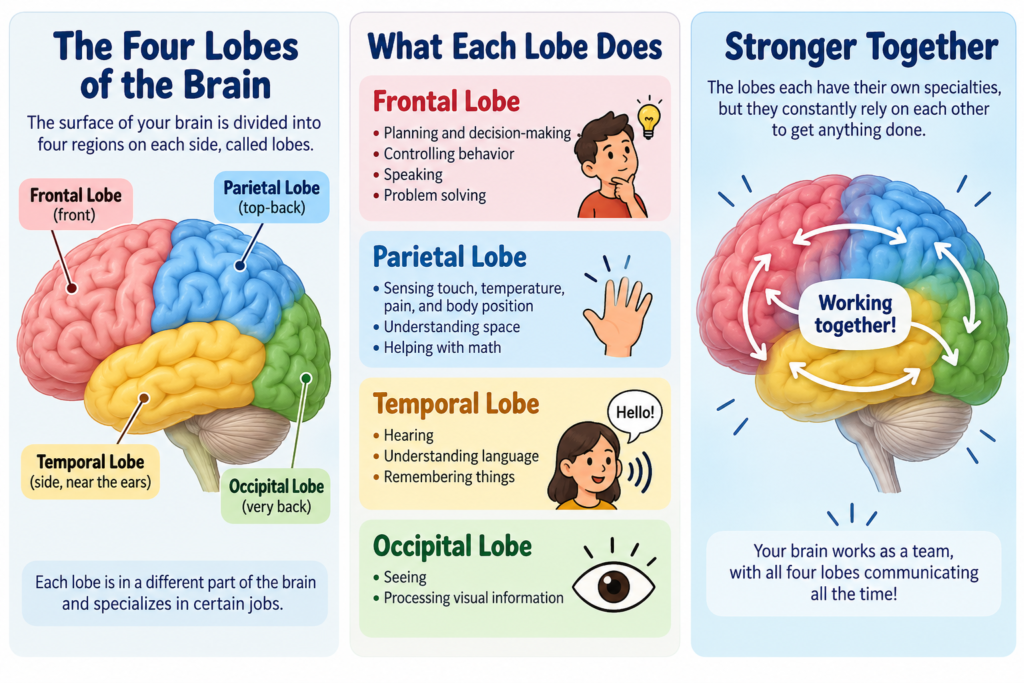
The surface of your brain is divided into four regions on each side, called lobes: the frontal lobe (front), parietal lobe (top-back), temporal lobe (side, near the ears), and occipital lobe (very back). Each one specializes in certain jobs, the way departments in a company do, but they constantly rely on each other to get anything done.
Where the Names Come From
A lobe is simply a large, visible region of the cerebral cortex, the thin outer layer of the brain. Anatomists named each lobe after the skull bone sitting over it, so the frontal lobe sits under the frontal bone, and so on. Each side of the brain has its own set of four, so there are eight lobes total.
How the Lobes Are Divided
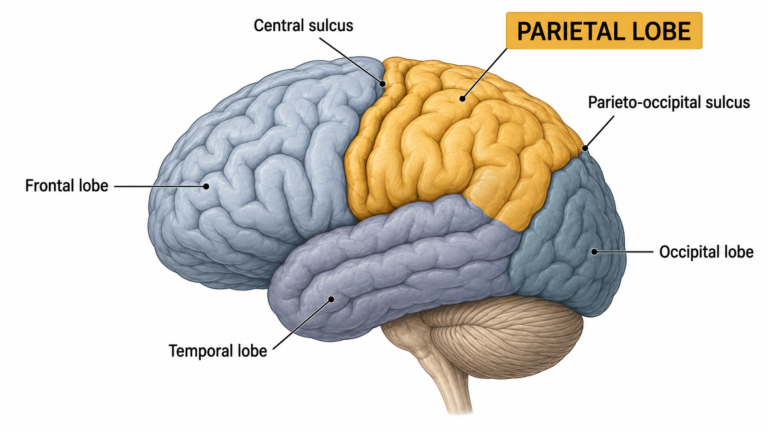
Three visible grooves mark the borders between them:
| Groove | What it separates |
|---|---|
| Central sulcus | Frontal lobe from parietal lobe |
| Lateral sulcus (Sylvian fissure) | Temporal lobe from frontal and parietal lobes |
| Parieto-occipital sulcus | Parietal lobe from occipital lobe |
These aren’t just textbook lines. A surgeon or radiologist uses them to describe exactly where a stroke or tumor sits — “just behind the central sulcus” tells a clinician the parietal lobe’s sensory function is likely affected, not the frontal lobe’s motor function just in front of it.
Not every source agrees there are only four. Many also describe an insular lobe, hidden beneath the other three, and some describe a limbic lobe on the brain’s inner surface, built from parts of the other lobes rather than having its own clean border. This article sticks to the four lobes virtually everyone agrees on.
What Each Lobe Does
| Lobe | Core job | Common misconception |
|---|---|---|
| Frontal | Planning and carrying out movement, attention, speech production, personality and judgment | Personality doesn’t live in one lobe alone — it involves widely distributed circuits |
| Parietal | Touch, pressure, body position, spatial awareness | Also contributes to language and spatial attention, not just touch |
| Temporal | Sound processing, language comprehension, forming new memories | The ear detects sound, but the temporal lobe is where it becomes meaning |
| Occipital | Visual processing | The eyes capture light, but the occipital lobe turns it into a visual experience |
When a Lobe Is Damaged
Doctors use this map daily after a stroke or head injury, because damage in each lobe produces a fairly recognizable pattern: frontal damage can bring weakness on one side, personality change, or trouble speaking; parietal damage can bring sensory loss or trouble recognizing objects by touch; temporal damage can bring hearing changes or unusual sensations; occipital damage can bring partial or total vision loss.
This mapping is a starting point, not a fixed rule. Language and other cortical functions run on networks that cross lobe boundaries — even older ideas like Wernicke’s area handling comprehension on its own are now understood as more complex than that. So two people with damage in “the same lobe” can end up with somewhat different symptoms, depending on exactly where the damage sits and how their individual brain is organized.
Sudden weakness, numbness, vision loss, confusion, trouble speaking, or a severe sudden headache can signal a stroke. Don’t wait to see if it improves — seek emergency care.
Key Terms
- Cerebral cortex: the thin, folded outer layer of the brain where the lobes sit.
- Sulcus (plural sulci): a groove on the brain’s surface; a deeper one is a fissure.
- Insular lobe: a lobe hidden beneath the frontal, parietal, and temporal lobes.
- Limbic lobe: a ring-shaped region on the inner surface built from parts of the other lobes; not universally counted as a separate lobe.
FAQ
Are there really only four lobes?
Four is the standard answer nearly everyone agrees on, though many sources also count an insular lobe and a limbic lobe.
Does each lobe do just one job?
No — each has specializations, but almost nothing the brain does comes from one lobe working alone.
Can damage be diagnosed from symptoms alone?
Symptoms strongly suggest which lobe is affected, but imaging confirms it, since no two brains are organized identically.
Related Reading
- What Are the Major Parts of the Brain?
- What Is the Cerebral Cortex?
- What Is the Cerebrum?
- NCBI: Neuroanatomy, Cerebral Cortex
- NINDS: Know Your Brain
Written by: MedMaru Editorial Team
Reviewed for medical accuracy by:
S. Chang, KMD