How Does the Brain Control the Autonomic Nervous System?
Your Organs Have Their Own Maintenance Crew
Picture your body’s organs — heart, gut, blood vessels, sweat glands — as a large building. The autonomic nervous system (say “aw-toh-NOM-ik” — it just means “self-governing”) is the building’s maintenance crew: it doesn’t wait for you to ask before it adjusts the heating, closes a valve, or dims a light. It works whether you’re awake, asleep, or thinking about something else entirely, and no single brain “switch” runs it — a few connected brainstem and hypothalamus stations constantly read signals from your organs and send out adjustments, like a thermostat that never stops checking the temperature.
This crew works in two main modes. Sympathetic mode is the “get ready for action” setting — heart rate rises, digestion slows, pupils widen — the system your body reaches for during exercise, stress, or a sudden fright. Parasympathetic mode is the “rest and digest” setting — heart rate slows, digestion speeds up, the body conserves energy. Neither is ever fully “off”: at any moment your organs are receiving a blend of both signals, and the brain continuously adjusts the mix. It’s worth being clear that sympathetic isn’t “bad” and parasympathetic isn’t “good” — you need “fight or flight” just as much as you need “rest and digest.” What researchers actually link to stress-related illness is chronic overactivation of the sympathetic system, not the system’s existence. A third, less commonly discussed part, the enteric nervous system, runs much of the gut’s own local activity somewhat independently, though the brain still influences it.
There’s No Single Control Room — Just a Relay Chain
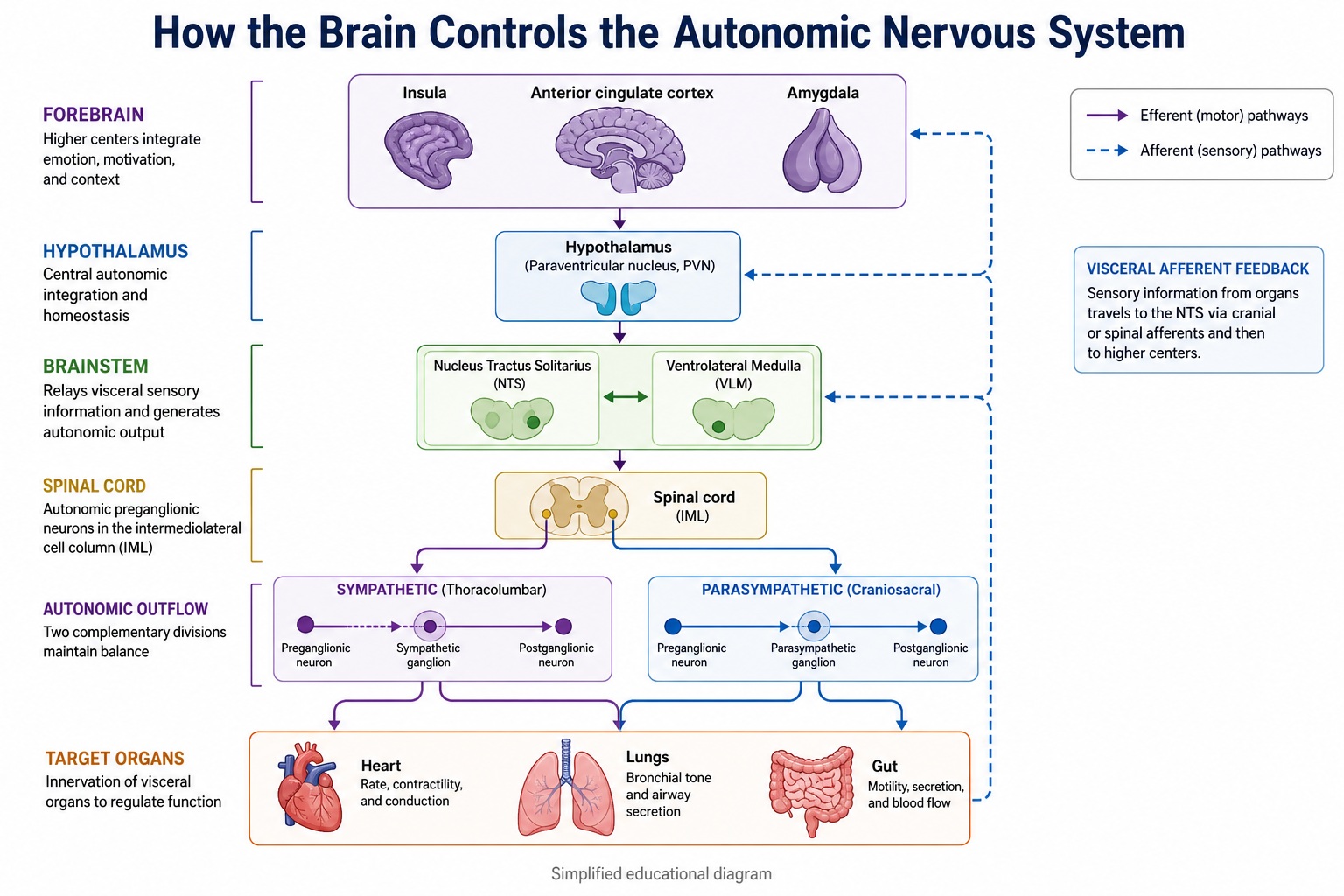
Here’s the part that trips up most beginners: there is no single “autonomic control center” in the brain. Instead, a chain of stations passes information along and sends instructions back out, and it usually completes in a fraction of a second without ever stopping. Stretch-sensitive cells in your blood vessels (baroreceptors — “baro” means pressure) and chemical sensors in your blood constantly measure things like blood pressure and oxygen levels, sending that information up the vagus nerve, among others, toward the brainstem. It arrives first at a relay station called the nucleus tractus solitarius (NTS), sitting in the lower brainstem — think of it as the building’s central sensor panel, where every incoming reading about blood pressure, blood chemistry, and gut stretch passes through first.
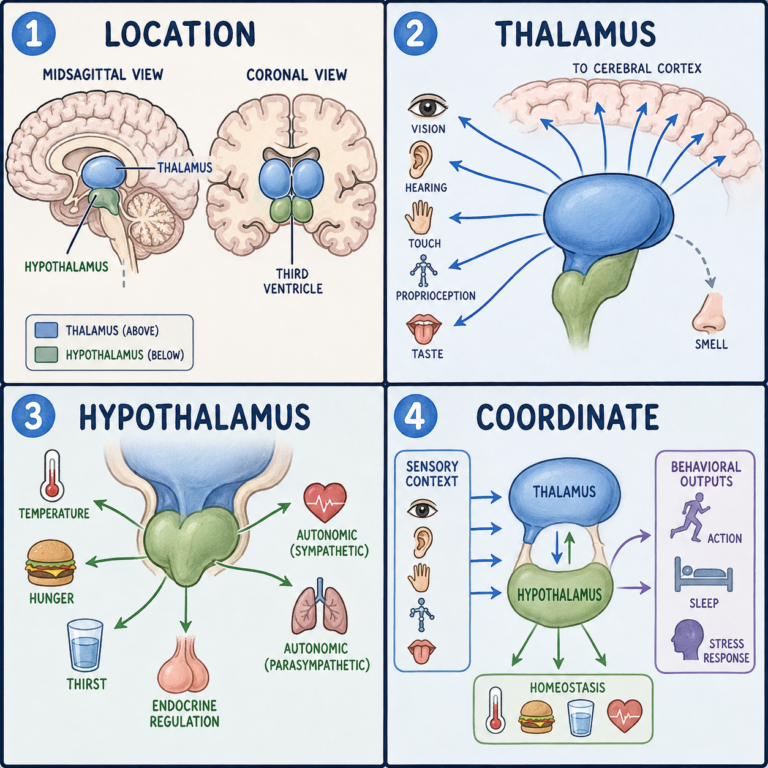
From the NTS, signals move to a nearby control point called the rostral ventrolateral medulla (RVLM), the main switch for sympathetic “get ready” output to blood vessels and the heart — if blood pressure drops, the RVLM increases sympathetic output to raise it back up, and dials it down if pressure climbs too high. Sitting just above the brainstem, the hypothalamus (specifically a region called the paraventricular nucleus) folds in bigger-picture information — body temperature, hydration, emotional state, time of day — and adjusts the brainstem’s baseline settings accordingly, which is why fear or a hot room can shift your heart rate even without any direct change in blood pressure. From there, instructions travel down the spinal cord to a column of neurons (the intermediolateral column) that connect out to the organs themselves, completing the loop.
A building’s climate-control system is a decent way to picture this: sensors in every room feed a central panel, the panel makes constant micro-adjustments, and a building manager (the hypothalamus) can override the routine settings for special situations — expecting a large crowd, say. The analogy has real limits, though: unlike a thermostat, the autonomic system doesn’t just react to a single set-point, and multiple brain regions influence the “manager” simultaneously. And despite how automatic all this sounds, you can’t just decide to override it — that’s the point of calling it autonomic. Practices like slow breathing can influence it indirectly, partly through vagus nerve signaling, but you can’t consciously command your heart rate the way you move your arm.
Why the Relay Model Matters Clinically
Because this is a chain of stations rather than one switch, damage at different points causes different problems. Stroke research links disruption of these same brainstem connections — the solitary tract and ventrolateral medulla — to reduced reflex control of blood pressure and a shift toward sympathetic dominance, which is one reason brainstem strokes are treated as medical emergencies. Damage to the vagus nerve, which carries much of the sensor information upward, can cause fainting or digestive symptoms. The brain and spinal cord make the decisions in all of this; the peripheral autonomic nerves running out to the organs carry them out — it’s a partnership, not a one-sided command. Chronic mental stress is linked to sustained sympathetic overactivation and reduced parasympathetic activity, which research connects to systemic inflammation and, over time, to higher risk of atherosclerosis, high blood pressure, and heart problems — though that’s a population-level association, not a guarantee for any individual, and the full mechanism is still being worked out. Blushing or sweating when nervous comes from the same system: blood vessels near the skin and sweat glands are common sympathetic targets, which is why emotional stress can trigger both.
This is educational background, not a diagnostic guide. Sudden fainting, a racing or very slow heartbeat, or a dramatic blood pressure change should be evaluated by a clinician, especially if it’s new or repeated — not self-diagnosed from this article.
Related: How Does the Brain Control Body Temperature? · How Does the Brain Control Hunger and Thirst? · How Does the Brain Control Sleep?
References
- Waxenbaum JA, Reddy V, Das JM. Anatomy, Autonomic Nervous System. StatPearls. Updated December 1, 2025.
- Shoemaker JK, Goswami R. Forebrain neurocircuitry associated with human reflex cardiovascular control. Frontiers in Physiology. 2015;6:240.
- Savić B, Murphy D, Japundžić-Žigon N. The Paraventricular Nucleus of the Hypothalamus in Control of Blood Pressure and Blood Pressure Variability. Frontiers in Physiology. 2022;13:858941.
- LeBouef T, Yaker Z, Whited L. Physiology, Autonomic Nervous System. StatPearls. Updated May 1, 2023.
Written by: MedMaru Editorial Team
Reviewed for medical accuracy by:
S. Chang, KMD