How Does the Brain Control Body Temperature?
Your Body Doesn’t Hold One Fixed Temperature
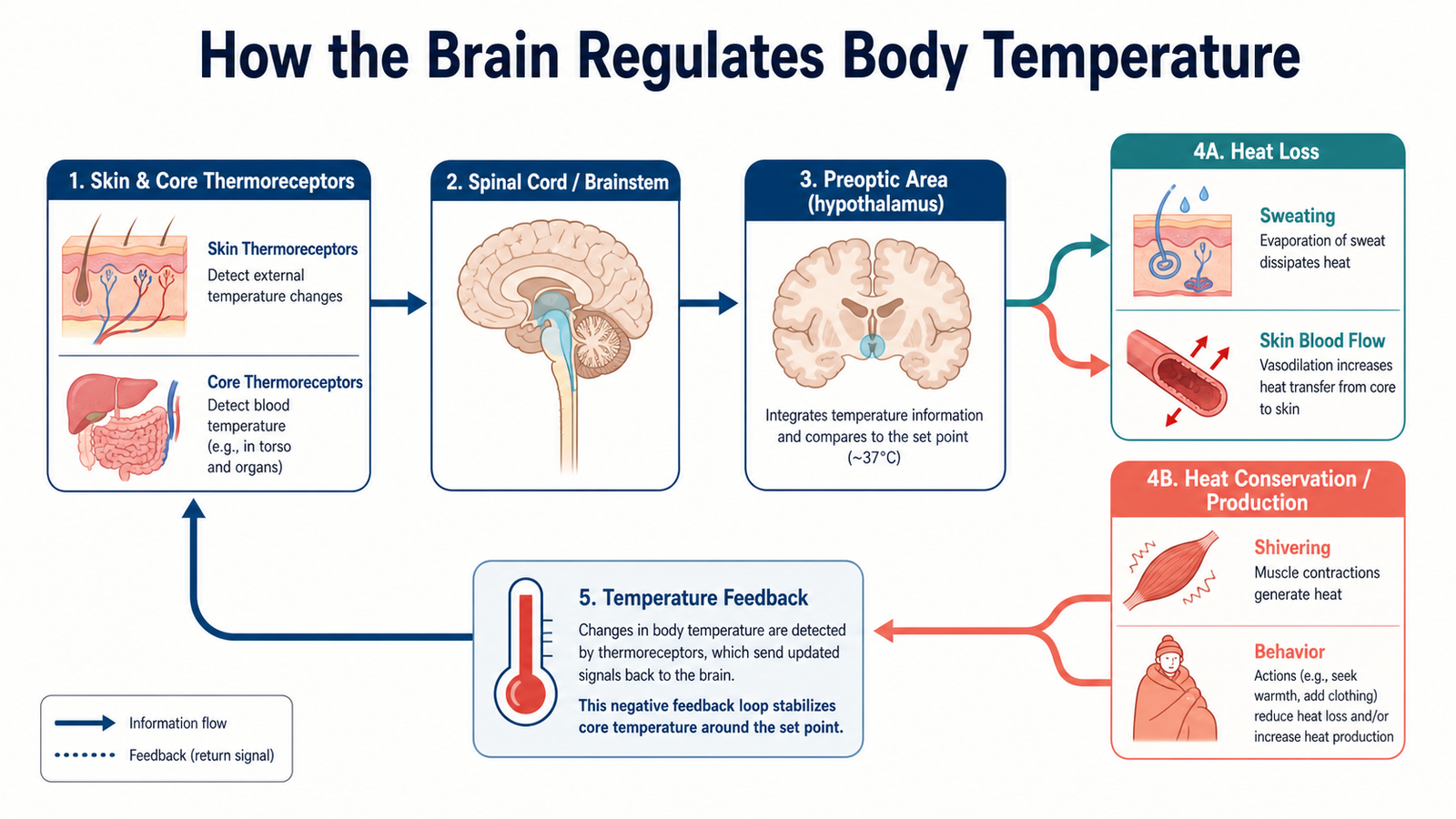
37°C gets taught as “normal,” but that number is really an average, not a fixed setpoint your body defends to the decimal. Core temperature shifts with time of day, activity, hormones, illness, and even where on the body it’s measured. What actually happens is a continuous feedback process: sensors in the skin, spinal cord, internal organs, and brain report thermal conditions, the preoptic area of the hypothalamus integrates that information, and it coordinates behavioral, autonomic, endocrine, and motor responses in return. Sweating and skin vasodilation dump heat; vasoconstriction, shivering, and thermogenesis conserve or generate it.
The thermostat analogy only goes so far
Warm- and cold-sensitive pathways carry information up through the spinal cord and brainstem, and neurons in and around the preoptic hypothalamus also sense local brain temperature directly, organizing responses through downstream hypothalamic, brainstem, spinal, and endocrine pathways. Comparing this to a household thermostat is a useful shorthand, but the biology is messier than one simple switch — it runs on multiple thresholds and distributed feedback circuits working together, not a single on/off comparison against one target number.
Losing heat versus keeping it
When the body needs to lose heat, the nervous system increases skin blood flow and activates eccrine sweating — though evaporation only cools effectively when the sweat can actually evaporate, which is why high humidity makes the same sweat far less useful. People also seek shade, shed clothing, drink fluids, or simply slow down. When conservation or production is the priority instead, skin vessels constrict, muscles shiver, metabolism can rise, and behavior turns toward finding warmth. Brown adipose tissue plays an outsized role in non-shivering heat production in infants, and persists to varying degrees in adults as well.
Fever is a controlled shift, not a malfunction
During fever, immune signals prompt prostaglandin E2 production that raises the thermoregulatory thresholds the preoptic area is defending — which is exactly why someone can feel cold and shiver even as their temperature climbs toward this new, higher defended level. That shivering isn’t the system failing; it’s heat-conserving and heat-producing responses firing because the current temperature now feels relatively cold against the new threshold. Hyperthermia is a genuinely different situation: heat production or environmental heat load simply overwhelms heat loss, without any regulated upward shift in the target at all. Severe heat illness, confusion, fainting, or a temperature that’s dangerously high or low all need urgent medical evaluation.
When the system itself is compromised
Brain injury, hypothalamic disease, spinal cord injury, autonomic disorders, medications, anesthesia, age, and environmental exposure can all impair thermoregulation directly. A single temperature reading, on its own, has to be interpreted alongside symptoms and the method used to measure it — the number by itself rarely tells the whole story.
Related: How Does the Brain Control the Autonomic Nervous System? · How Does the Brain Control Hunger and Thirst? · How Does the Brain Control Sleep?
References
- Morrison SF, Nakamura K. Central mechanisms for thermoregulation. Annual Review of Physiology. 2019;81:285-308.
- Tansey EA, Johnson CD. Recent advances in thermoregulation. Advances in Physiology Education. 2015;39:139-148.
- Osilla EV, Marsidi JL, Sharma S. Physiology, Temperature Regulation. StatPearls / NCBI Bookshelf.
- Nakamura K. Central circuitries for body temperature regulation and fever. American Journal of Physiology-Regulatory, Integrative and Comparative Physiology. 2011;301:R1207-R1228.
Written by: MedMaru Editorial Team
Reviewed for medical accuracy by:
S. Chang, KMD