How Does Language Work in the Brain?
Broca’s and Wernicke’s Areas Aren’t “The Language Centers”
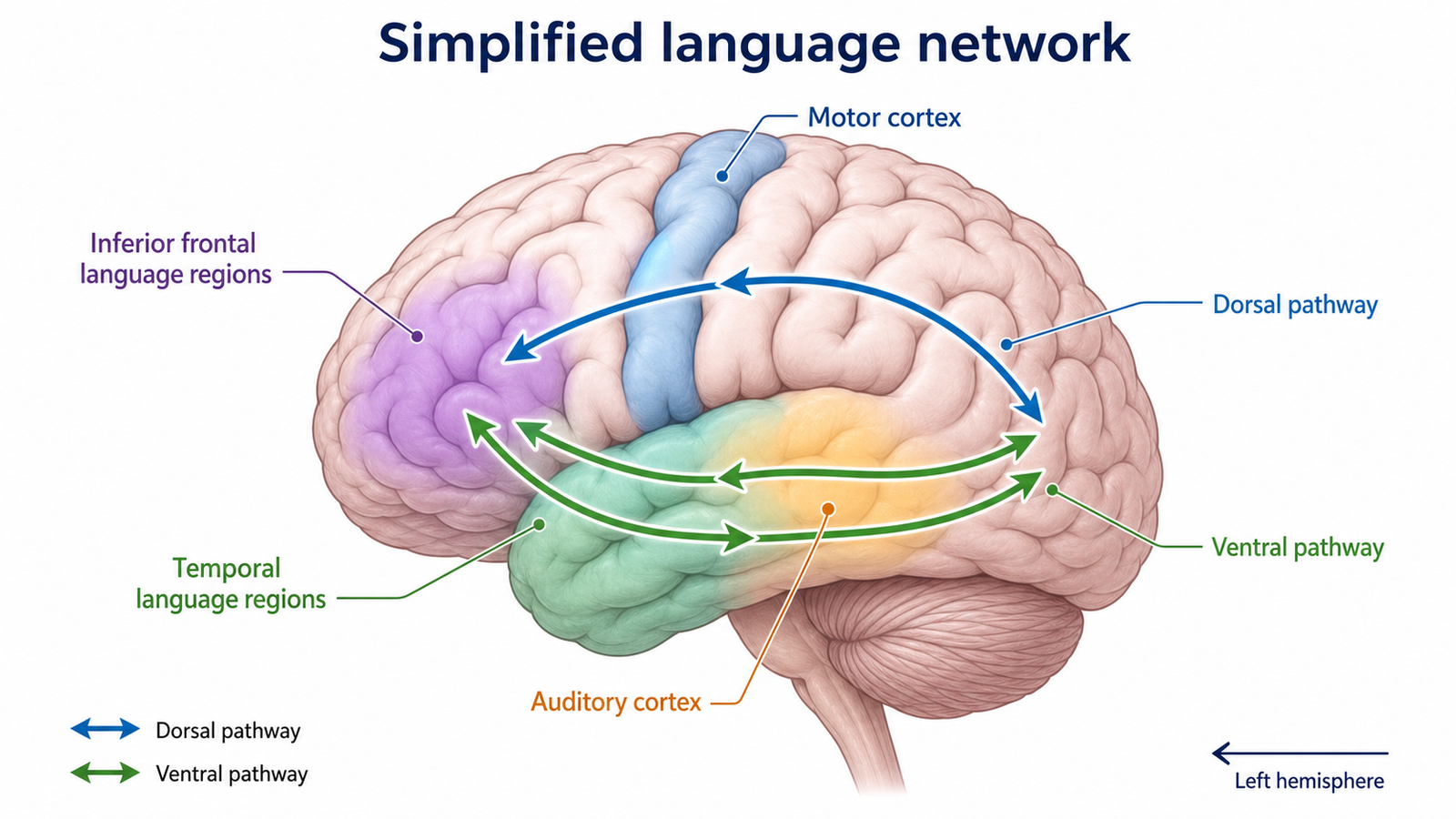
Broca’s area and Wernicke’s area get taught as if they were two self-contained modules — one for producing speech, one for understanding it. They’re useful historical labels, but that’s an oversimplification of what’s actually going on. Language runs on a distributed, largely left-lateralized network: temporal regions map speech sounds or visual word forms onto linguistic meaning, frontal and temporal areas combine words into structured sentences, and parietal, motor, auditory, visual, memory, and executive systems all pitch in depending on the task. No two boxes account for it.
Understanding language is a convergence problem
Understanding starts differently depending on the input — hearing for speech, visual processing for reading, visual-spatial processing for signed language — but auditory cortex alone, for instance, never extracts a sentence’s full meaning by itself. The brain has to analyze the incoming pattern, recognize the sounds or symbols as words, pull up stored knowledge about what those words mean, and combine them according to context. Whatever the input route, these separate pathways converge on the same language-selective regions that handle word meaning and linguistic combination.
Modern work describes this as frontal and temporal language regions linked by two white-matter highways: dorsal pathways, more relevant to sound-to-articulation and sequencing operations, and ventral pathways, which contribute more to mapping language onto meaning. That’s a useful division, but a simplified one — the functions overlap substantially and vary from person to person.
Producing language is its own pipeline
Speaking requires the brain to select concepts and words, build a grammatical and phonological plan, and then coordinate the motor commands needed to move the larynx, tongue, lips, and breath in the right sequence — while auditory and somatosensory feedback monitor for errors along the way. And speech is rarely just language production in isolation: ordinary conversation pulls in attention, working memory, social inference, and turn-taking systems that sit outside the core language network entirely.
“Left-brained” oversells the asymmetry
Language is usually more left-lateralized than right, but “left-brained” overstates it — both hemispheres contribute, and exactly how lateralized the system is varies by person, by the specific language task, by developmental history, and by prior injury. The exact anatomical location of these functional regions also shifts somewhat between individuals, which is a big part of why surgeons map language function in a specific patient’s brain before operating rather than relying on a standard atlas. It’s also worth being clear about what happens with more than one language: bilingual speakers aren’t running two separate brains for it — the languages draw on substantially overlapping networks, with the differences that do exist shaped by proficiency, age of acquisition, and the task at hand, not by some hidden second language center.
When the network breaks down
Aphasia — an acquired language disorder, often following a stroke — can affect speaking, understanding, reading, or writing, and its symptoms rarely fit a clean, one-area textbook diagram, because a lesion typically damages multiple nodes of the network and the connections between them rather than a single tidy region. Sudden new difficulty with language is an emergency symptom and needs immediate medical assessment, not a wait-and-see approach.
Related: How Does the Brain Learn? · How Does the Brain Form Memories? · What Is Executive Function?
References
- Fedorenko E, Ivanova AA, Regev TI. The language network as a natural kind within the broader landscape of the human brain. Nature Reviews Neuroscience. 2024;25:289-312.
- Friederici AD, Gierhan SM. The language network. Current Opinion in Neurobiology. 2013;23:250-254.
- Hickok G, Poeppel D. The cortical organization of speech processing. Nature Reviews Neuroscience. 2007;8:393-402.
- Tremblay P, Dick AS. Broca and Wernicke are dead, or moving past the classic model of language neurobiology. Brain and Language. 2016;162:60-71.
Written by: MedMaru Editorial Team
Reviewed for medical accuracy by:
S. Chang, KMD