What Is Executive Function?
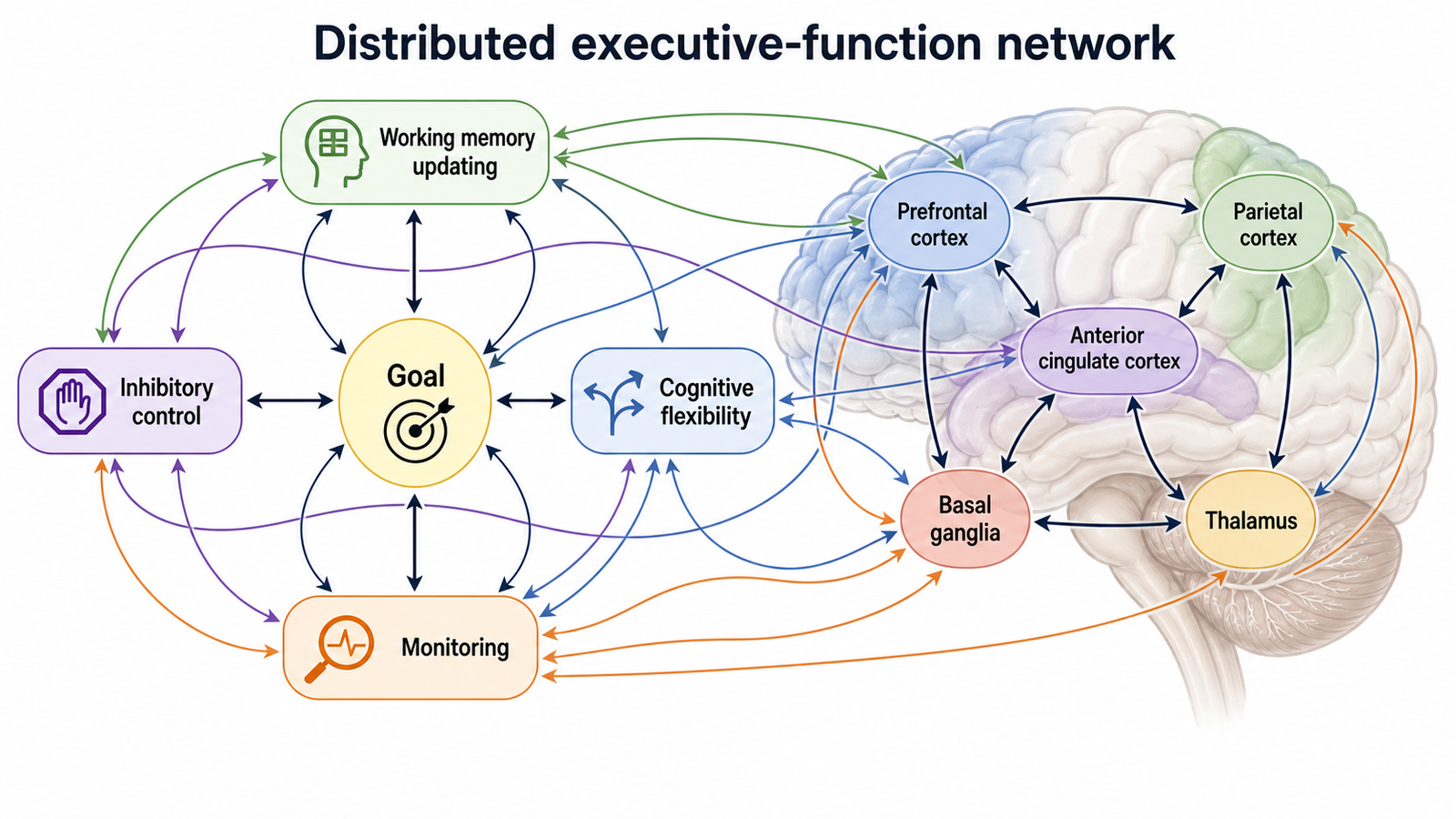
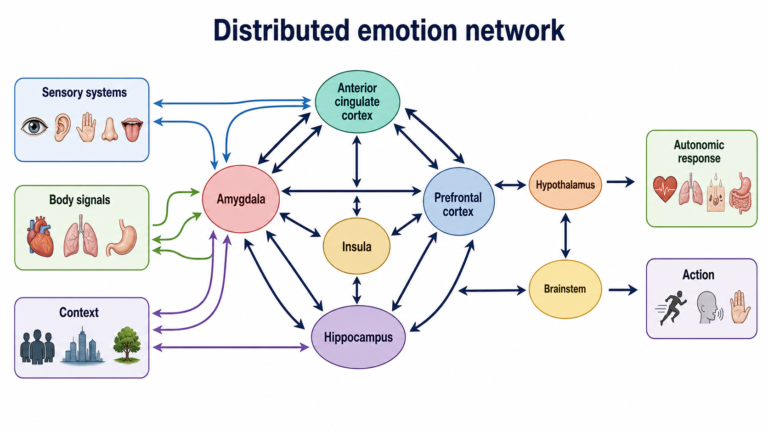
Executive function is the brain’s way of organizing thoughts and actions toward a goal. It is an umbrella term rather than a single ability. It covers holding and updating information in mind, stopping an automatic response, switching between rules or points of view, planning, checking how you are doing, and managing goals. The prefrontal cortex at the front of the brain plays a central role, but executive function is not located there alone. It depends on connected networks across frontal and parietal regions, the cingulo-opercular network, the striatum, the thalamus, the cerebellum, and sensory and motor systems.
One skill or many?
Picture an orchestra conductor. The conductor keeps the score in mind, cues some players and quiets others, changes tempo when the piece demands it, and listens for mistakes. Executive function does similar work for thought and behavior. The comparison has a clear limit, though. There is no single conductor in the brain; the coordination emerges from many interacting networks.
Researchers describe executive functions as showing both unity and diversity. Three core skills, updating working memory, inhibiting a response, and switching tasks, are correlated but separable. They share general demands for control, yet each also relies on its own task-specific representations and circuits. That is why a person can do well on one executive task and struggle with another.
Holding, stopping, and switching
Working memory keeps goal-relevant information available. It holds and manipulates a limited amount of information over short periods, which is what lets you follow instructions, do mental arithmetic, understand what you are reading, and compare options. It is not simply a short-term storage box, because attention and long-term knowledge both feed into it. Working memory is related to intelligence on some tasks, but the two are not the same thing.
Inhibitory control manages competition between responses. It helps you delay or replace a dominant response when that response conflicts with your goal, such as not reaching for your phone during a conversation. Effective control often works by strengthening the intended rule and adjusting attention, rather than by pressing a single neural brake.
Cognitive flexibility lets you change the plan. It allows you to switch tasks, update a rule, or see a problem differently. Switching has a measurable cost, because the brain has to reconfigure its priorities and retrieve a new set of task rules. Anyone who has felt slow after jumping between emails and a report has experienced that cost.
Planning and keeping track
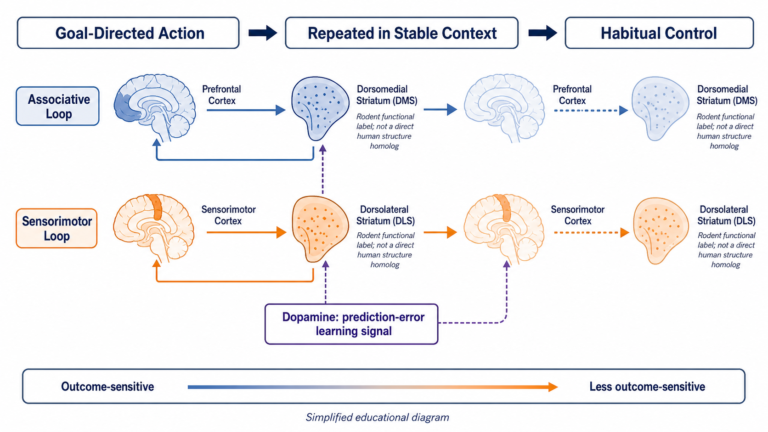
Managing a goal over time draws all of these skills together. It requires picturing future states, choosing actions, noticing errors, estimating what each option is worth, and revising behavior along the way. Different prefrontal and parietal regions interact with the basal ganglia and other systems, and which ones take the lead depends on the content of the task and how motivated the person is.
Why performance shifts with context
Executive function is not a fixed score. Sleep loss, stress, pain, emotional state, familiarity with the task, sensory distractions, and motivation all change how well it works on a given day. It also develops gradually, continuing through childhood and adolescence. Normal aging and disease can affect its different components in different ways.
That context matters for training claims, too. Practicing an executive task can improve performance on that task. Broad transfer to unrelated abilities is less consistent, however, and should not be guaranteed.
Executive difficulties appear in many conditions. They are not specific to ADHD or to frontal-lobe injury. A formal assessment usually combines a history, observation of behavior across different settings, and several tests. A single low score or an everyday mistake is not a diagnosis.
This article is educational background, not individual medical advice. Persistent difficulties with planning, attention, or self-control that affect school, work, or daily life are worth discussing with a clinician.
Related: How Does the Brain Make Decisions? · How Does the Brain Learn? · How Does the Brain Form Habits?
References
- National Library of Medicine. Executive Function — MeSH
- Duncan J, Friedman NP. How the Brain Creates Unity and Diversity of Executive Functions. In: The Frontal Cortex. MIT Press; 2024. NCBI Bookshelf
- Latzman RD, Markon KE. Executive Dysfunction and the Prefrontal Cortex. Continuum. 2022;28:305–322. PubMed
- Jaeggi SM, Iordan AD, Salmi J. Cognitive Interventions Targeting Executive Functions. In: The Frontal Cortex. 2024. NCBI Bookshelf
Written by: MedMaru Editorial Team
Reviewed for medical accuracy by:
S. Chang, KMD