How Does the Brain Control Sleep?
Sleep Is Something the Brain Does, Not Something That Happens to It
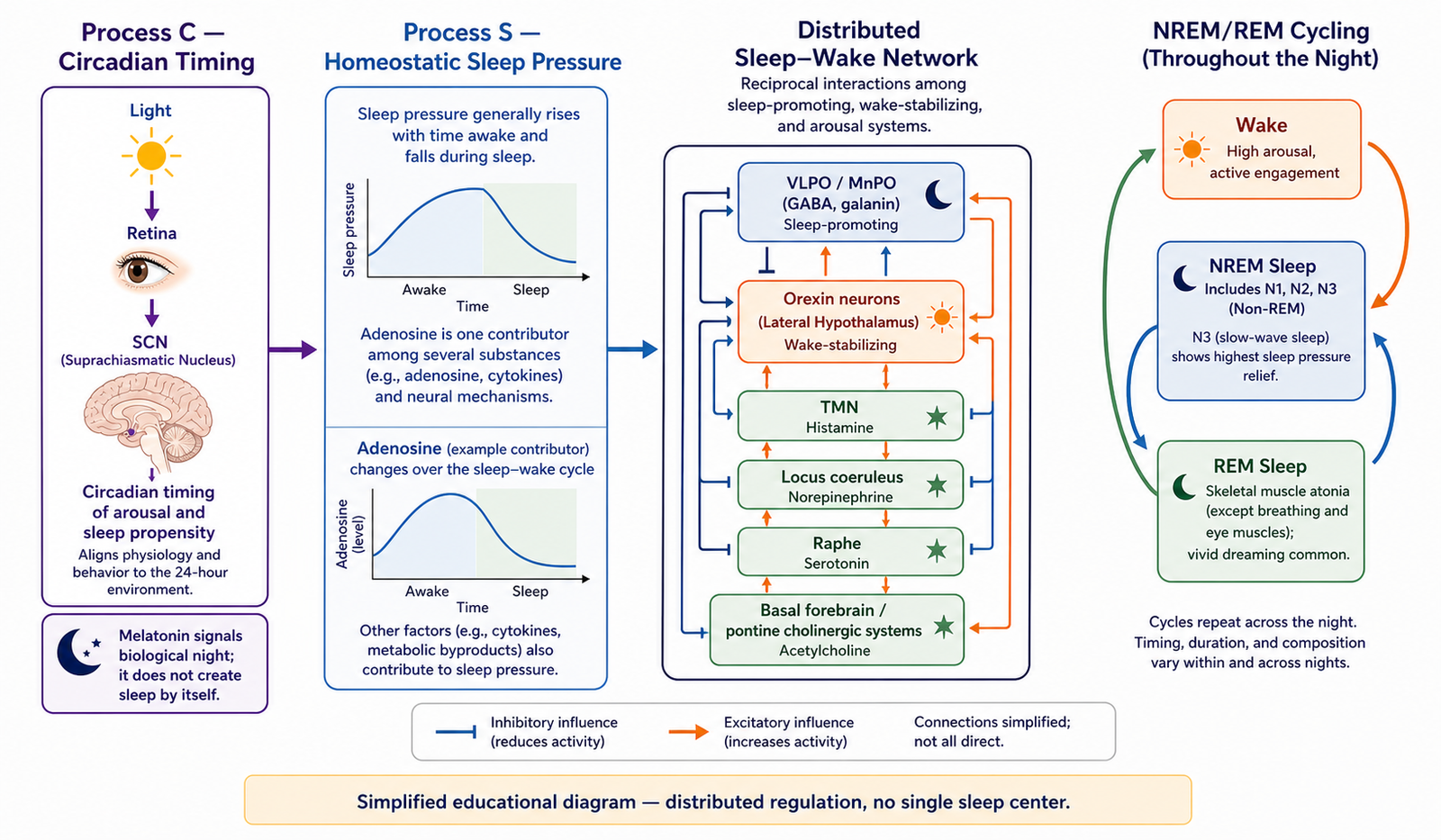
It’s easy to picture sleep as the brain simply powering down. It’s the opposite: sleep is a reversible, actively generated state, marked by reduced responsiveness, characteristic shifts in brain electrical activity, reduced voluntary movement, and species-typical posture — and it’s produced and regulated by dedicated circuitry, not just an absence of wakefulness. Two interacting systems do the work. A circadian process, timed by a roughly 24-hour internal clock centered on the suprachiasmatic nucleus (SCN) in the hypothalamus, determines when sleep tends to happen. A homeostatic process — “sleep pressure,” tied to the buildup of adenosine and other sleep-promoting signals during wakefulness — determines how strongly the brain pushes toward sleep. Sleep researcher Alexander Borbély first proposed this as the two-process model, and it still holds up well, though real regulation is messier than a simple additive schedule: think of the circadian clock as a timetable for when the “sleep train” is due to leave, and sleep pressure as a fuel gauge for how urgently the trip is needed — two different signals, working together rather than substituting for each other.
The clock: timing, not producing, sleep
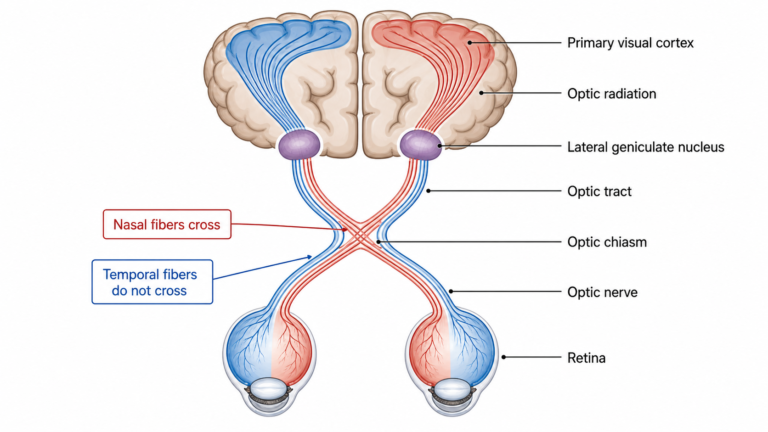
The SCN is the brain’s primary circadian pacemaker, and it receives direct light input from specialized retinal ganglion cells via the retinohypothalamic tract, which lets daily light exposure reset (“entrain”) the clock. Importantly, the SCN doesn’t generate sleep itself — it times when sleep-promoting and wake-promoting systems get the upper hand. Under SCN control, the pineal gland releases melatonin in darkness via a sympathetic pathway, and melatonin levels rise in the evening and fall by morning. But melatonin is best understood as a timing signal — it tells the rest of the body that it’s biological night and helps shift when the clock is set — rather than a sedative that directly produces sleep. Its measured sedative effect in healthy people tends to be more modest than popular framing suggests, and its clearest evidence-based clinical use is for circadian-timing problems like jet lag or delayed sleep phase, not general sleeplessness.
The pressure: a debt that builds while you’re awake
During wakefulness, adenosine — a byproduct of cellular energy use — is thought to build up in parts of the basal forebrain and cortex and promote sleepiness partly by inhibiting wake-promoting neurons. That’s one widely cited mechanism behind Process S, though not the only one proposed. It’s also why caffeine works the way it does: its stimulant effect comes from blocking adenosine receptors, which temporarily masks accumulated sleep pressure rather than eliminating it — the debt is still there underneath.
A switch, not a dimmer
Sleep-wake control isn’t located in one “sleep center” — it’s distributed across the ventrolateral preoptic nucleus (VLPO), whose GABA- and galanin-releasing neurons are most active during sleep, and a set of wake-promoting arousal systems: histamine neurons in the tuberomammillary nucleus, norepinephrine neurons in the locus coeruleus, serotonin neurons in the raphe nuclei, acetylcholine neurons in the basal forebrain and brainstem, and orexin/hypocretin neurons in the lateral hypothalamus. Sleep researchers, notably Saper and colleagues, proposed that these sleep-promoting and wake-promoting groups mutually inhibit each other much like an electrical flip-flop switch — when one side is active, it suppresses the other, producing relatively sharp transitions rather than a gradual blend. Orexin neurons appear to help stabilize this switch, which is part of why their loss, as in narcolepsy, produces unstable, fragmented transitions between wakefulness, NREM, and REM sleep rather than a clean absence of sleep.
What a night actually moves through
As light fades in the evening, the SCN eases its inhibition on melatonin release just as homeostatic pressure — built up since morning — peaks, and the two processes align to push sleep propensity up. VLPO activity rises, inhibiting the arousal systems, and the flip-flop switch moves toward sleep. From there, NREM sleep progresses through recognizable EEG stages — N1’s theta activity, N2’s sleep spindles and K-complexes, and N3’s high-amplitude slow waves, the deepest NREM stage and the one concentrated earliest in the night. Periodically, brainstem circuits in the pons take over and EEG activity starts resembling wakefulness again — “paradoxical sleep” — with rapid eye movements and near-total skeletal muscle atonia produced by descending brainstem and spinal pathways, a protective mechanism generally understood to keep the body from acting out dream content. NREM and REM alternate roughly every 90 to 110 minutes across the night, with deep N3 sleep dominating earlier cycles and REM periods generally stretching longer toward morning. None of these figures are fixed rules — they vary by individual, age, prior sleep debt, and health status. By morning, rising light and a mostly discharged Process S let the SCN favor arousal-system activity again, melatonin falls, and the switch settles back into stable wakefulness.
The brain’s “cleaning” system — a genuinely open question
A well-known 2013 mouse study by Xie and colleagues reported that clearance of interstitial waste through the brain’s perivascular (“glymphatic”) pathways increases during sleep compared with wakefulness, and later human imaging and biomarker studies have reported findings broadly consistent with sleep-associated brain clearance. This remains a genuinely unsettled area, though: more recent tracer studies from 2024–2025 have challenged parts of the original mouse methodology and raised real questions about how directly those animal findings translate to human physiology. It’s a promising hypothesis, not a proven, complete explanation for why sleep is restorative, and it shouldn’t be treated as the basis for any treatment claim.
When this system runs into trouble
Circadian rhythm sleep-wake disorders — delayed sleep phase, jet lag, shift-work disorder — reflect a real mismatch between the SCN-driven timing system and a person’s desired or required schedule, not simply poor sleep habits. Narcolepsy type 1 is linked to loss of orexin/hypocretin-producing neurons and destabilization of the switching system described above, offered as one explanation for symptoms like excessive daytime sleepiness, cataplexy, and REM intrusion into wakefulness. Insomnia and other sleep disorders can involve disturbances in the circadian process, the homeostatic process, or both, plus psychological and behavioral contributors — it’s rarely explainable by one brain region or one neurotransmitter. Shift work, jet lag, and irregular light exposure can desynchronize the circadian and homeostatic processes from each other and from the outside world, contributing to some of the health effects reported in the research literature.
It’s worth being honest about the limits of this evidence base: much of the detailed circuit-level mechanics described here — the flip-flop switch, orexin stabilization, parts of the adenosine story — comes primarily from animal models, and how directly that translates to intact human physiology is still an active research question rather than settled fact. The specific functional roles of individual sleep stages, including claims about which stage matters most for which kind of memory, remain hypotheses under investigation too.
This article is educational, not a substitute for a clinical sleep evaluation. Consider seeking a qualified healthcare professional’s evaluation for ongoing sleep difficulty that affects daily functioning, loud snoring with witnessed breathing pauses or gasping (possible signs of sleep apnea), sudden muscle weakness triggered by strong emotion or overwhelming daytime sleepiness (possible narcolepsy signs), acting out dreams physically or unsafe sleepwalking, or significant unexplained changes in sleep pattern. If someone is in acute medical distress, contact local emergency services rather than relying on educational material like this.
Related: How Does the Brain Control Body Temperature? · How Does the Brain Control Hunger and Thirst? · How Does the Brain Control the Autonomic Nervous System?
References
- Borbély AA. A two process model of sleep regulation. Human Neurobiology. 1982;1(3):195-204.
- Saper CB, Chou TC, Scammell TE. The sleep switch: hypothalamic control of sleep and wakefulness. Trends in Neurosciences. 2001;24(12):726-731.
- Scammell TE, Arrigoni E, Lipton JO. Neural circuitry of wakefulness and sleep. Neuron. 2017;93(4):747-765.
- Porkka-Heiskanen T, Strecker RE, Thakkar M, et al. Adenosine: a mediator of the sleep-inducing effects of prolonged wakefulness. Science. 1997;276(5316):1265-1268.
- Xie L, Kang H, Xu Q, et al. Sleep drives metabolite clearance from the adult brain. Science. 2013;342(6156):373-377.
Written by: MedMaru Editorial Team
Reviewed for medical accuracy by:
S. Chang, KMD