How Does the Brain Maintain Balance?
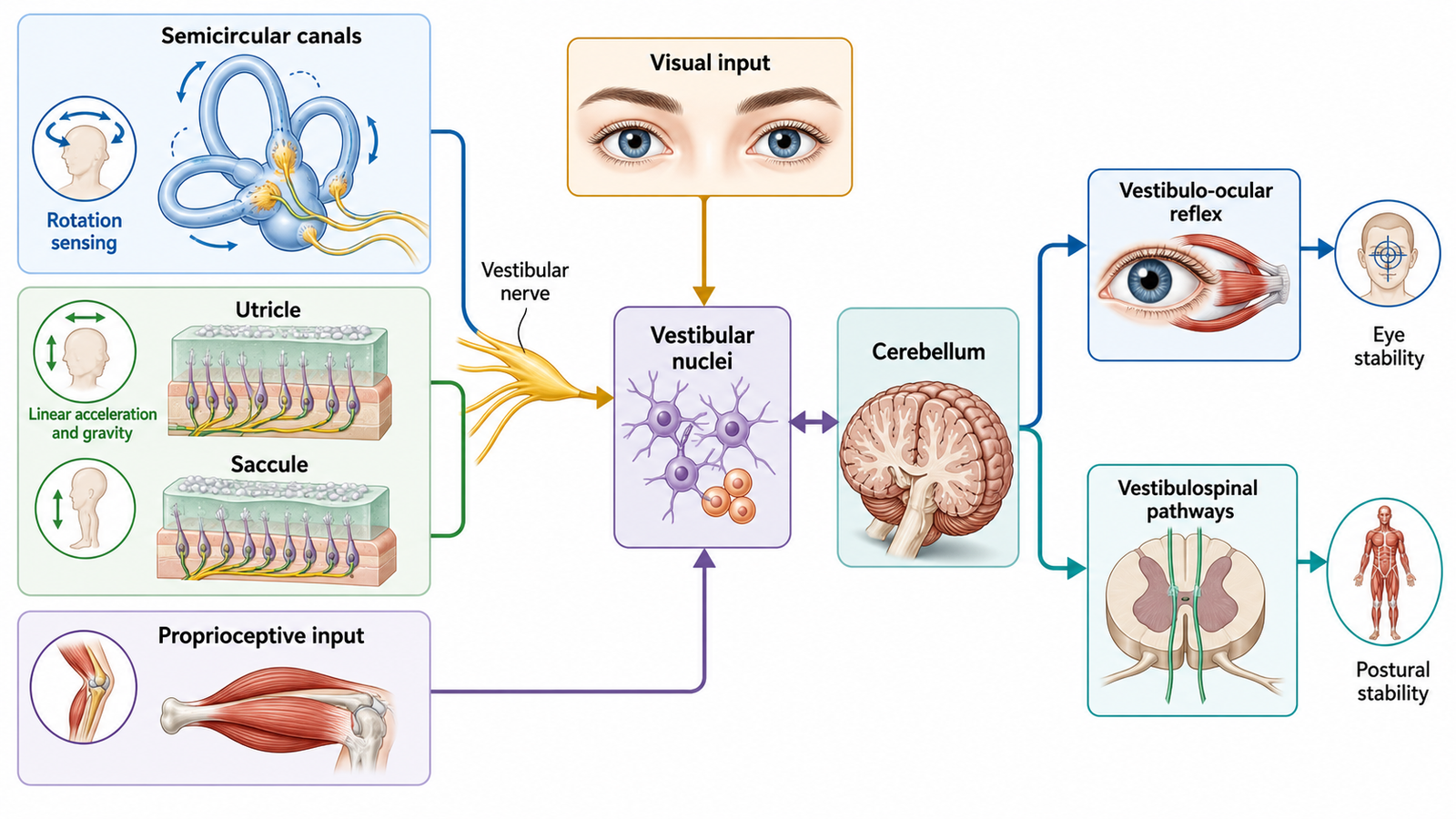
Balance is not the work of a single organ. Your brain keeps you upright by constantly combining three streams of information: signals from the vestibular system in the inner ear, what your eyes see, and reports from your muscles, joints, and skin about where your body is and what it is touching. In the inner ear, the semicircular canals detect rotation of the head, while two small organs, the utricle and saccule, detect straight-line movement and the tilt of the head relative to gravity. Brainstem centers called the vestibular nuclei, together with the cerebellum, compare all these signals and drive quick reflexes of the eyes and body. Networks in the cortex and hippocampus add a conscious sense of orientation and help you find your way around.
Balance is a calculation, not a sensor
At every moment, your nervous system is estimating where your head and body are and how they are moving. No single balance organ does this alone. Vision tells the brain how you are moving relative to your surroundings. Proprioceptors, the position sensors in muscles and joints, and receptors in the skin report joint angles and contact with the floor. The vestibular apparatus in the inner ear reports head motion and orientation.
A useful comparison is a ship’s navigator who checks the compass, the stars, and the feel of the deck before deciding where the ship is. If one source becomes unreliable, the navigator leans on the others. The analogy is imperfect, because the brain’s weighing is automatic and continuous rather than a deliberate check, but the principle is the same. It also explains why closing your eyes can make balance harder. Removing vision leaves the nervous system more dependent on the vestibular and body signals.
Two kinds of motion sensor in the inner ear
The semicircular canals detect rotation. There are three of them in each ear, arranged in different planes. When the head turns and speeds up or slows down, fluid inside the canals, called endolymph, lags behind and bends a jelly-like flap called the cupula. That bending changes the activity of the vestibular hair cells, the sensory cells of the inner ear. The canals work in matched pairs across the two ears, so the brain can compare one side with the other to judge which way and how fast the head is turning.
The utricle and saccule, known together as the otolith organs, detect straight-line acceleration and tilt. Their hair cells are weighted by tiny crystals called otoconia. Because of how these organs are oriented, they respond both to linear acceleration and to the direction of gravity. The utricle is especially important for horizontal acceleration and tilt, while the saccule contributes strongly to vertical acceleration. These are simplified emphases, since natural movements activate combinations of sensors at once.
Fast corrections from the brainstem and cerebellum
Signals from the inner ear travel along the vestibular nerve to the vestibular nuclei in the medulla and pons, and also connect with the cerebellum. From there, two fast reflex systems go to work.
The first keeps your vision steady. The vestibulo-ocular reflex moves the eyes in the opposite direction to a head turn, which keeps an image stable on the retina. You can see it for yourself by shaking your head while reading this sentence: the words stay readable because your eyes are being counter-rotated automatically. The second system, the vestibulospinal pathways, adjusts the muscles of the neck, trunk, and limbs to support your posture. Meanwhile, the cerebellum calibrates the brain’s predictions about movement and corrects errors using repeated sensory feedback.
When the senses disagree
Some situations change how reliable each sense is. Reading in a moving car is one example, and standing in darkness is another. The brain responds by reweighting vision, vestibular signals, and body sensation according to the context. When the cues conflict, the result can be motion sickness, dizziness, or unsteadiness. Over time, adaptation can reduce some of these conflicts.
Balance also reaches beyond reflexes. Vestibular networks in the thalamus and cortex contribute to your awareness of motion and of which way is up. Connections with the hippocampal system support spatial orientation and navigation. Balance therefore combines fast reflexes, conscious perception, and learned movement strategies.
Dizziness is a broad word. It can describe vertigo, light-headedness, unsteadiness, or other sensations, and it has many possible causes. This article cannot tell whether symptoms come from the ear, the nervous system, circulation, medication, or something else. Sudden severe imbalance together with weakness, double vision, difficulty speaking, a new severe headache, or inability to walk requires urgent medical evaluation.
Related: How Does the Brain Process Pain? · How Does the Brain Process Vision? · How Does the Brain Process Sensory Information?
References
- Casale J, Browne T, Murray IV, Gupta G. Physiology, Vestibular System. StatPearls. Updated May 1, 2023.
- Cullen KE. Internal models of self-motion: neural computations by the vestibular cerebellum. Current Opinion in Neurobiology. 2023.
- Green AM, Angelaki DE. Internal models and neural computation in the vestibular system. Experimental Brain Research. 2010;200(3-4):197-222. doi:10.1007/s00221-009-2054-4.
Written by: MedMaru Editorial Team
Reviewed for medical accuracy by:
S. Chang, KMD