How Does the Brain Process Sensory Information?
Every moment, your nervous system is flooded with information from the outside world and from inside your body. Light reaches the eyes, sound vibrates the inner ear, chemicals stimulate taste and smell receptors, and pressure or temperature activates receptors in the skin. Yet the brain does not simply record these inputs like a camera. It selects, organizes, compares, and interprets the incoming signals so they can guide perception and behavior. Sensory processing is not a single event in one region. It is a chain of transformations spread across receptors, nerves, the spinal cord, the brainstem, the thalamus, the cerebral cortex, and many feedback pathways.
It starts with translation
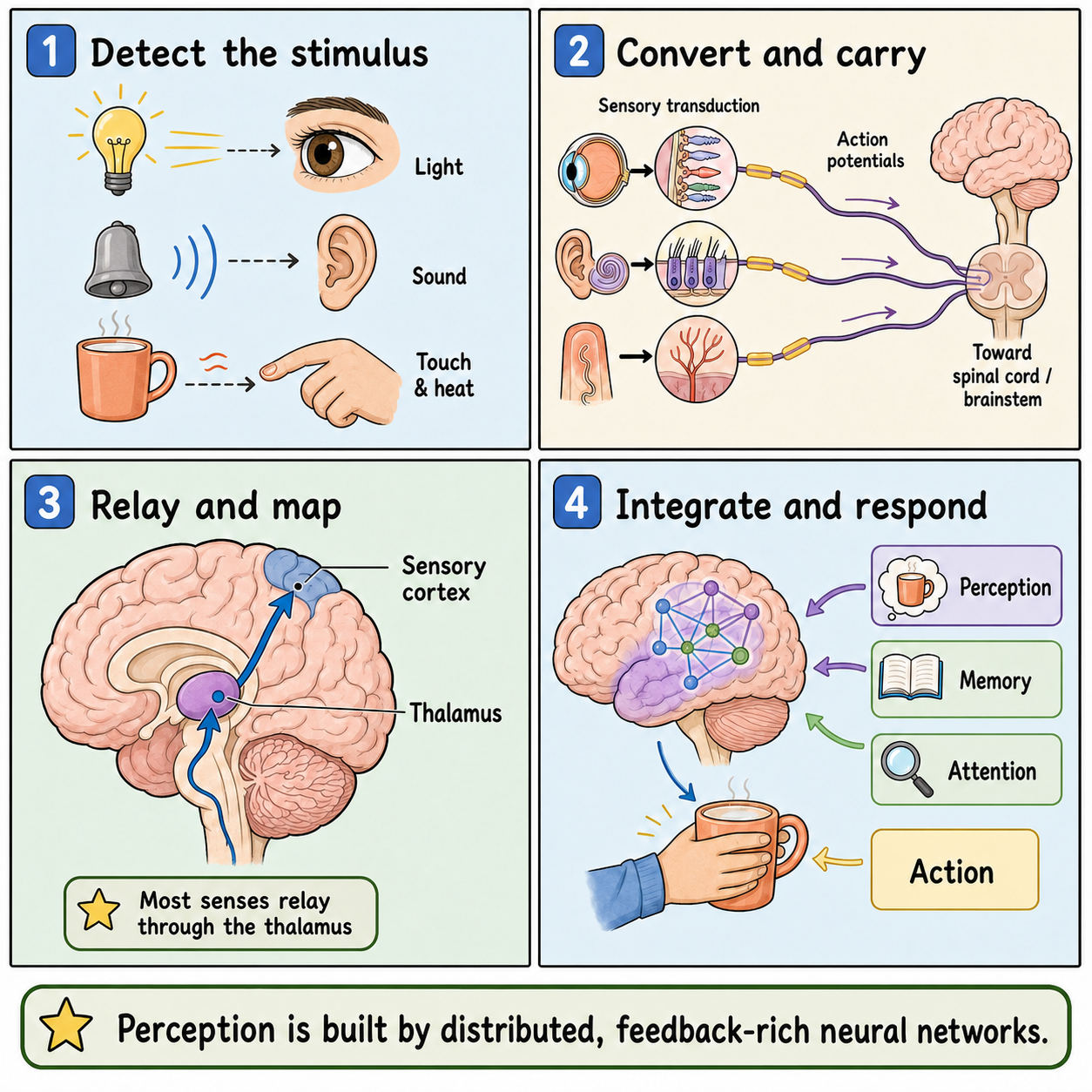
Each sense begins with specialized receptor cells or nerve endings, and each type is most sensitive to one kind of stimulus. Photoreceptors in the retina respond to light. Hair cells in the inner ear respond to the mechanical movement produced by sound and by head motion. Mechanoreceptors respond to touch, pressure, vibration, and stretch. Thermoreceptors respond to changes in temperature. Nociceptors respond to mechanical, thermal, or chemical events that could damage tissue. Chemoreceptors take part in taste and smell and also monitor the body’s internal chemical environment.
What all of them share is a job of translation. Each converts a particular form of energy into an electrical change, a step called sensory transduction. Think of it as translating many foreign languages into the one language the nervous system speaks. The analogy has a limit: no translation is word-for-word, and receptors only ever sample part of what is out there. That is why the brain never receives an exact copy of the world. Perception is a useful interpretation shaped by the input that is available and by the state of the nervous system.
How neurons carry the message
After transduction, neurons carry the information onward. Changes in a stimulus’s intensity, timing, duration, and location can be represented by patterns of action potentials spread across many nerve fibers. The route matters too. Activity arriving through the visual pathway is interpreted differently from activity arriving through a hearing or touch pathway. No single neuron holds a complete perception. A useful sensory representation usually depends on many neurons working together. For the basic signaling units behind this, see What Is a Neuron?, What Is an Action Potential?, and What Is a Synapse?.
Sensory pathways are more than cables. Along the way, circuits can amplify some features, suppress others, compare signals, and combine input from neighboring receptors. Important processing therefore begins long before the cortex, in peripheral structures, the spinal cord, and the brainstem. Some touch signals, for example, enter the spinal cord and drive rapid protective reflexes before conscious perception is complete. Touch and body-position information also travels upward through organized pathways toward the brainstem and thalamus. These pathways are not interchangeable. Different senses use different receptors, cranial nerves, spinal tracts, relay nuclei, and patterns of crossing from one side to the other. Much of this early work, including reflexes, filtering, and adaptation, happens without any conscious awareness.
The thalamus as a hub, with one exception
For most senses, the thalamus is a major relay and processing hub on the way to the cerebral cortex. Different thalamic nuclei receive different kinds of information and communicate with matching areas of cortex. The thalamus is not a passive switchboard, though. Circuits linking it with the cortex help regulate which signals get through and how sensory information interacts with attention and the brain’s overall state.
Smell is the notable exception. Olfactory information reaches the primary olfactory cortex without first passing through a thalamic relay, although the thalamus does take part in later stages of smell processing.
Maps in the cortex
Each sense has its own main region of cortex. Vision is first processed in the primary visual cortex of the occipital lobe. Hearing reaches the primary auditory cortex in the temporal lobe. Body sensation reaches the primary somatosensory cortex in the postcentral gyrus of the parietal lobe. Taste engages the gustatory cortex, including parts of the insula and the frontal operculum. Smell engages primary olfactory areas, including the piriform cortex and connected limbic regions.
These primary areas preserve important relationships from the outside world. The somatosensory cortex holds an organized map of the body. The visual cortex holds maps of visual space. The auditory system keeps sound frequencies in order. These maps are useful organizing principles rather than rigid pictures, since neural responses also depend on context, attention, learning, and activity in connected areas. For a broader structural overview, see What Is the Cerebral Cortex?.
Perception is assembled, not received
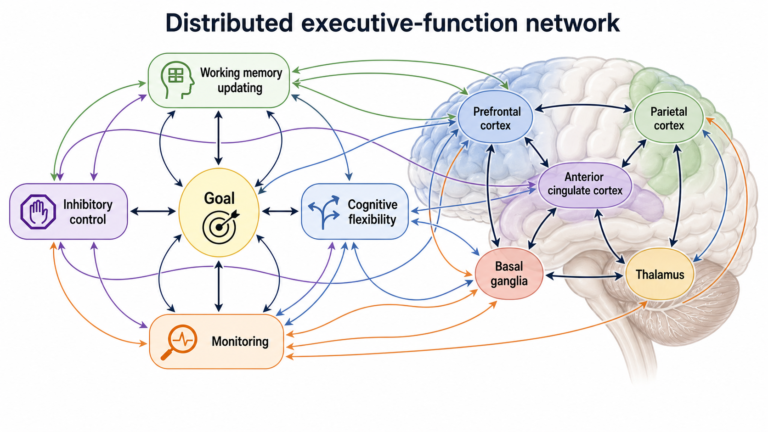
Recognizing an object, or deciding whether a sensation matters, takes more than activity in a primary sensory area. Higher-order cortical areas combine features within one sense and integrate information across senses. Memory, expectation, emotion, attention, and the person’s current goal can all shape the final experience. Signals travel from receptors toward the cortex, but extensive feedback also flows from higher areas back to earlier stages, changing which information gets emphasized. Sensory processing is better understood as a network of parallel, looping circuits than as a one-way chain, which is also why one brain area usually can’t process a complete sensation by itself.
Picking up a warm cup of tea shows how this works. Skin receptors signal contact, pressure, texture, and warmth. Proprioceptors report the position of your fingers and wrist. These signals travel through peripheral nerves and rising pathways, and thalamic and cortical circuits represent where the stimulus is and what it is like. Vision identifies the cup, while memory supplies expectations about how heavy and how hot it should be. Sensory and motor systems interact to adjust your grip and guide the movement. The experience of holding a warm cup is an integrated construction rather than a copy of one receptor’s signal. For the movement side of this loop, see How Does the Brain Control Movement?.
Why we notice change
The nervous system receives far more input than can reach conscious awareness. Attention boosts the processing of information that matters for behavior, while repeated or unchanging stimulation can lead to adaptation. That is why you stop noticing the pressure of your clothes but instantly notice a new touch or an unexpected sound. Adaptation does not mean every pathway simply switches off; its mechanisms and timing differ across receptors and circuits. The broader principle is that sensory systems emphasize change and information that may be useful for action.
References
- Purves D, Augustine GJ, Fitzpatrick D, et al., editors. Neuroscience. 2nd ed. Part II: Sensation and Sensory Processing. Sinauer Associates; 2001. NCBI Bookshelf
- Purves D, Augustine GJ, Fitzpatrick D, et al., editors. The Somatic Sensory System. In: Neuroscience. 2nd ed. Sinauer Associates; 2001. NCBI Bookshelf
- Gadhvi M, Moore MJ, Waseem M. Physiology, Sensory System. StatPearls. Updated 2022. NCBI Bookshelf
- Raju H, Tadi P. Neuroanatomy, Somatosensory Cortex. StatPearls. Updated 2022. NCBI Bookshelf
- Siegle JH, Jia X, Durand S, et al. Survey of spiking in the mouse visual system reveals functional hierarchy. Nature. 2021;592:86–92. doi:10.1038/s41586-020-03171-x
Medical information notice: This article is for general education and does not replace individual medical evaluation, diagnosis, or treatment.
Written by: MedMaru Editorial Team
Reviewed for medical accuracy by:
S. Chang, KMD