
What Is a Synapse? How Brain Cells Communicate
What Is a Synapse?
Introduction
A synapse is a specialized junction where a neuron communicates with another cell. Synapses allow information to move through neural circuits, making sensation, movement, learning, memory, and emotion possible.
Most communication in the human nervous system occurs through chemical synapses, where neurotransmitters carry signals across a microscopic space between cells.
A synapse is the specialized junction through which a neuron communicates with another neuron, muscle cell, or gland cell. At a chemical synapse, neurotransmitters cross a narrow synaptic cleft and bind to receptors on the receiving cell.
What Is a Synapse?
A synapse is not simply the gap between two neurons. It is the entire communication junction, including:
- The signal-sending part of the first cell
- The narrow space between the cells
- The signal-receiving membrane of the next cell
Most synapses connect one neuron to another. However, neurons can also form synapses with muscle cells, gland cells, and other target cells.
The neuron that sends the signal is called the presynaptic neuron. The cell that receives the signal is called the postsynaptic cell.
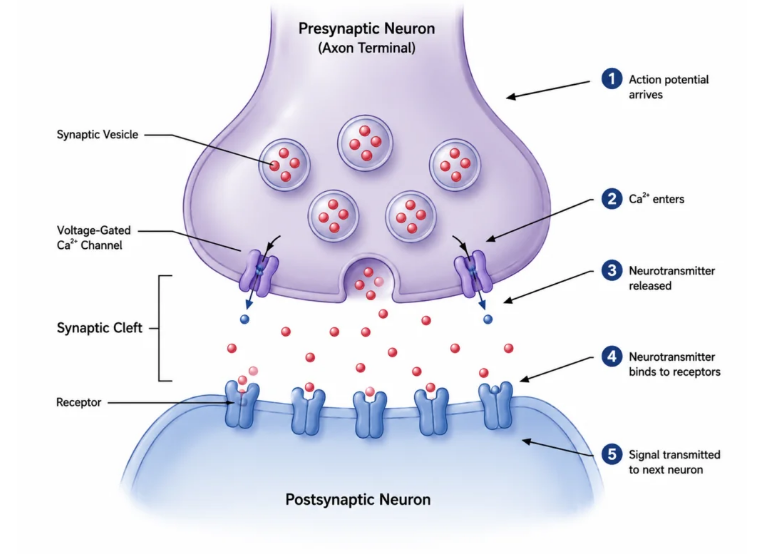
What Are the Three Main Parts of a Chemical Synapse?
1. Presynaptic Terminal
The presynaptic terminal is usually located at the end of an axon. It contains small membrane-bound sacs called synaptic vesicles, which store neurotransmitters.
When an action potential reaches the terminal, calcium channels open. The entry of calcium triggers synaptic vesicles to fuse with the cell membrane and release neurotransmitters.
2. Synaptic Cleft
The synaptic cleft is the microscopic space separating the presynaptic and postsynaptic membranes.
After their release, neurotransmitters diffuse across this space. The cleft is extremely narrow, but the two cells remain structurally separate.
3. Postsynaptic Membrane
The postsynaptic membrane contains receptors that recognize particular neurotransmitters.
When neurotransmitters bind to these receptors, they may:
- Increase the likelihood that the receiving neuron will fire
- Decrease the likelihood that it will fire
- Modify the cell’s activity without immediately producing an electrical impulse
Therefore, a synaptic signal does not always generate a new action potential. Its effect depends on the neurotransmitter, receptor type, and state of the receiving cell.
How Does a Chemical Synapse Work?
Communication at a chemical synapse generally follows these steps:
- An action potential travels along the axon.
- The action potential reaches the presynaptic terminal.
- Voltage-gated calcium channels open.
- Calcium enters the terminal.
- Synaptic vesicles release neurotransmitters into the synaptic cleft.
- The neurotransmitters bind to receptors on the postsynaptic membrane.
- The receiving cell’s electrical or biochemical activity changes.
The signal is then ended when neurotransmitters are removed by reuptake, enzymatic breakdown, or diffusion away from the synapse.
Are Synapses Excitatory or Inhibitory?
Synaptic communication can have different effects.
An excitatory synapse increases the likelihood that the receiving neuron will generate an action potential. An inhibitory synapse decreases that likelihood.
Some synapses have a modulatory effect. Instead of directly exciting or inhibiting the neuron, they alter how strongly the cell responds to other signals.
A neuron usually receives input from many synapses at the same time. It integrates these signals before determining whether to generate an action potential.
Chemical and Electrical Synapses
The nervous system uses both chemical and electrical synapses.
Chemical Synapses
Chemical synapses transmit information using neurotransmitters. They are highly adaptable and can strengthen or weaken with experience.
These synapses usually transmit information in one direction: from the presynaptic cell to the postsynaptic cell.
Electrical Synapses
Electrical synapses contain specialized channels called gap junctions, which connect the interiors of adjacent cells.
Ions and small molecules can pass directly through these channels. This allows electrical activity to spread rapidly and can help groups of neurons synchronize their activity.
Electrical synapses are generally faster than chemical synapses, although they offer less opportunity for signal modification. Some electrical synapses can transmit signals in both directions, while others show directional preference.
Why Are Synapses Important?
Synapses organize neurons into functional circuits. Without synaptic communication, the nervous system could not:
- Process sensory information
- Control muscles and movement
- Regulate organs and glands
- Form and retrieve memories
- Support learning
- Coordinate emotion and behavior
Synapses also help determine how information is selected, amplified, weakened, or blocked as it moves through the nervous system.
What Is Synaptic Plasticity?
Synaptic plasticity is the ability of a synapse to change its strength or effectiveness over time.
Some changes last only milliseconds or minutes. Others may persist for days, months, or longer. Long-lasting changes in synaptic strength are important mechanisms involved in learning and memory.
Synaptic plasticity does not mean that every memory is stored in a single synapse. Memories are thought to depend on changes distributed across networks of connected neurons.
Common Misunderstandings
“A synapse is just the gap between two neurons.”
Not exactly.
The gap is called the synaptic cleft. The synapse includes the presynaptic terminal, synaptic cleft, and postsynaptic membrane.
“Neurotransmitters always cause the next neuron to fire.”
No.
A neurotransmitter may excite, inhibit, or modulate the receiving cell. A new action potential occurs only when the neuron’s combined inputs bring it to the required threshold.
“Neurons directly merge at a synapse.”
At a chemical synapse, the membranes are positioned extremely close together but remain separate. Electrical synapses are different because gap junction channels create a direct pathway between adjacent cells.
“All synapses use neurotransmitters.”
No.
Chemical synapses use neurotransmitters, whereas electrical synapses transmit signals through gap junctions.
- A synapse is a specialized junction through which a neuron communicates with another cell.
- A chemical synapse includes a presynaptic terminal, synaptic cleft, and postsynaptic membrane.
- Neurotransmitters may excite, inhibit, or modulate the receiving cell.
- A synaptic signal does not necessarily produce a new action potential.
- Chemical synapses use neurotransmitters, while electrical synapses use gap junctions.
- Changes in synaptic strength contribute to learning, memory, and adaptation.
Related Articles
References
- Kandel ER, Koester JD, Mack SH, Siegelbaum SA, eds. Principles of Neural Science. 6th ed. McGraw Hill; 2021.
- Südhof TC. Neurotransmitter release: The last millisecond in the life of a synaptic vesicle. Neuron. 2013;80(3):675–690. doi:10.1016/j.neuron.2013.10.022.
- Abbott LF, Regehr WG. Synaptic computation. Nature. 2004;431:796–803. doi:10.1038/nature03010.
- Connors BW, Long MA. Electrical synapses in the mammalian brain. Annual Review of Neuroscience. 2004;27:393–418. doi:10.1146/annurev.neuro.26.041002.131128.
Written by: MedMaru Editorial Team
Reviewed for medical accuracy by:
S. Chang, KMD