
What Is an Action Potential? Brain Signals Explained
What Is an Action Potential?
Introduction
An action potential is a brief electrical signal that travels along a neuron. It is the main way neurons communicate over long distances, allowing the brain and nervous system to send information quickly throughout the body.
Every movement, thought, sensation, and memory depends on action potentials.
An action potential is a rapid electrical signal that travels along a neuron’s axon. It allows neurons to transmit information to other neurons, muscles, and glands.
What Is an Action Potential?
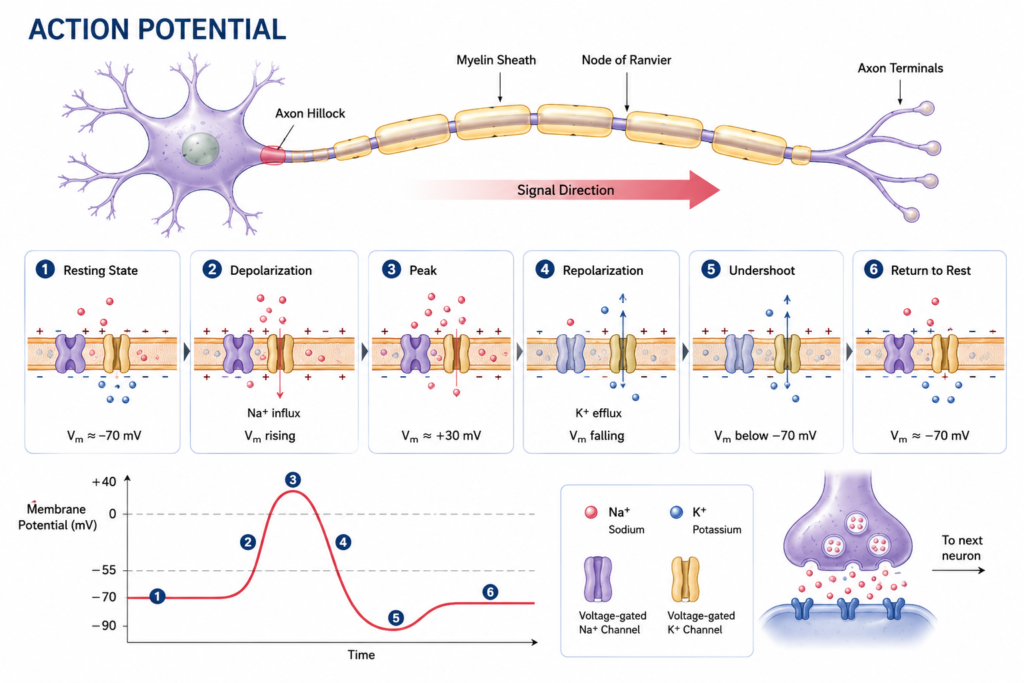
An action potential is a temporary change in the electrical charge across a neuron’s membrane.
When a neuron receives enough stimulation, it generates an action potential that travels from the cell body down the axon to the axon terminals.
This electrical signal carries information without becoming weaker as it travels.
How Does an Action Potential Start?
An action potential begins when the neuron receives enough incoming signals to reach a threshold.
Once this threshold is reached, voltage-gated sodium channels open, allowing sodium ions to enter the neuron.
This causes the inside of the neuron to become temporarily more positive, starting the action potential.
How Does an Action Potential Travel?
After it begins, the action potential moves along the axon like a wave.
As one section of the axon becomes electrically active, it triggers the next section to generate another action potential.
This process continues until the signal reaches the axon terminals.
In myelinated axons, the signal travels much faster by jumping between the nodes of Ranvier, a process called saltatory conduction.
What Happens When the Signal Reaches the End?
When the action potential reaches the axon terminal, it triggers the release of neurotransmitters.
These chemical messengers cross the synapse and pass the signal to the next neuron, muscle, or gland.
This allows information to continue moving through the nervous system.
Why Are Action Potentials Important?
Action potentials are essential for communication throughout the nervous system.
Without them, neurons could not send information, muscles could not contract, and the brain could not process thoughts, memories, or emotions.
Every action performed by the nervous system depends on electrical signaling.
Common Misunderstanding
Does electricity flow through the neuron like it does through a wire?
No.
An action potential is not the same as electricity flowing through a metal wire.
Instead, it is created by the movement of sodium and potassium ions across the neuron’s membrane, producing a temporary change in electrical charge.
- An action potential is a rapid electrical signal generated by a neuron.
- It begins when the neuron reaches a threshold.
- The signal travels along the axon without losing strength.
- Myelin speeds up signal transmission through saltatory conduction.
- Action potentials trigger the release of neurotransmitters at synapses.
Related Articles
- What Is the Brain? Definition, Structure, and Function
- What Is a Neuron?
- What Is a Synapse?
- What Are Neurotransmitters?
- How Does the Brain Work?
References
- Grider MH, Jessu R, Kabir R. Physiology, Action Potential. StatPearls. Updated May 8, 2023.
- Caire MJ, Reddy V, Varacallo MA. Physiology, Synapse. StatPearls. Updated March 27, 2023.
- Cooper GM. Signaling Molecules and Their Receptors. The Cell: A Molecular Approach. NCBI Bookshelf.
Written by: MedMaru Editorial Team
Reviewed for medical accuracy by:
S. Chang, KMD