
How Does the Brain Work? Brain Communication
How Does the Brain Work?
Introduction
The brain works by sending and receiving billions of electrical and chemical signals every second. These signals allow you to think, move, remember, learn, feel emotions, and respond to the world around you. Although the brain appears to work as a single organ, it is actually made up of billions of nerve cells communicating through an enormous network.
The brain works through communication between neurons. Neurons send electrical signals and exchange chemical messengers called neurotransmitters. This constant communication allows the brain to control every thought, movement, sensation, and emotion.
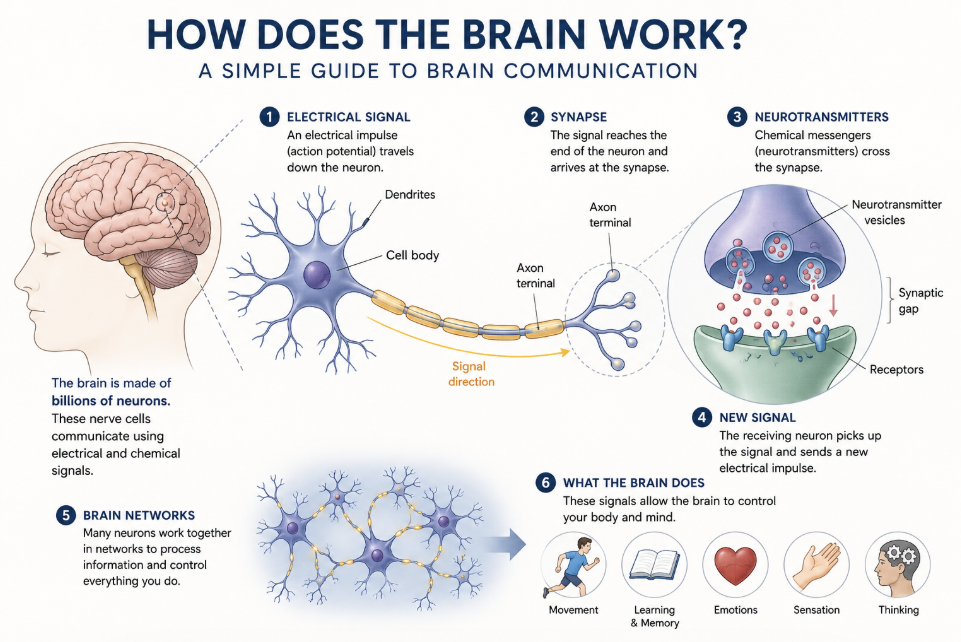
The Brain Is Built from Billions of Neurons
The human brain contains approximately 86 billion neurons. Each neuron is a specialized nerve cell that receives, processes, and sends information to other neurons.
Rather than working alone, neurons form complex networks. These networks allow different parts of the brain to work together and perform many tasks at the same time.
Neurons Send Electrical Signals
Neurons communicate using tiny electrical signals called action potentials.
An action potential travels along the neuron’s axon, carrying information from one end of the cell to the other. These signals travel very quickly, allowing the brain to process information almost instantly.
Neurons Communicate at Synapses
Neurons usually do not touch each other directly.
Instead, they communicate across tiny gaps called synapses.
When an electrical signal reaches the end of a neuron, it triggers the release of chemical messengers known as neurotransmitters. These chemicals cross the synapse and pass the message to the next neuron.
Neurotransmitters Carry Messages
Neurotransmitters are chemicals that allow neurons to communicate.
Different neurotransmitters have different roles. For example, dopamine is involved in movement, motivation, and reward, while GABA helps reduce excessive brain activity.
The balance of these chemicals is important for healthy brain function.
Brain Networks Work Together
Different brain regions have specialized functions, but they rarely work alone.
For example, reading a book requires several brain networks to work together. Your eyes detect the words, language areas understand their meaning, memory systems connect them with previous knowledge, and attention networks help you stay focused.
This teamwork allows the brain to perform complex tasks efficiently.
The Brain Never Stops Working
Even while you are asleep, your brain remains active.
It continues to control breathing, heartbeat, body temperature, and many other automatic functions. During sleep, the brain also helps strengthen memories and supports learning.
Common Misunderstanding
Does the brain work like a computer?
Not exactly.
Both the brain and computers process information, but they work in very different ways. The brain constantly changes by forming new connections and strengthening existing ones, allowing it to learn and adapt throughout life.
- The brain works through communication between billions of neurons.
- Neurons send electrical signals called action potentials.
- Neurotransmitters carry messages across synapses.
- Different brain regions work together through complex neural networks.
- The brain remains active even during sleep.
Related Articles
- What Is the Brain?
- What Does the Brain Do?
- What Is a Neuron?
- What Is a Synapse? How Brain Cells Communicate
- What Is an Action Potential?
- What Are Neurotransmitters?
References
- National Institutes of Health. Information about the Brain. NIH Curriculum Supplement Series. NCBI Bookshelf.
- Caire MJ, Reddy V, Varacallo MA. Physiology, Synapse. StatPearls. Updated March 27, 2023.
- Grider MH, Jessu R, Kabir R. Physiology, Action Potential. StatPearls. Updated May 8, 2023.
Written by: MedMaru Editorial Team
Reviewed for medical accuracy by:
S. Chang, KMD