
What Is a Neuron? How Nerve Cells Work
What Is a Neuron?
Introduction
A neuron is a specialized cell that carries information throughout the nervous system. Neurons allow you to think, move, feel, learn, and remember by sending electrical and chemical signals between different parts of the body.
The human brain contains approximately 86 billion neurons that work together to form an incredibly complex communication network.
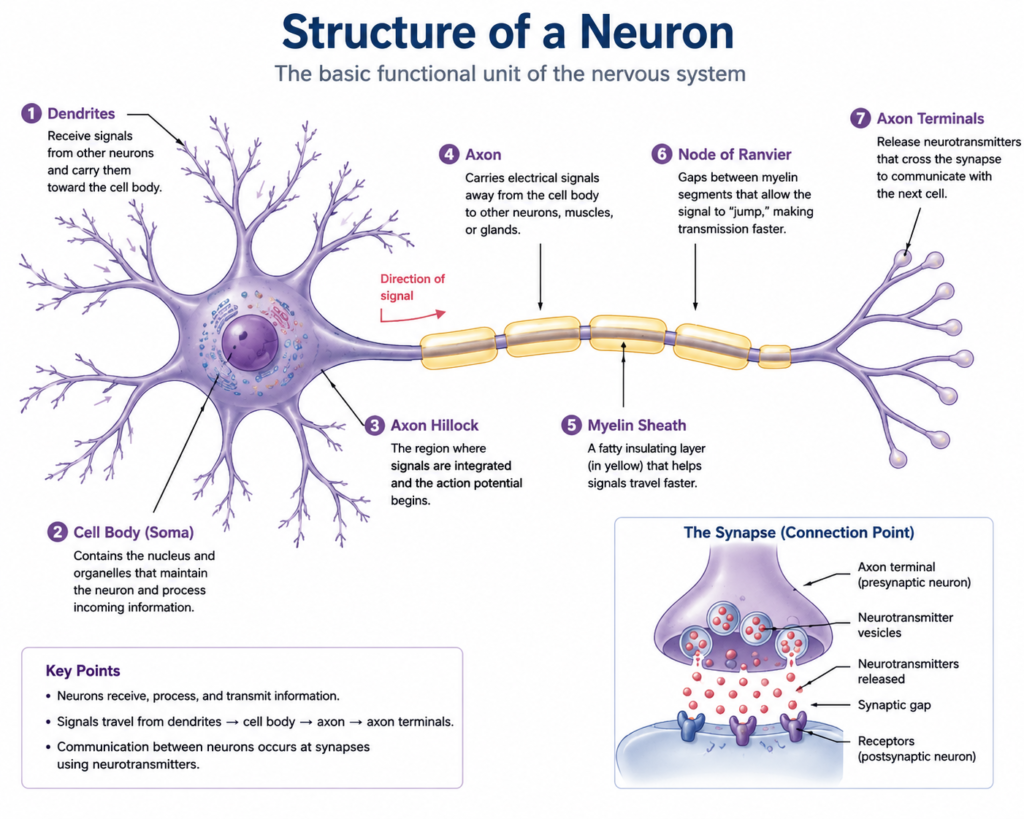
A neuron is a nerve cell that receives, processes, and transmits information. Neurons communicate using electrical signals and chemical messengers, making them the basic building blocks of the brain and nervous system.
What Is a Neuron?
A neuron is the basic functional unit of the nervous system.
Unlike most other cells, neurons are specialized for communication. They receive information from other neurons, process that information, and send signals to other nerve cells, muscles, or glands.
This constant communication allows the brain and nervous system to control nearly every function of the human body.
The Main Parts of a Neuron
A typical neuron has four main parts.
Dendrites
Dendrites receive signals from other neurons and carry this information toward the cell body.
Cell Body (Soma)
The cell body contains the nucleus and other structures that keep the neuron alive and functioning.
It also processes incoming information before sending a signal along the axon.
Axon
The axon is a long extension that carries electrical signals away from the cell body.
Some axons are only a few millimeters long, while others can extend more than one meter.
Axon Terminals
Axon terminals are located at the end of the axon.
When an electrical signal reaches the axon terminal, neurotransmitters are released to communicate with the next cell.
How Do Neurons Communicate?
Neurons communicate in two ways.
First, an electrical signal called an action potential travels along the axon.
When the signal reaches the end of the neuron, neurotransmitters are released into a tiny gap called the synapse. These chemical messengers carry the signal to the next neuron.
This process happens billions of times every second.
Different Types of Neurons
Neurons have different roles depending on where they are located.
Sensory Neurons
Sensory neurons carry information from the body to the brain and spinal cord.
Motor Neurons
Motor neurons send commands from the brain and spinal cord to muscles and glands.
Interneurons
Interneurons connect other neurons within the brain and spinal cord.
Most neurons in the human brain are interneurons.
Why Are Neurons Important?
Every thought, memory, movement, emotion, and sensation depends on neurons.
Without neurons, the brain could not process information or communicate with the rest of the body.
Healthy neurons are essential for normal brain function throughout life.
Common Misunderstanding
Are neurons the only cells in the brain?
No.
Neurons are the main communication cells, but they are not the only cells in the brain.
The brain also contains glial cells, which support, protect, and nourish neurons.
- A neuron is the basic communication cell of the nervous system.
- Neurons receive, process, and transmit information.
- Every neuron contains dendrites, a cell body, an axon, and axon terminals.
- Neurons communicate using electrical signals and neurotransmitters.
- Billions of neurons work together to control every function of the brain and body.
Related Articles
- What Is the Brain?
- How Does the Brain Work?
- What Is the Central Nervous System?
- What Is a Synapse?
- What Is an Action Potential?
References
- National Institutes of Health. Information about the Brain. NIH Curriculum Supplement Series. NCBI Bookshelf.
- Caire MJ, Reddy V, Varacallo MA. Physiology, Synapse. StatPearls. Updated March 27, 2023.
- Grider MH, Jessu R, Kabir R. Physiology, Action Potential. StatPearls. Updated May 8, 2023.
Written by: MedMaru Editorial Team
Reviewed for medical accuracy by:
S. Chang, KMD