What Is the Central Nervous System? Structure, Function
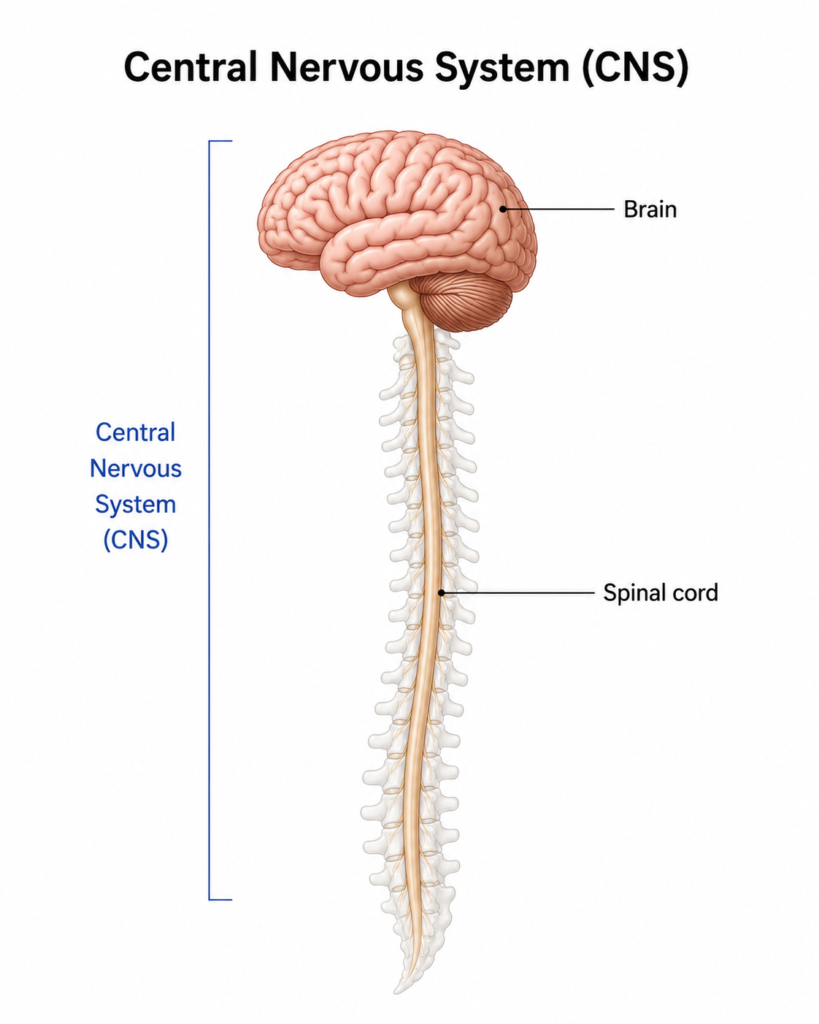
The central nervous system, or CNS, is made up of the brain and the spinal cord. It is the body’s main information-processing and control center. It receives information from the body, processes and interprets it, and sends out commands that control movement, sensation, thinking, memory, emotion, and many automatic functions. Every thought you have, every movement you make, and every sensation you feel depends on the brain and spinal cord working together.
Two organs that run the body
The nervous system has two major parts: the central nervous system and the peripheral nervous system. The CNS contains just two organs, the brain and the spinal cord. A common mistake is to treat the brain alone as the central nervous system, but the spinal cord is part of it too. Together these two organs make up only a small share of body weight, yet they coordinate almost everything the body does.
The peripheral nervous system covers all the nerves outside the brain and spinal cord. A familiar comparison is that the CNS is like a computer and the PNS like the cables connecting it to the outside world. The CNS processes information, makes decisions, and coordinates body functions, while the PNS carries information to and from it. The analogy has a real limit, though: unlike a computer, the CNS constantly rewires itself, and as we’ll see, even the spinal cord does some processing of its own.
The brain: the primary control center
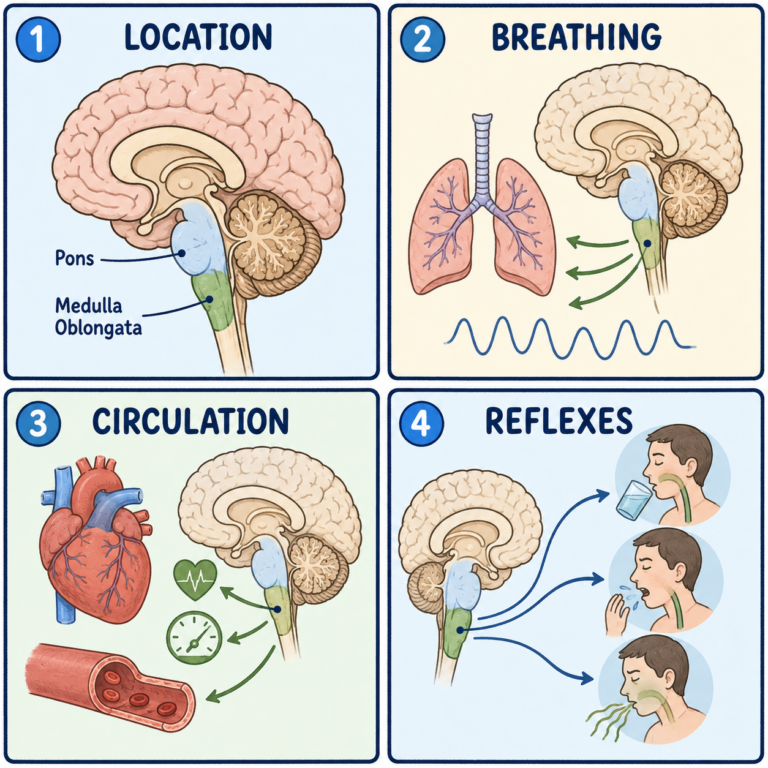
The brain receives sensory information, processes complex data, stores memories, generates emotions, plans movement, and controls both voluntary and involuntary behavior. Different regions specialize. The cerebral cortex is heavily involved in thinking, language, and conscious movement. The cerebellum coordinates balance and precise movement. The brainstem controls breathing, heart rate, and other life-sustaining functions. Despite this specialization, the whole brain works as an integrated network.
The spinal cord: more than a cable
The spinal cord connects the brain to the rest of the body and has two major jobs. It carries sensory information up from the body to the brain, and it carries motor commands down from the brain to muscles and organs. But it does more than pass signals along. It also contains circuits that produce fast reflexes without waiting for input from the brain. When you snatch your hand away from something hot, that response is largely coordinated by reflex pathways in the spinal cord. So the spinal cord is both a communication pathway and a processing center.
How information flows
The CNS is constantly taking in information from the body and the environment, and its work follows four broad steps. First comes sensory input. Specialized receptors detect changes such as touch, temperature, pain, light, or sound, and the signals travel through peripheral nerves to the spinal cord and brain. Second is processing. The brain compares incoming information with stored memories, current goals, and other senses, which is how we recognize objects, make decisions, and plan actions.
Third is motor output. The brain sends commands through the spinal cord and peripheral nerves to muscles and glands, letting us move, speak, and respond to what is around us. Fourth is continuous feedback. The nervous system keeps monitoring the results of every movement, so posture, balance, and movement can be adjusted in real time.
What the CNS does for you
The central nervous system processes sensory information, controls voluntary movement, regulates involuntary functions such as breathing and heart rate, supports learning and memory, language and communication, decision-making, and emotional regulation, and helps maintain homeostasis, the body’s stable internal balance. Without it, we could not think, move, remember, communicate, or keep the body running normally. Because it integrates enormous amounts of information every second, it allows us to adapt to a constantly changing world.
When the CNS is affected
Many neurological diseases directly affect the central nervous system, including stroke, Parkinson’s disease, Alzheimer’s disease, multiple sclerosis, epilepsy, brain tumors, and spinal cord injury. They affect different parts of the CNS in different ways, but all of them interfere with normal communication between neurons.
This article is educational background, not a diagnostic guide. Sudden weakness, numbness, confusion, trouble speaking, or a seizure needs urgent medical care.
Related: What Is the Peripheral Nervous System? · What Is the Brain? · What Is a Neuron? · How Do Neurons Communicate? · What Is a Reflex Arc?
References
- Standring S, ed. Gray’s Anatomy: The Anatomical Basis of Clinical Practice. 42nd ed. Elsevier; 2020.
- Basinger H, Hogg JP. Neuroanatomy, Brainstem. StatPearls. Updated July 4, 2023.
- Bui T, Das JM. Neuroanatomy, Cerebral Hemisphere. StatPearls. NCBI Bookshelf.
Written by: MedMaru Editorial Team
Reviewed for medical accuracy by:
S. Chang, KMD