Cerebellum: Function, Location, and Anatomy
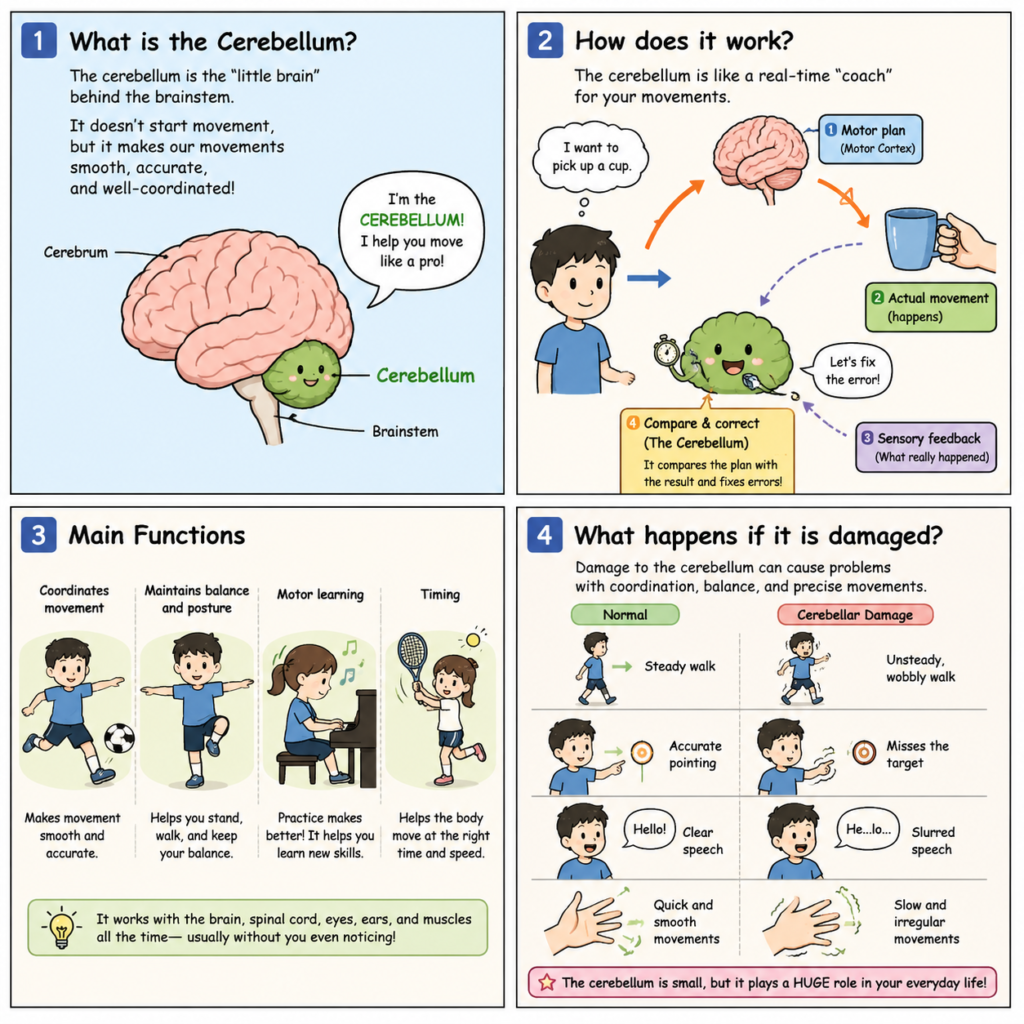
The cerebellum, whose name means “little brain,” is the part of the brain that makes movement smooth, accurate, and well-timed. It coordinates movement, keeps you balanced and upright, and helps you learn motor skills. It does not start movements. Instead, it compares the movement you intended with the movement actually happening and keeps correcting the difference. It makes up only about 10 percent of the brain’s volume, yet it contains more than half of the brain’s neurons, which makes it one of the most densely packed structures in the nervous system.
Where it sits and how it is built
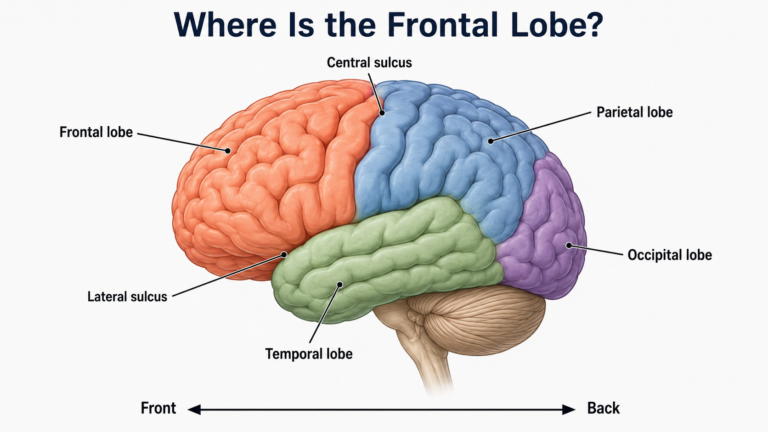
The cerebellum sits at the back of the head, behind the brainstem and beneath the occipital lobes of the cerebrum. It is in constant communication with the cerebral cortex, the brainstem, the spinal cord, and the vestibular system of the inner ear.
It has two cerebellar hemispheres joined in the middle by a narrow strip called the vermis. Like the cerebrum, it has an outer layer of gray matter, the cerebellar cortex, with white matter beneath it and clusters of neurons buried deep inside, called the deep cerebellar nuclei. Anatomists also divide it into three lobes: the anterior lobe, the posterior lobe, and the flocculonodular lobe. These regions have different roles but work together continuously.
An error-correcting coach
The best way to understand the cerebellum is as a coach who watches every move and calls out corrections in real time. It continuously receives two streams of information: motor plans from the cerebral cortex, describing what you intend to do, and sensory feedback from the body, describing what is actually happening. When the two don’t match, it sends corrective signals back to the motor system so the movement becomes smoother and more accurate. All of this happens constantly and mostly without your awareness. The coach image has one limit worth stating: the cerebellum works far faster than any coach could speak, adjusting muscle activity within moments.
This is why the cerebellum does not initiate voluntary movement. The motor cortex generates the movement commands; the cerebellum refines and coordinates them. Without it, even simple actions such as walking or reaching for a cup become inaccurate and poorly coordinated.
Balance, timing, and practice
Balance is one important job, though far from the only one. To keep you upright, the cerebellum combines information from the vestibular system, vision, proprioceptors (the position sensors in muscles and joints), and the spinal cord. That integration supports balance, posture, and a steady walk.
Timing is another. Many movements need precise timing, and the cerebellum helps synchronize muscle activity so that movements happen at the right speed and in the right order. Think of the split-second coordination involved in catching a ball.
The cerebellum is also central to motor learning. Repeated practice makes movements more accurate over time, and the cerebellum plays an essential role in learning new skills, improving accuracy, and adapting after mistakes. Riding a bicycle, playing the piano, throwing a ball, and learning to type all depend on it. Everyday activities like walking, running, writing, speaking, holding your posture, and using tools rely on normal cerebellar function, and even small cerebellar injuries can noticeably affect movement accuracy.
Beyond movement
For many years the cerebellum was thought to handle only balance and coordination. Research now suggests it also takes part in certain cognitive and emotional processes through its extensive connections with the cerebral cortex. These may include attention, language processing, working memory, and emotional regulation. These roles remain an active area of research, and they are generally considered secondary to the cerebellum’s well-established role in motor control. So the cerebellum is primarily a motor structure, but not purely a muscle controller.
When the cerebellum is damaged
Damage to the cerebellum produces a recognizable set of problems. The hallmark is ataxia, a loss of coordination. People may have poor balance, a tremor that appears when reaching toward a target, called intention tremor, and difficulty judging distance so that movements overshoot or undershoot, called dysmetria. Rapid alternating movements, like flipping the hand back and forth, become clumsy, a sign called dysdiadochokinesia. Speech can become slurred in a pattern called ataxic dysarthria, and the eyes may make abnormal jerking movements called nystagmus.
The contrast with basal ganglia disorders is useful. Cerebellar disorders typically cause poor coordination, while basal ganglia disorders are more associated with problems in starting movement.
This article is educational background, not a diagnostic guide. Sudden loss of coordination, severe dizziness with trouble walking, or new slurred speech needs urgent medical evaluation.
Related: What Is the Brain? · What Is the Brainstem? · How Does the Brain Control Movement? · What Is Proprioception?
References
- Standring S, ed. Gray’s Anatomy: The Anatomical Basis of Clinical Practice. 42nd ed. Elsevier; 2020.
- Jimsheleishvili S, Dididze M. Neuroanatomy, Cerebellum. StatPearls. NCBI Bookshelf.
- Manto M, et al. Consensus paper: roles of the cerebellum in motor control. Cerebellum. 2012;11(2):457-487. doi:10.1007/s12311-011-0331-9.
Written by: MedMaru Editorial Team
Reviewed for medical accuracy by:
S. Chang, KMD