Brainstem: Function, Location, and Major Parts
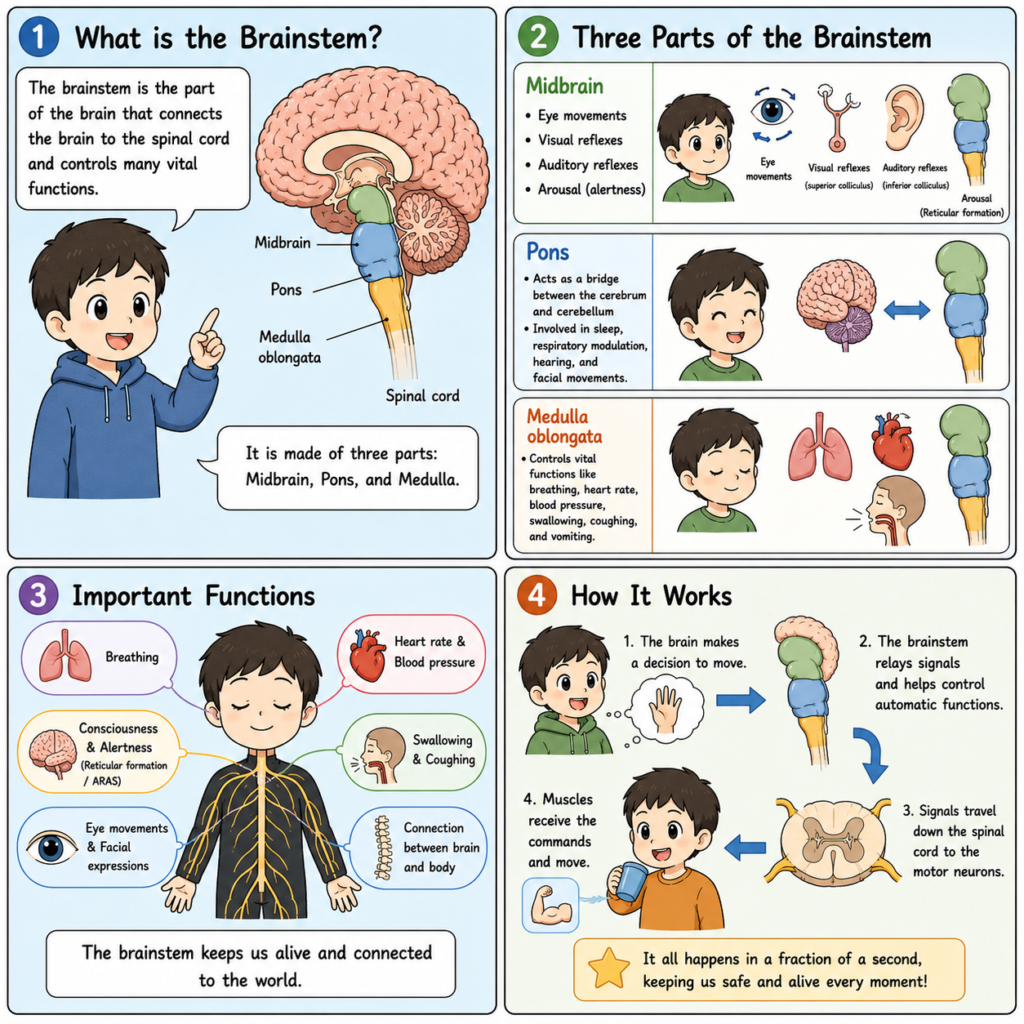
The brainstem is the lower part of the brain that connects the cerebrum and diencephalon to the spinal cord. It is much smaller than the cerebrum, yet every breath you take, every heartbeat, and your ability to stay awake depend on it. It is made of three parts, the midbrain, the pons, and the medulla oblongata, and it controls breathing, heart rate, blood pressure, swallowing, eye movements, consciousness, and many other automatic functions. Because so much passes through and depends on this small structure, severe damage to the brainstem can be life-threatening.
More than a connecting cable
The brainstem is one of the four major divisions of the brain. It sits below the diencephalon, in front of the cerebellum, and above the spinal cord. It is the main route for nerve fibers traveling between the brain and the rest of the body, carrying sensory information up and motor commands down. It also holds many clusters of neurons, called nuclei, that regulate vital automatic functions, and it contains the nuclei of most cranial nerves.
So it is a mistake to think of the brainstem as just a cable linking brain and spinal cord. Picture a busy train station that also houses the city’s power plant and emergency services. Trains pass through constantly, but the station also keeps the lights on. The comparison has its limits, since the brainstem’s regulatory centers and pathways are intertwined rather than housed in separate buildings, but it captures its double role.
The brainstem isn’t purely automatic either. While it handles much automatic regulation, it also contributes to eye movements, motor control, sensory processing, attention, and coordination with the cerebellum.
Three parts, stacked top to bottom
The midbrain, also called the mesencephalon, is the uppermost part. It contributes to eye movements, visual and auditory reflexes, motor control, and arousal. It contains important structures including the superior colliculus, the inferior colliculus, the substantia nigra, and the red nucleus.
The pons sits in the middle, between the midbrain and the medulla. It is a major communication center between the cerebrum and the cerebellum. It is involved in facial sensation and movement, hearing, balance, sleep regulation, and fine-tuning of breathing, and several cranial nerve nuclei are located within it.
The medulla oblongata is the lowest part, continuous with the spinal cord. It holds vital autonomic centers responsible for breathing, heart rate, blood pressure, swallowing, coughing, sneezing, and vomiting, all of which run without conscious effort. The three regions have their own specialties, but they work together continuously.
Home of the cranial nerves
The brainstem contains the nuclei of 10 of the 12 cranial nerves. The two exceptions are the olfactory nerve, cranial nerve I, and the optic nerve, cranial nerve II, which do not arise from the brainstem. The cranial nerve nuclei here control eye movements, facial expression, hearing, balance, taste, swallowing, and tongue movement.
The reticular formation and staying awake
Running through the whole brainstem is a diffuse network of neurons called the reticular formation. It is not a single structure but a web involved in maintaining consciousness, regulating the sleep–wake cycle, controlling attention and alertness, modulating pain, and coordinating autonomic functions. Part of this network, the ascending reticular activating system, or ARAS, is essential for staying awake.
The brainstem at work
Consider touching a hot object. Sensory signals travel up through the spinal cord and pass through the brainstem on their way to the cerebrum, which processes the sensation. Motor commands then travel back down through the brainstem, and the spinal cord activates the muscles that pull your hand away. All the while, the brainstem keeps regulating your breathing and circulation without any conscious awareness. This constant background work, from breathing and heart rate to blood pressure, consciousness, sleep, eye movements, swallowing, and protective reflexes, is why life cannot be sustained without normal brainstem function.
When the brainstem is damaged
Because so many critical pathways and nuclei are packed into the brainstem, even small lesions can cause significant neurological problems. Causes include brainstem stroke, multiple sclerosis, tumors, traumatic brain injury, and cranial nerve disorders. Locked-in syndrome, in which a person is conscious but almost completely paralyzed, is one of the most severe outcomes of brainstem damage. Symptoms can include double vision, difficulty swallowing, facial weakness, loss of balance, breathing failure, and altered consciousness.
This article is educational background, not a diagnostic guide. Sudden double vision, trouble swallowing or speaking, facial weakness, severe dizziness, or reduced alertness needs emergency medical care.
Related: What Is the Brain? · What Is the Cerebrum? · What Is the Diencephalon?
References
- Standring S, ed. Gray’s Anatomy: The Anatomical Basis of Clinical Practice. 42nd ed. Elsevier; 2020.
- Basinger H, Hogg JP. Neuroanatomy, Brainstem. StatPearls. Updated July 4, 2023.
- Physiology, Sensory System. StatPearls. NCBI Bookshelf.
Written by: MedMaru Editorial Team
Reviewed for medical accuracy by:
S. Chang, KMD