What Is a Sensory Neuron? Structure, Function, and Pathway
Every sensation you experience, from the warmth of sunlight to the sting of a pinprick, the sound of music, or the sense of where your arm is, begins with a sensory neuron. A sensory neuron, also called an afferent neuron, is a nerve cell that carries information from sensory receptors to the central nervous system, the brain and spinal cord. Sensory neurons pick up touch, temperature, pain, vibration, and body position, as well as signals from internal organs, so the brain can perceive and interpret them. Without them, the central nervous system would know nothing about the world outside or the condition of the body inside.
The incoming line
Sensory neurons are one of the three major functional classes of neurons. They form the afferent pathway, carrying information toward the central nervous system for processing. Motor neurons do the opposite job, carrying commands from the brain and spinal cord out to muscles.
An unusual shape built for speed
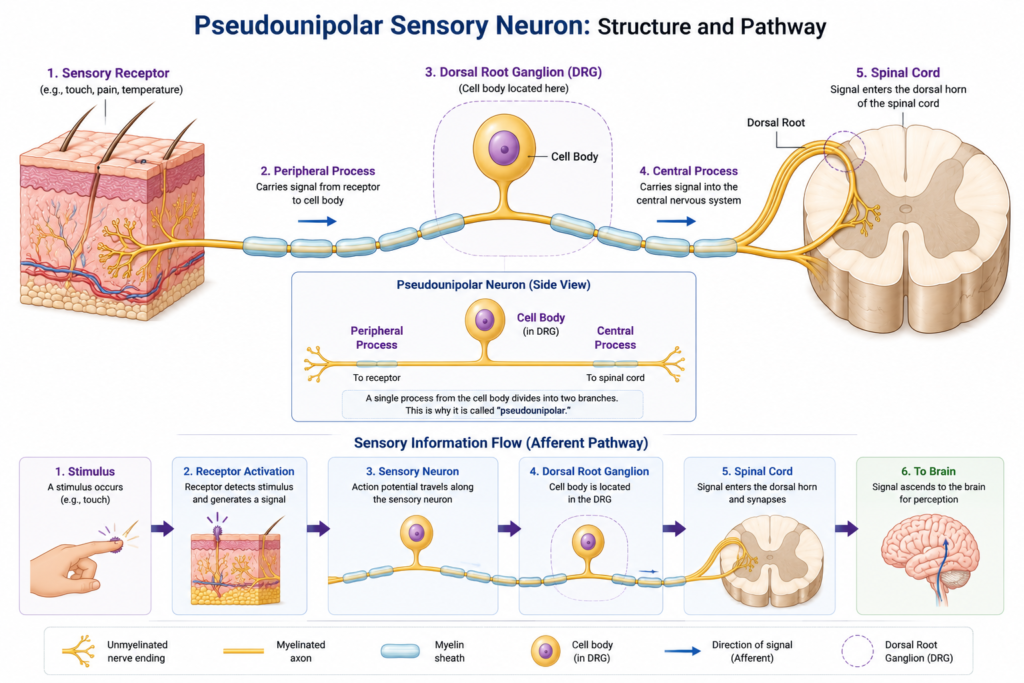
Most sensory neurons that carry information from the body have an unusual shape called pseudounipolar. A single process leaves the cell body and quickly splits into two branches. The peripheral branch reaches out to a sensory receptor in the skin, muscles, joints, or internal organs. The central branch enters the spinal cord or brainstem and carries the signal inward.
What makes this design unusual is where the cell body sits. In most neurons the cell body lies in the path of the signal, but here it hangs off to the side, like a house set back from a road with a short driveway. The signal travels straight along the road without needing to pass through the house. The image is a simplification, but it explains why the signal moves through so directly. For most body-sensing neurons, the cell body is in the dorsal root ganglion, a cluster of sensory cell bodies just outside the spinal cord.
Not all sensory neurons look like this, though. The neurons involved in vision, hearing, smell, taste, and balance have different anatomical arrangements.
From stimulus to signal
The journey happens in four stages. First, a specialized receptor detects a stimulus, such as touch, pressure, temperature, pain, vibration, or muscle stretch. Second, the receptor converts the stimulus into a small electrical change called a receptor potential. If that potential reaches threshold, the sensory neuron fires an action potential. Third, the action potential travels along the neuron through peripheral nerves to the spinal cord or brainstem. Fourth, the signal enters the central nervous system, where interneurons and higher brain centers process and interpret it.
The dorsal root ganglion is the entry point for most sensory information from the body, but it is not a relay station. Under normal conditions, no synapses occur inside it. The action potential passes straight through the pseudounipolar neuron without stopping to connect with another cell there.
Many kinds of information
Sensory neurons carry far more than touch. General body sensation includes touch, pressure, vibration, pain, temperature, and proprioception, the sense of body position and movement. Visceral sensation comes from internal organs and includes blood pressure, blood oxygen and carbon dioxide levels, bladder filling, stomach stretching, and visceral pain. These signals help drive autonomic reflexes and maintain homeostasis.
Special senses form a third group: vision, hearing, balance, taste, and smell. These use specialized receptor organs and dedicated pathways rather than the typical dorsal root ganglion route.
Why sensory input matters
Sensory neurons give the central nervous system a continuous picture of the outside world and of the body’s internal state. Without that input, the brain couldn’t detect injury, keep balance, coordinate movement, recognize objects by touch, track body position, or run many autonomic reflexes. Every voluntary movement depends on continuous sensory feedback.
When sensory neurons or their pathways are damaged, people may experience numbness, tingling, called paresthesia, reduced vibration sense, loss of proprioception, impaired balance, or neuropathic pain, which is pain caused by nerve damage itself. Common causes include peripheral neuropathy, diabetic neuropathy, herpes zoster affecting the dorsal root ganglion, and sensory neuronopathy, also called ganglionopathy.
This article is educational background, not a diagnostic guide. Persistent numbness, tingling, or unexplained balance problems should be evaluated by a clinician.
Related: What Is a Reflex Arc? · What Is a Motor Neuron? · What Is an Interneuron? · What Is the Somatic Nervous System?
References
- Physiology, Sensory System. StatPearls. NCBI Bookshelf.
- Raju H, Tadi P. Neuroanatomy, Somatosensory Cortex. StatPearls. Updated November 7, 2022.
- Grider MH, Jessu R, Kabir R. Physiology, Action Potential. StatPearls. Updated May 8, 2023.
Written by: MedMaru Editorial Team
Reviewed for medical accuracy by:
S. Chang, KMD