What Is a Neural Circuit?
A single neuron can receive, process, and pass on a signal, but almost nothing the nervous system does can be achieved by one neuron alone. Seeing a face, taking a step, or remembering a phone number all emerge from groups of interconnected neurons working together. These groups are called neural circuits. A neural circuit is a set of neurons linked by synapses that takes in information, transforms it through patterns of excitation and inhibition, and produces an output. Some circuits are small and local. Others link several regions of the brain, spinal cord, or peripheral nerves. What a circuit does depends not only on which neurons are connected, but also on the strength, timing, and changing activity of those connections.
More than a chain of neurons
The output of a circuit can take many forms. It may activate a muscle, regulate an organ, adjust another circuit, contribute to a sensation, store or retrieve information, or influence a decision. So a circuit is more than a cluster of nearby neurons. Its identity comes from its connections and how its parts interact.
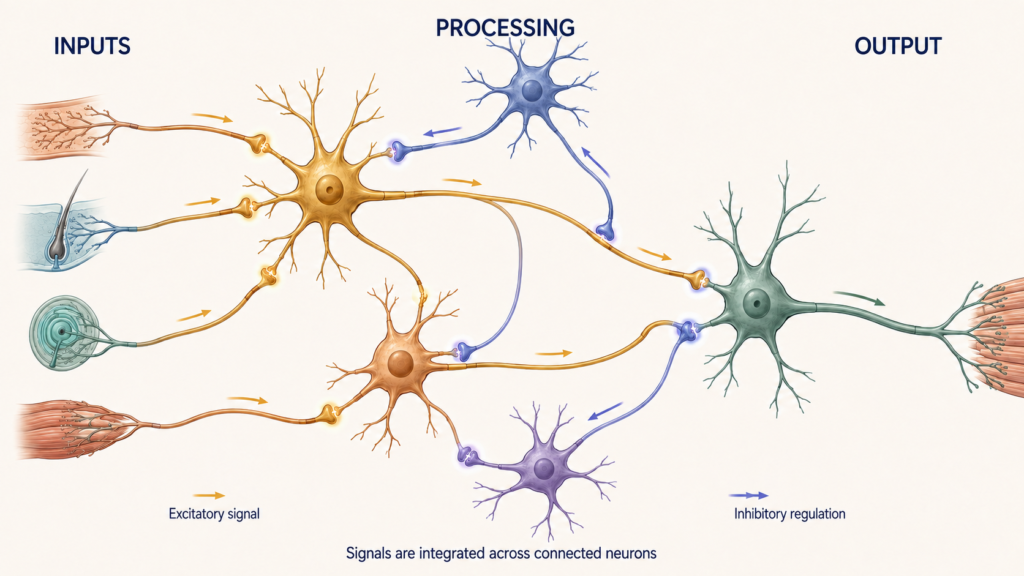
Textbooks often describe circuits in three parts: input, the information coming in; processing, the transformation that happens inside; and output, the signal sent on to another neuron, brain region, muscle, or gland. That description is a helpful starting point, but it is easy to take too literally. Most brain circuits are not simple one-way chains. Even small circuits tend to contain branching routes, convergence, inhibition, recurrent loops, and feedback from several sources.
A city’s road system is a reasonable comparison. Some roads are quiet local streets, some are highways between distant districts, and traffic everywhere is shaped by signals, merges, and detours. The comparison falls short in one important respect: neural traffic changes the roads themselves, because connections strengthen or weaken with use.
Local, long-range, and distributed
Circuits exist at several scales. Local circuits connect neurons within a small area, such as one layer of the cerebral cortex, one segment of the spinal cord, or a single brain nucleus. They usually combine principal neurons, which send out the circuit’s main output, with interneurons, which regulate their neighbors, along with both excitatory and inhibitory connections. Local circuits filter signals, sharpen responses, control timing, and prevent excessive excitation.
Long-range circuits connect distant parts of the nervous system through axons running in white-matter tracts or peripheral nerves. Movement is a good example. It involves communication among the cerebral cortex, basal ganglia, thalamus, cerebellum, brainstem, spinal cord, sensory systems, and muscles.
Many functions depend on distributed circuits spread across several regions rather than on a single center. Memory, attention, emotion, and decision-making all work this way. Individual regions make specialized contributions, but their activity is coordinated with others, and one region can take part in more than one function. That is why most behaviors cannot be traced to one circuit in one place.
How a signal moves through a circuit
Circuits run on electrical and chemical signaling. Input arrives from sensory receptors, other neurons, or another brain region, and a single neuron can receive signals from many others. Excitatory and inhibitory postsynaptic potentials, small voltage changes at the receiving end of synapses, push the neuron’s membrane potential up or down. The neuron adds these effects up across space and time. If the activity near the axon initial segment reaches threshold, the neuron usually fires an action potential.
That action potential travels down the axon and triggers neurotransmitter release at the next synapses, so the signal affects the next neurons in line. Several pathways can carry information at the same time, and along the way some signals are strengthened, suppressed, delayed, or merged with others. The resulting pattern of activity becomes the circuit’s output. Importantly, information is usually carried by the coordinated activity of a whole population of neurons rather than by one cell alone. Circuits also change with experience. Through plasticity, synaptic strength and circuit activity shift during development, learning, memory, injury, and repetition.
Recurring wiring patterns
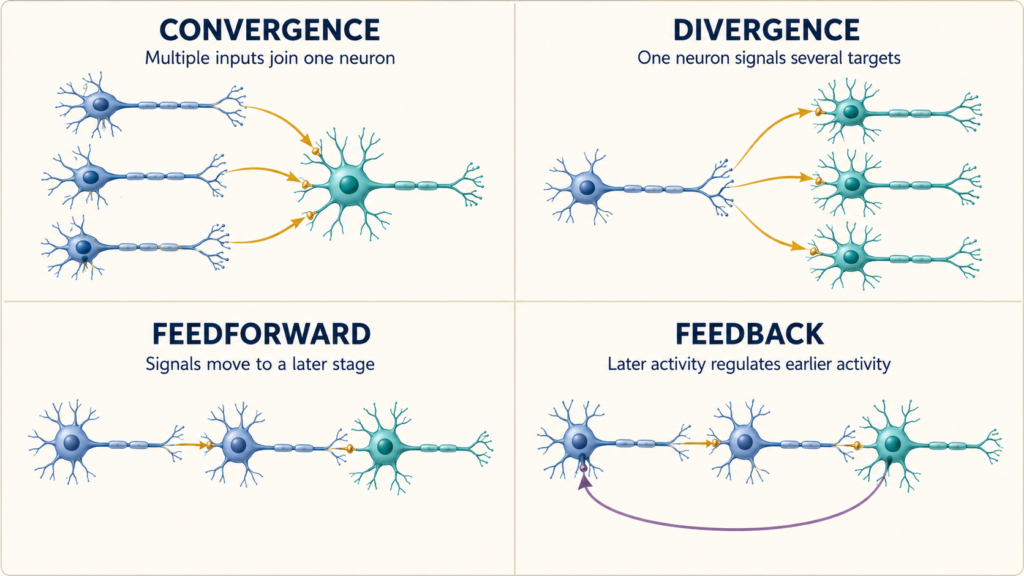
Neural circuits reuse a handful of connection patterns, sometimes called circuit motifs, and they appear throughout sensory, motor, autonomic, and cognitive systems. In convergence, several neurons send signals to one neuron, combining information from multiple sources. In divergence, one neuron sends signals to many targets, spreading information along several routes. In lateral inhibition, active neurons suppress their neighbors, which sharpens contrast and makes signals more selective.
Direction of flow defines two more patterns. In feedforward signaling, information moves mainly from an earlier stage to a later one. A sensory signal may travel from a receptor to the spinal cord, the thalamus, and the cortex, being transformed rather than simply copied at each step. A special case, feedforward inhibition, happens when an incoming signal excites both a principal neuron and an inhibitory interneuron. The interneuron then limits the principal neuron’s response, which improves timing and prevents excess activity. In feedback signaling, activity at a later stage influences an earlier one. Feedback can raise or lower activity, select relevant information, adjust responses to context, compare expected with actual outcomes, and stabilize the circuit. Feedback is not always inhibitory. Depending on the wiring, it can increase, suppress, or reshape activity.
Recurrent circuits send activity back into the same network. Recurrent excitation can keep activity going after the original input has faded, a property studied in circuits for working memory, decision-making, and persistent representations. It has to be kept in check, though, and inhibitory neurons and other regulatory mechanisms prevent it from running away. Recurrent circuits can also produce rhythms. The rhythms behind breathing and walking, for example, arise from specialized interactions among neurons rather than from a single neuron acting as a master controller.
Why excitation and inhibition must work together
Excitatory signals make particular neurons more likely to fire. Inhibitory signals usually reduce or reshape that activity. Together they let circuits select the right signals, suppress competing activity, control timing, prevent runaway excitation, generate coordinated rhythms, and tune their sensitivity. This interplay is often called excitation–inhibition balance. Balance does not mean the two must always be equal. The right relationship changes across circuits, behaviors, stages of development, and moments in time.
It also means more activity is not automatically better. Effective processing needs well-timed, coordinated activity, and too much, too little, or poorly synchronized activity can all interfere with function.
Circuits keep changing
Circuits are organized, but they are not fixed after childhood. During development they change as new synapses form, some connections are pruned, synapses strengthen or weaken, axons and dendrites grow and refine, myelination changes, and excitatory and inhibitory signaling mature. Adult circuits can still change. Learning can alter synaptic strength, the distribution of receptors, how excitable neurons are, and how they coordinate. That capacity has limits. How much a circuit can change, and in what way, depends on the circuit, age, experience, biological conditions, and any injury or disease.
Circuit, pathway, or network?
These three words overlap, and neuroscientists don’t draw fixed lines between them. A pathway usually means a route that signals travel between defined structures, such as a sensory pathway or a descending motor pathway. A circuit emphasizes interconnected neurons and how their connections transform information or produce an output. A network is a broader term for many interacting neurons or brain regions, and in another context it can also mean an artificial computational system. The choice of word often depends on scale and on the research question.
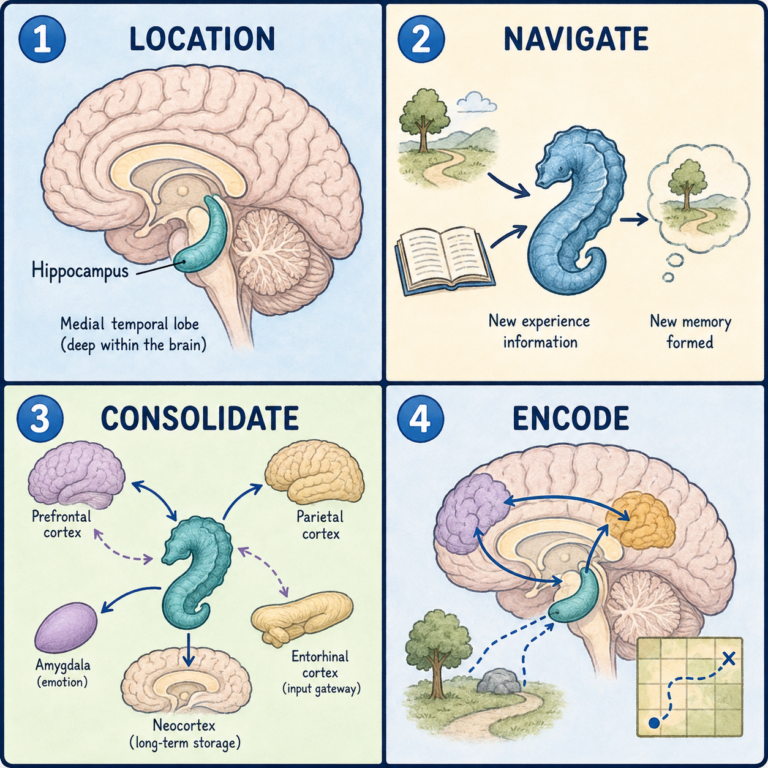
A few examples show circuits at work. A reflex circuit links sensory input to a motor response very quickly, sometimes through only a few synaptic steps, though sensory feedback and signals from the brain can still modify it. Visual circuits carry information from retinal neurons through several brain regions, with parallel pathways handling contrast, color, motion, form, and location. Motor circuits in the cortex, basal ganglia, cerebellum, brainstem, and spinal cord select actions, plan movement, coordinate timing, adjust posture, and activate muscles. Memory relies on distributed interactions among the hippocampus, cortex, amygdala, thalamus, and other structures, and different types and stages of memory do not share one identical circuit.
How scientists study circuits
No single method can fully explain a circuit, so researchers combine several. Anatomical tracing identifies connections, and microscopy examines neurons and synapses. Electrophysiology records electrical activity, while calcium or voltage imaging watches whole populations of neurons. Optogenetic and chemogenetic methods switch selected cells on or off, functional brain imaging tracks large-scale activity, and computational models test possible mechanisms.
Each method has blind spots. A wiring diagram shows possible routes of communication, but it does not reveal how information actually flows during behavior, because function also depends on timing, synaptic strength, neurotransmitters, cell properties, and the current state of the nervous system. Likewise, correlated activity between two regions does not prove a direct connection or a causal link. Strong conclusions usually require evidence that ties together anatomy, activity, manipulation, and behavior.
Circuits in health and disease
Many neurological and psychiatric disorders may involve changes in particular circuits rather than damage to one isolated structure. Circuit abnormalities have been associated with epileptic seizures, Parkinson’s disease and other movement disorders, stroke, chronic pain, memory disorders, and some psychiatric and neurodevelopmental conditions. Calling a disorder circuit-based does not mean one simple broken loop explains it, though. Symptoms can reflect interacting changes in neurons, synapses, glial cells, neurotransmitters, development, and connections across several regions.
Some treatments work partly by changing circuit activity, including medications, rehabilitation, deep brain stimulation, and noninvasive brain stimulation. Their effects depend on the circuit being targeted and on the individual’s condition. This article is educational background and does not replace medical evaluation.
Related: What Is a Neuron? · What Is an Interneuron? · How Do Neurons Communicate? · What Are Excitatory and Inhibitory Signals? · How Do Neurons Combine Excitatory and Inhibitory Signals? · What Is Excitation–Inhibition Balance in the Brain? · What Are Neural Receptors? · What Is a Reflex Arc?
References
- Purves D, Augustine GJ, Fitzpatrick D, et al., editors. Neural Circuits. In: Neuroscience. 2nd ed. Sunderland, MA: Sinauer Associates; 2001.
- Douglas RJ, Martin KAC. Neuronal circuits of the neocortex. Annual Review of Neuroscience. 2004;27:419–451. doi:10.1146/annurev.neuro.27.070203.144152.
- Sporns O. The human connectome: a complex network. Annals of the New York Academy of Sciences. 2011;1224:109–125. doi:10.1111/j.1749-6632.2010.05888.x.
- Grillner S. The motor infrastructure: from ion channels to neuronal networks. Nature Reviews Neuroscience. 2003;4(7):573–586. doi:10.1038/nrn1137.
- Tau GZ, Peterson BS. Normal development of brain circuits. Neuropsychopharmacology. 2010;35(1):147–168. doi:10.1038/npp.2009.115.
- Deisseroth K. Optogenetics: 10 years of microbial opsins in neuroscience. Nature Neuroscience. 2015;18(9):1213–1225. doi:10.1038/nn.4091.
Written by: MedMaru Editorial Team
Reviewed for medical accuracy by:
S. Chang, KMD