How Does the Brain Learn?
Why “Learning Grows New Brain Cells” Is Wrong — And What Actually Happens
Most people picture learning as something being added to the brain — a new cell, a new file saved somewhere. That picture is intuitive, and it’s largely incorrect. Learning is mostly a matter of change, not addition: existing connections get stronger, weaker, or reorganized, and the systems doing that reorganizing depend on what kind of learning is happening.
Learning isn’t one thing
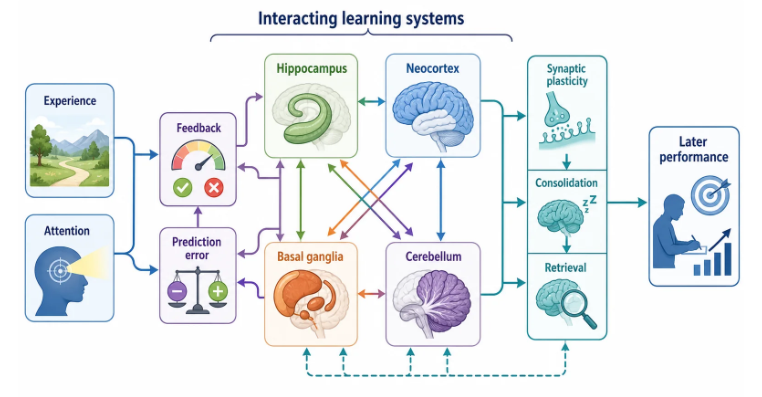
Ask someone to define “learning” and they’ll usually describe memorizing facts. But remembering a phone number, getting better at free throws, and learning to flinch at a sound you associate with pain are handled by different systems in the brain:
- Declarative learning — facts and events — leans heavily on hippocampal–cortical networks
- Procedural learning — skills and habits — depends more on basal ganglia circuits
- Movement refinement and prediction — recruits cerebellar circuits
- Perceptual and motor expertise — develops through cortical networks over repeated exposure
These systems interact constantly rather than working in isolation, and no single “learning center” runs the show. A study session that works well for memorizing vocabulary may do very little for a motor skill like typing, because different circuitry is doing the work.
What’s actually changing at the synapse
The physical basis of learning is synaptic plasticity — activity-driven changes in how strongly neurons communicate with each other. Long-term potentiation and depression, studied extensively in hippocampal circuits, are the best-known experimental examples, but they’re not the whole story. Learning also involves:
- Inhibitory plasticity (not just excitatory connections getting stronger)
- Neuromodulation — chemical signals that adjust how circuits respond
- Structural changes at the level of individual synapses
- Gene expression changes that stabilize new connections
- Reorganization across entire networks, not single synapses
It’s tempting to treat LTP as “the mechanism” of learning because it’s the most studied. It’s more accurate to think of it as one well-documented piece of a much larger, messier process.
The brain runs on being wrong
One of the more counterintuitive findings in learning research is how much depends on prediction error — the gap between what you expected and what actually happened. When an outcome differs from expectation, neural systems update predictions and action values accordingly.
Dopamine plays a role here, but calling it “the pleasure chemical” oversimplifies to the point of being misleading. Its effects on learning depend on which pathway is involved, which receptors are activated, the timing of the signal, and the specific task. Dopamine’s role in reinforcement learning is closer to “this outcome was better or worse than expected” than to “this feels good.”
Why some practice works and some doesn’t
Given how learning actually operates — through repeated, error-driven updating of connections — some study strategies line up with the biology better than others:
- Retrieval practice (testing yourself) tends to outperform passive rereading, because it forces the prediction-and-correction cycle that drives plasticity
- Spaced practice — revisiting material after a delay — gives consolidation processes room to work between sessions
- Feedback that arrives promptly helps the brain attribute the prediction error to the right decision
- Difficulty that’s high enough to require real retrieval, but not so high that you fail outright, seems to engage the system best
None of these effects are universal — they vary by material, learner, and context — but they’re consistent with what’s known about how plasticity and prediction-error learning actually function.
Sleep isn’t optional, but it’s not magic either
Learning doesn’t stop when practice ends. New learning stays fragile for a while afterward, and consolidation — including reactivation of neural patterns during sleep — helps stabilize or reorganize what was practiced. Sleep supports many kinds of learning tasks. It does not substitute for adequate practice, and it won’t rescue material that was never meaningfully encoded in the first place.
Getting better isn’t just about stronger synapses
Synaptic change explains part of learning, but not all of it. As people improve, they also discover underlying rules, chunk information into larger units, direct their attention more efficiently, and shift strategies — processes that aren’t fully captured by a diagram of two neurons and a strengthened connection between them. Instruction and language reshape learning in ways that go beyond synapse-level descriptions.
When learning doesn’t go as expected
Difficulty learning can stem from many sources unrelated to any single “learning circuit” — attention, sensory access, sleep quality, mood, language background, prior education, medication effects, or an underlying neurologic condition. A general description of how learning works in a typical brain isn’t a diagnostic tool, and persistent learning difficulty is worth discussing with a qualified professional rather than self-diagnosing from an educational article.
A common assumption is that all of this depends on growing new brain cells — but that’s not really what’s happening in everyday learning. Most of it plays out through changes in circuits that already exist; the birth of new neurons in the adult brain is real, but it’s a separate, narrower phenomenon that neuroscientists study on its own terms, not the engine behind ordinary studying or practice. And despite dopamine’s reputation as “the learning chemical,” no single neurotransmitter carries that role — dopamine matters in specific circuits, but learning depends on many signals and networks working in concert. If there’s a single practical takeaway from all of this, it’s that no one method fits every goal, but spaced retrieval with prompt feedback and meaningfully organized material has the strongest support across the research reviewed here.
Related: How Does the Brain Form Memories? · How Does the Brain Form Habits? · What Is Executive Function?
References
- Mayford M, Siegelbaum SA, Kandel ER. Synapses and Memory Storage. Cold Spring Harbor Perspectives in Biology. 2012;4:a005751.
- Ibrahim MZB, Benoy A, Sajikumar S. Long-term plasticity in the hippocampus. FEBS Journal. 2022;289:2176–2201.
- Squire LR, Genzel L, Wixted JT, Morris RG. Memory Consolidation. Cold Spring Harbor Perspectives in Biology. 2015;7:a021766.
- Doyon J, Benali H. Reorganization and plasticity in motor skill learning. Current Opinion in Neurobiology. 2005;15:161–167.
Written by: MedMaru Editorial Team
Reviewed for medical accuracy by:
S. Chang, KMD