How Does the Brain Form Memories?
A Memory Isn’t Stored Anywhere — It’s Reassembled Every Time
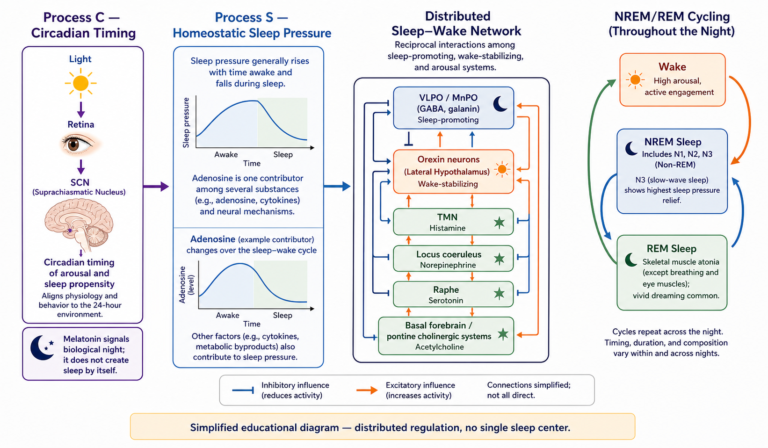
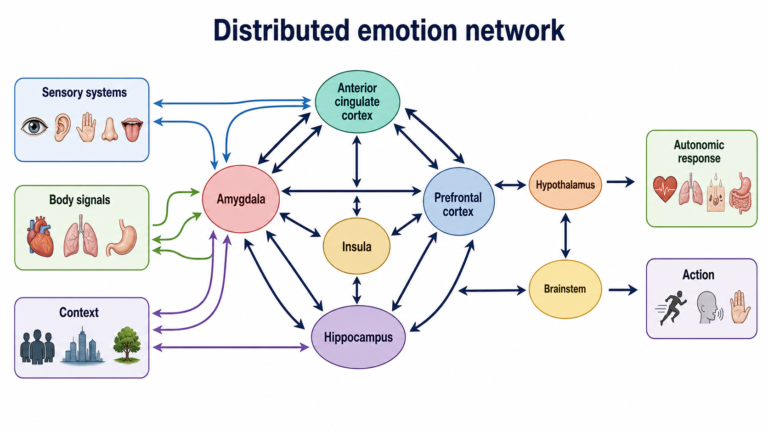
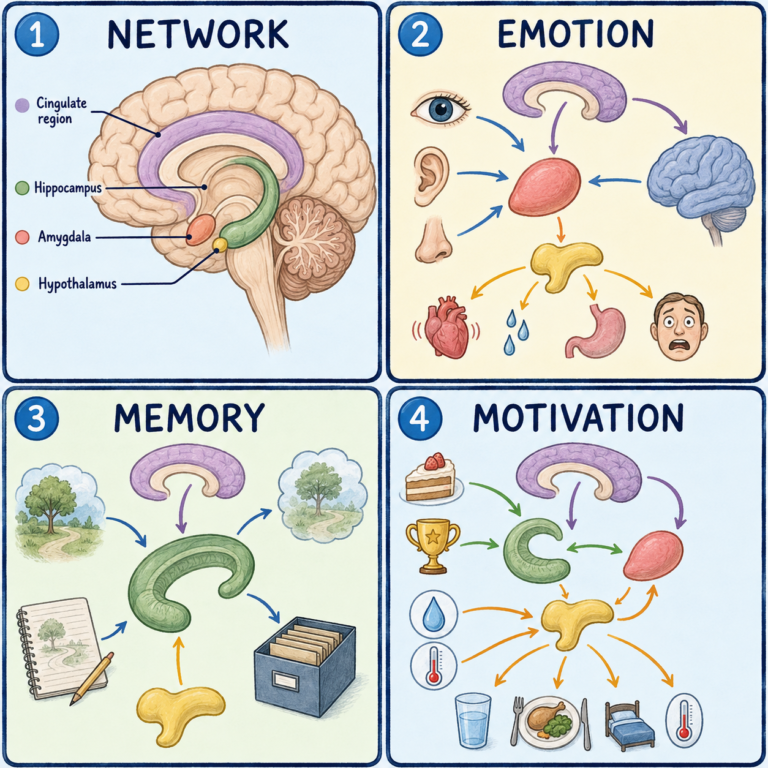
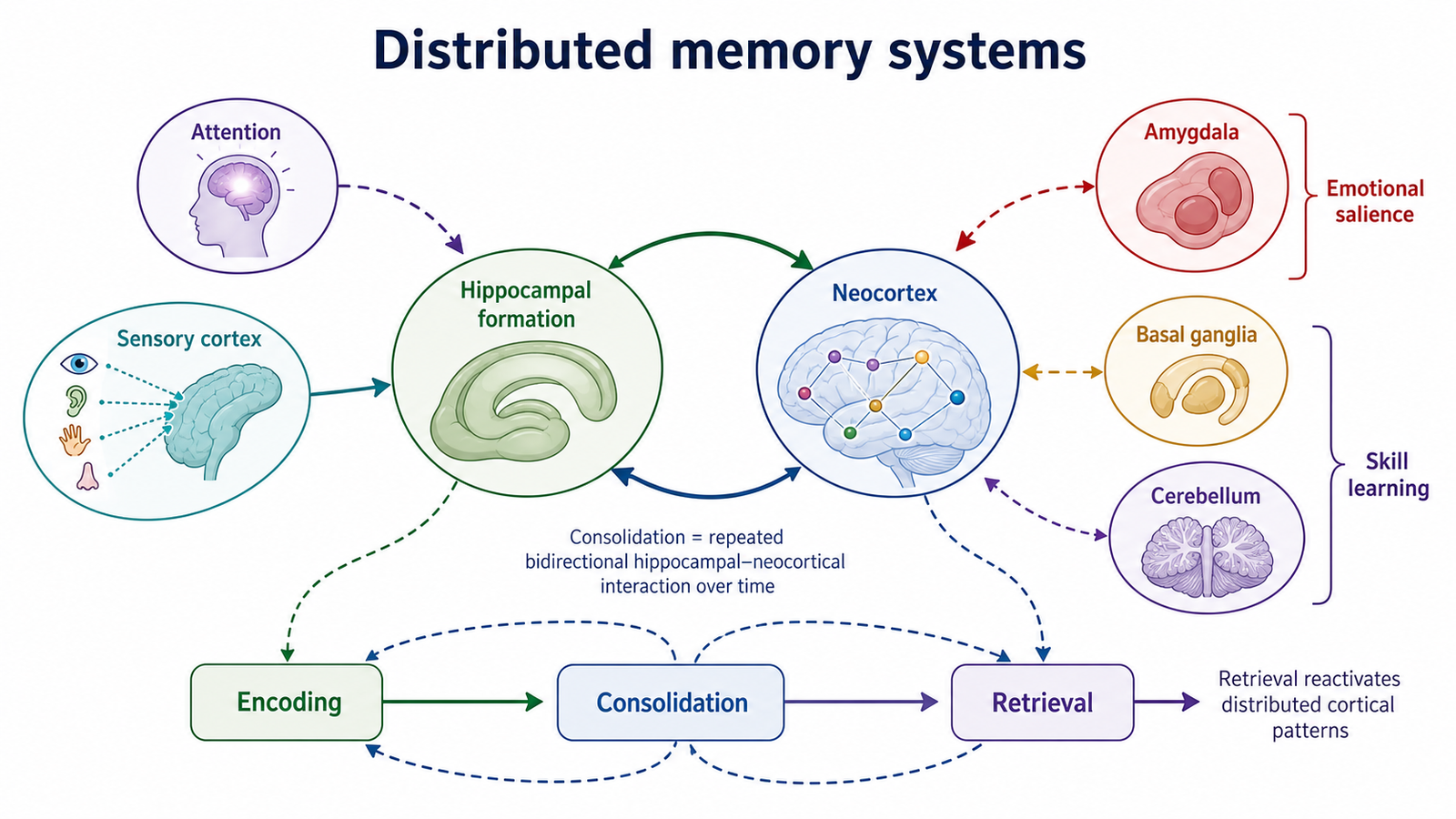
It’s natural to think of memory like a filing cabinet: something happens, it gets filed away, and later you pull the file back out unchanged. That’s not how it works. Forming a memory means encoding it, stabilizing it, storing it across a distributed network, and later reconstructing it — and each of those stages can change what you end up with. No single brain region does all of this. The hippocampal formation is especially important for rapidly linking the elements of new episodic and factual memories, distributed cortical networks hold their sensory and conceptual content, the amygdala can weight emotional significance, and the basal ganglia, cerebellum, and motor networks handle skills and habits separately from all of that.
Memory isn’t one system
“Memory” covers several distinct systems that overlap but don’t run on the same circuitry. Working memory temporarily holds and manipulates information for whatever you’re doing right now. Episodic memory covers events and their context; semantic memory covers facts and concepts, independent of when or where you learned them. Procedural memory underlies skills and habits. These interact constantly, but they lean on hippocampal, cortical, striatal, cerebellar, and prefrontal networks to different degrees — which is part of why someone can lose one kind of memory while another stays intact.
Encoding is selective, not comprehensive
Attention determines a lot of what gets encoded in the first place — new information gets tied to context, meaning, existing knowledge, and current goals, not recorded indiscriminately. Contrary to the filing-cabinet image, the hippocampus isn’t storing a complete permanent recording of an experience; it’s rapidly linking together distributed cortical patterns that represent the people, places, objects, and events involved, so the “memory” lives across that network rather than in one place.
What gets encoded is still fragile
New memories start out vulnerable to interference. Cellular consolidation — molecular and synaptic changes unfolding over hours — stabilizes them at a small scale, while systems consolidation describes a much longer-term reorganization of how the hippocampus and neocortex interact. Sleep supports this process, but sleep is not a guarantee that everything you experienced during the day becomes a durable memory; it helps consolidate what’s there, it doesn’t manufacture memories from nothing.
Plasticity is a real mechanism, not the whole story
Long-term potentiation and long-term depression — activity-dependent changes in synaptic strength — are the best-studied experimental models for how experience strengthens or weakens neural connections. They’re genuinely useful models. They’re also not a complete explanation: no single plasticity mechanism accounts for the full range of human memory.
Recall rebuilds the memory, it doesn’t replay it
When a cue reactivates part of a stored network, the brain reconstructs the memory from stored information plus whatever context you’re in right now — which is exactly why recall can come out incomplete or distorted rather than as a faithful replay. Retrieval can even make a memory temporarily modifiable before it restabilizes, a process called reconsolidation, though the details and full significance of that process are still active areas of research.
When memory trouble means something more
Difficulty with memory can come from sleep loss, stress, medication, mood, sensory loss, neurologic disease, and plenty of other ordinary causes — it isn’t automatically a sign of something serious. Sudden confusion or an acute loss of memory is different and needs urgent medical assessment; this article is educational and isn’t equipped to determine a cause for any individual case.
Related: How Does the Brain Learn? · How Does the Brain Create Emotions? · How Does the Brain Form Habits?
References
- Camina E, Güell F. Physiology, Long Term Memory. StatPearls. NCBI Bookshelf.
- Squire LR, Genzel L, Wixted JT, Morris RG. Memory Consolidation. Cold Spring Harbor Perspectives in Biology. 2015;7:a021766.
- Mayford M, Siegelbaum SA, Kandel ER. Synapses and Memory Storage. Cold Spring Harbor Perspectives in Biology. 2012;4:a005751.
- Ibrahim MZB, Benoy A, Sajikumar S. Long-term plasticity in the hippocampus. FEBS Journal. 2022;289:2176-2201.
Written by: MedMaru Editorial Team
Reviewed for medical accuracy by:
S. Chang, KMD