Limbic System: Location, Function, and Anatomy
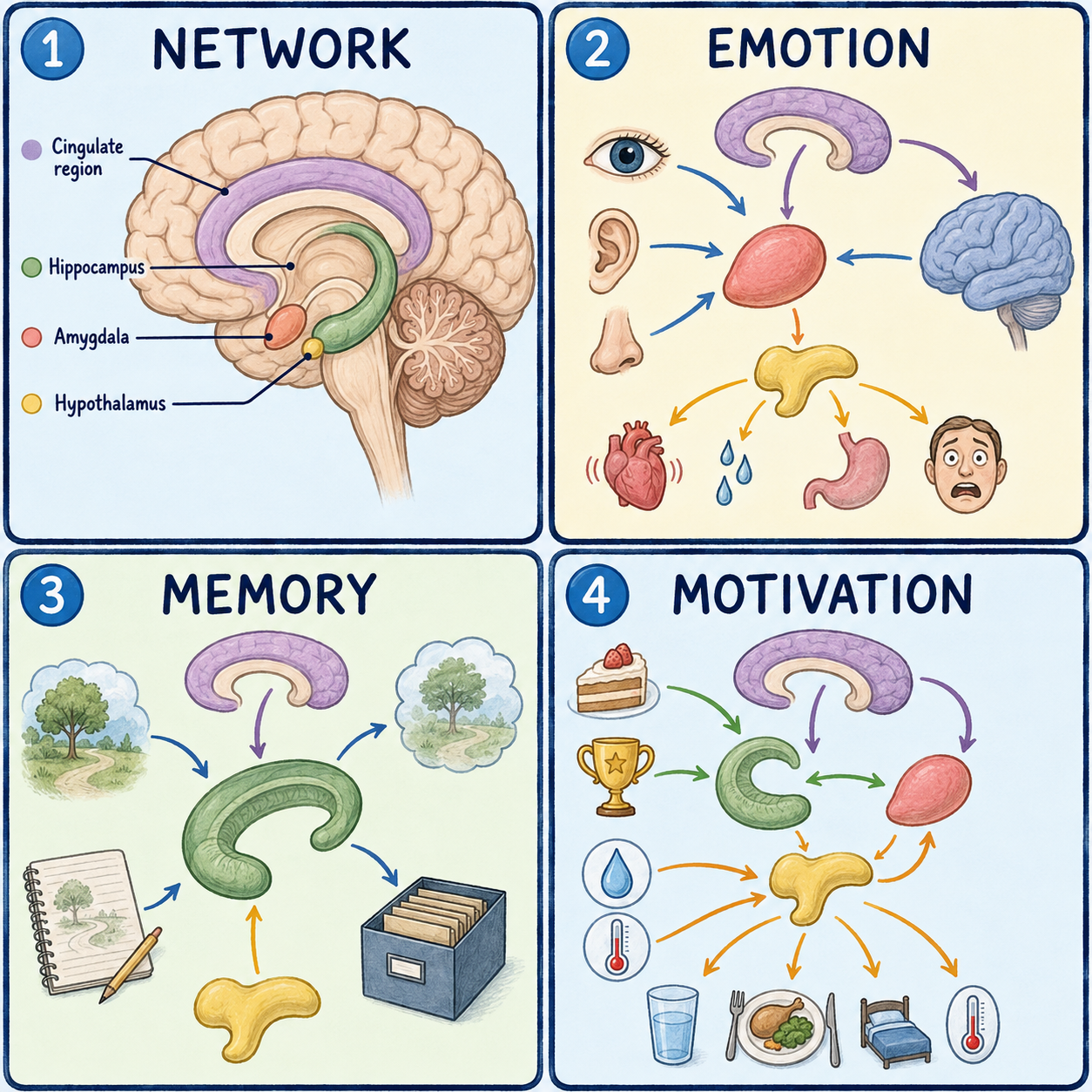
The limbic system isn’t a single structure you can point to. It is a group of brain structures, including the hippocampus, the amygdala, the hypothalamus, and parts of the cerebral cortex, that work together in emotion, memory, and motivation. Textbooks group them because damage to one often affects how the others function. Modern neuroscience, though, treats “limbic system” more as a useful teaching label than as a precisely bounded anatomical system, and different sources don’t always agree on exactly which structures belong in it.
Why these structures are grouped together
Imagine five students on a school project team. Each has a different job: one makes the poster, one runs the experiment, one writes the report. They are graded as one team because of how well they work together, even though they sit in different seats. The limbic system works in a similar way. The comparison has a limit, of course: brain structures don’t divide tasks neatly, and each one also works on other “projects” outside the team.
The term refers to a set of structures along the inner edge of the cerebrum, between the outer thinking layer, the cerebral cortex, and the deeper brainstem structures that keep basic body functions running. They are not one continuous piece of tissue. They are separate structures in different locations, densely wired to one another, that tend to become active together during tasks involving emotion, motivation, and memory.
The structures most sources agree on each bring something different. The hippocampus plays a central role in turning experience into long-term memory. The amygdala is central to processing strong emotions such as fear. The hypothalamus regulates hormones, hunger, thirst, and the body’s stress response. The cingulate cortex, a strip of cortex on the inner surface of the brain, links emotion with attention and decision-making. The thalamus, a relay station that passes sensory information to the cortex, is often included too; the hypothalamus and thalamus are covered in the diencephalon article.
The word limbic comes from the Latin limbus, meaning border or edge, which describes how these structures sit at the boundary between the cortex and the deeper brain. Knowing that a structure belongs to the limbic system is a starting point for understanding its role in emotion or memory, not a complete description. The same structures are also deeply involved in functions that have little to do with emotion, including cognition, motor regulation, and basic survival.
A concept built by history, not discovery
Structures this different in appearance and location weren’t grouped together for anatomical reasons. The reasons are historical.
In 1878, the French physician Paul Broca named a ring of cortex encircling the brainstem the “grand lobe limbique,” simply because of its border-like shape, not to describe an emotional center. In 1937, the physician James Papez proposed that a loop connecting the hippocampus, hypothalamus, anterior thalamus, and cingulate cortex generated emotional experience. That loop is now known as the Papez circuit. Between 1949 and 1952, the physiologist Paul MacLean expanded on Papez’s circuit, added structures such as the amygdala, and coined the term “limbic system” for a network dedicated to emotion.
MacLean later proposed the “triune brain” theory in 1969. It suggested the brain evolved in three layers stacked like floors of a house: an old “reptilian” layer for instinct, a “limbic” layer for emotion, and a modern cortex for reason. The idea became popular in psychology books and science writing, but it doesn’t hold up well. Structures once assigned to the reptilian layer, such as the basal ganglia, are found across all vertebrates, and birds and reptiles show complex learning and flexible behavior that a purely instinct-driven model can’t explain. Most comparative neuroscientists today regard the triune brain as a persistent myth about brain evolution, not an accurate account of it.
The triune idea also left behind a popular misconception: that the limbic system is a tidy “emotional brain” cleanly separated from a “thinking” cortex. In reality, emotion and cognition are intertwined throughout the brain. It is more accurate to think of the limbic system as shorthand for a functionally related group of structures than as an emotional layer bolted onto a more advanced brain.
Later in the 20th century, some neuroscientists argued that the limbic system concept itself lacks a consistent structural or functional boundary. Some limbic structures, like the hippocampus, turned out to be more central to memory than to emotion. Some clearly emotional processes, like fear responses generated by the amygdala, don’t depend on the full classic Papez circuit. The limbic system was never discovered as a single anatomical unit the way an organ like the liver was. It was assembled as a teaching concept from structures that seemed to share a family resemblance.
Which structures belong, and why the list isn’t fixed
There is no single official membership list, which is part of why the concept is still debated. Depending on which historical layer a textbook uses as its reference point, whether Broca’s lobe, Papez’s circuit, or MacLean’s expanded system, the list changes. The hippocampus, amygdala, and hypothalamus are almost always included. The cingulate cortex, the thalamus (particularly its anterior nuclei), the fornix, and the mammillary bodies, small paired structures connected to the hippocampus and thalamus that take part in memory, are commonly included as well, though sources differ at the edges.
What this means in medicine
The history has a practical consequence. Because “limbic system” is a functional label rather than a fixed anatomical package, a phrase like “limbic system damage” in an MRI report or a research paper shouldn’t be assumed to mean the same set of structures every time. A stroke, tumor, or injury can affect one limbic structure without touching the others, and the symptoms depend on which one is involved. Memory problems point toward the hippocampus. Exaggerated fear or a blunted emotional response points toward the amygdala. Disrupted appetite, sleep, or stress-hormone regulation points toward the hypothalamus.
Because these structures are involved in memory, emotion regulation, and the stress response, they also come up in research on several conditions, including Alzheimer’s disease, anxiety disorders, depression, post-traumatic stress disorder, schizophrenia, and substance use disorders. How each condition relates to particular limbic structures is an active area of research, and in many cases the mechanisms are still being worked out. A structure being involved in a condition is not the same as it being the cause.
This article is educational background, not a diagnostic guide. New memory problems, marked changes in mood or behavior, or disturbed appetite and sleep should be discussed with a clinician.
Related: What Is the Cerebral Cortex? · What Is the Brain? · What Is the Cerebrum?
References
- StatPearls. “Neuroanatomy, Limbic System.” NCBI Bookshelf, NBK538491 — https://www.ncbi.nlm.nih.gov/books/NBK538491/
- Morgane, P.J., Galler, J.R., Mokler, D.J. “The Limbic System Conception and Its Historical Evolution.” PMC3236374 — https://pmc.ncbi.nlm.nih.gov/articles/PMC3236374/
- Cleveland Clinic. “Limbic System.” — https://my.clevelandclinic.org/health/body/limbic-system
Written by: MedMaru Editorial Team
Reviewed for medical accuracy by:
S. Chang, KMD