Diencephalon: Anatomy, Parts, and Function
What Is the Diencephalon?
Introduction
Deep within the center of the brain lies a relatively small but critically important region called the diencephalon.
Although it occupies far less space than the cerebrum, the diencephalon serves as a central hub that connects many parts of the nervous system. Nearly every sensory signal traveling to the cerebral cortex passes through it, and it also helps regulate body temperature, hunger, thirst, sleep, hormone secretion, and autonomic nervous system activity.
The diencephalon acts as a bridge between higher brain centers and the brainstem, helping the body maintain stable internal conditions while processing information from both the external and internal environment.
Understanding the diencephalon is essential for learning neuroanatomy because many important brain structures—including the thalamus and hypothalamus—are located within this region.
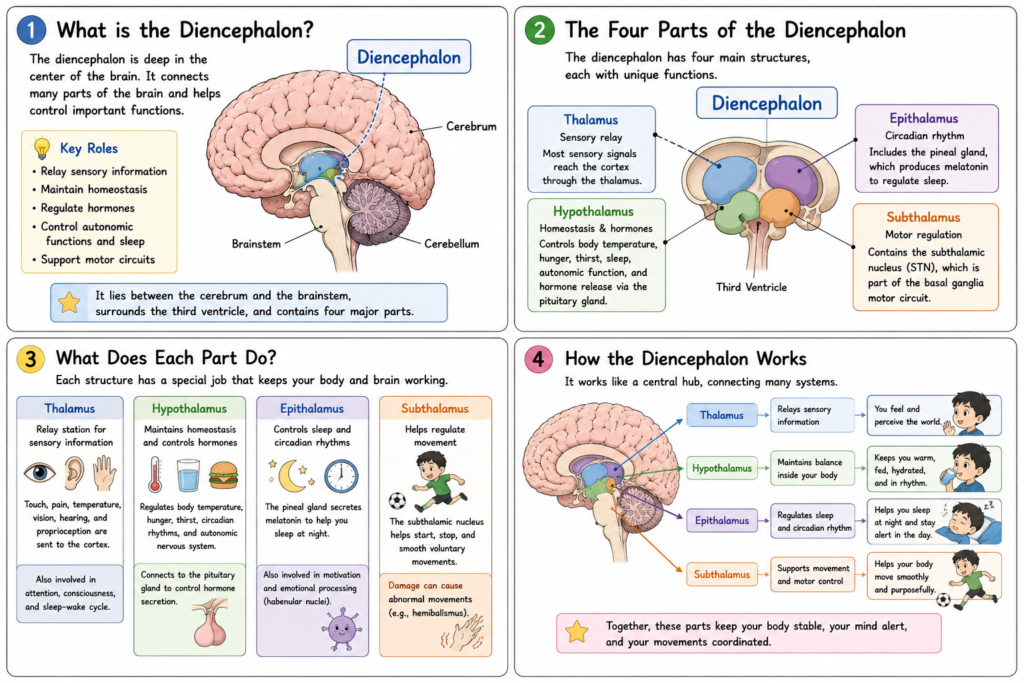
The diencephalon is a central part of the brain located between the cerebrum and the brainstem. It includes the thalamus, hypothalamus, epithalamus, and subthalamus, which together regulate sensory relay, homeostasis, endocrine function, autonomic control, sleep, and motor circuits.
What Is the Diencephalon?
The diencephalon is one of the four major anatomical divisions of the brain.
It surrounds the third ventricle and lies beneath the cerebral hemispheres and above the midbrain.
Although relatively compact, it contains several structures that play essential roles in maintaining life and coordinating communication throughout the nervous system.
Anatomy of the Diencephalon
The diencephalon consists of four major components.
- Thalamus
- Hypothalamus
- Epithalamus
- Subthalamus
Each structure performs distinct but interconnected functions.
1. Thalamus
The thalamus is the largest structure within the diencephalon.
It functions as the brain’s principal relay station.
Most sensory information—including touch, pain, temperature, vision, hearing, and proprioception—is processed through the thalamus before reaching the cerebral cortex.
The thalamus also participates in:
- Motor control
- Attention
- Consciousness
- Sleep-wake regulation
- Cognitive processing
One important exception is olfaction (smell), which reaches the cortex without first passing through the thalamus.
2. Hypothalamus
The hypothalamus is located beneath the thalamus.
Although small, it is one of the body’s most important regulatory centers.
It maintains homeostasis by controlling:
- Body temperature
- Hunger
- Thirst
- Circadian rhythms
- Sleep
- Endocrine function
- Autonomic nervous system activity
The hypothalamus communicates directly with the pituitary gland, allowing the nervous system to influence hormone secretion throughout the body.
3. Epithalamus
The epithalamus forms the posterior portion of the diencephalon.
Its best-known structure is the pineal gland, which produces melatonin, a hormone involved in regulating the sleep-wake cycle.
The epithalamus also includes the habenular nuclei, which participate in reward processing, motivation, and emotional regulation.
4. Subthalamus
The subthalamus lies below the thalamus and above the midbrain.
It contains the subthalamic nucleus (STN), an important component of the basal ganglia motor circuit.
The subthalamus helps regulate:
- Voluntary movement
- Motor planning
- Movement inhibition
Damage to the subthalamic nucleus may produce hemiballismus, a rare movement disorder characterized by violent involuntary limb movements.
How the Diencephalon Works
The four components of the diencephalon continuously exchange information with the cerebral cortex, brainstem, cerebellum, and spinal cord.
For example:
- The thalamus relays sensory information to the cortex.
- The hypothalamus regulates internal body functions.
- The epithalamus helps regulate sleep.
- The subthalamus participates in motor control.
Together, they integrate sensory, autonomic, endocrine, and motor information to support normal brain function.
Why the Diencephalon Is Important
Although relatively small, the diencephalon is essential for survival.
It allows the brain to:
- Process sensory information
- Maintain body temperature
- Regulate hunger and thirst
- Control hormone secretion
- Coordinate autonomic functions
- Support normal movement
- Regulate sleep and circadian rhythms
Nearly every moment of daily life depends on one or more diencephalic structures.
Clinical Relevance
Disorders affecting the diencephalon can produce a wide variety of neurological and endocrine symptoms.
Examples include:
- Thalamic stroke
- Hypothalamic tumors
- Sleep disorders
- Diabetes insipidus
- Parkinson disease (subthalamic nucleus circuitry)
- Hemiballismus
- Pineal gland tumors
Symptoms depend on the specific structure involved.
Common Misunderstandings
“The thalamus only relays sensory information.”
Not entirely.
The thalamus also participates in motor control, attention, cognition, and consciousness.
“The hypothalamus only controls hormones.”
Incorrect.
The hypothalamus regulates endocrine function, but it also controls autonomic function, body temperature, hunger, thirst, and sleep.
“The diencephalon consists only of the thalamus.”
Incorrect.
The diencephalon contains four major anatomical structures:
- Thalamus
- Hypothalamus
- Epithalamus
- Subthalamus
- The diencephalon is located between the cerebrum and the brainstem.
- It consists of the thalamus, hypothalamus, epithalamus, and subthalamus.
- The thalamus is the major sensory relay station of the brain.
- The hypothalamus regulates homeostasis and endocrine function.
- The epithalamus contributes to circadian rhythm regulation.
- The subthalamus participates in basal ganglia motor circuits.
Related Articles
- What Are the Major Parts of the Brain?
- What Is the Cerebrum?
- What Is the Brainstem? Structure and Function
References
- Standring S, ed. Gray’s Anatomy: The Anatomical Basis of Clinical Practice. 42nd ed. Elsevier; 2020.
- Bui T, Das JM. Neuroanatomy, Cerebral Hemisphere. StatPearls. NCBI Bookshelf.
- Physiology, Sensory System. StatPearls. NCBI Bookshelf.
Written by: MedMaru Editorial Team
Reviewed for medical accuracy by:
S. Chang, KMD