
What Is the Peripheral Nervous System? Functions and Types
What Is the Peripheral Nervous System?
Introduction
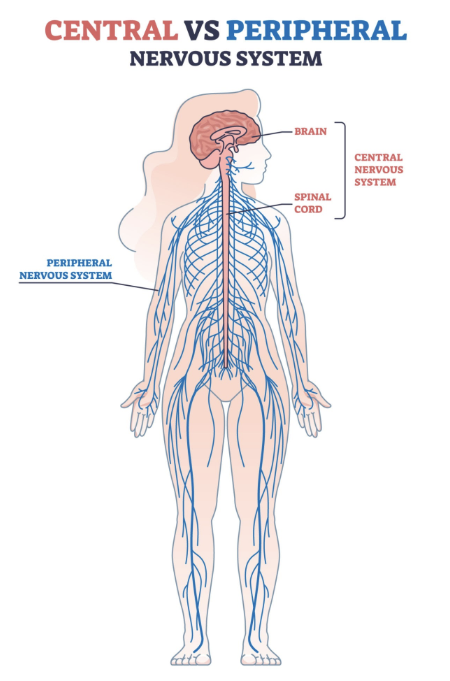
The human nervous system is divided into two major parts: the central nervous system (CNS) and the peripheral nervous system (PNS). While the brain and spinal cord act as the body’s control center, they cannot communicate with the rest of the body without the peripheral nervous system.
The peripheral nervous system forms an extensive network of nerves that extends throughout the body. It carries sensory information from the skin, muscles, and internal organs to the brain and spinal cord, and delivers motor commands from the central nervous system back to muscles and glands.
Understanding the peripheral nervous system helps explain how we feel touch, move our muscles, maintain posture, and regulate many automatic body functions.
The peripheral nervous system (PNS) includes all nerves outside the brain and spinal cord. It connects the central nervous system with the rest of the body by carrying sensory information to the brain and spinal cord and transmitting motor commands to muscles, glands, and organs.
What Is the Peripheral Nervous System?
The peripheral nervous system consists of every neural structure located outside the central nervous system.
It includes:
- Cranial nerves
- Spinal nerves
- Peripheral nerves
- Sensory ganglia
- Autonomic ganglia
Together, these structures create a communication network linking the brain and spinal cord with every part of the body.
Major Components of the Peripheral Nervous System
Cranial Nerves
The peripheral nervous system includes 12 pairs of cranial nerves, which arise directly from the brain or brainstem.
These nerves control sensation and movement in the head and neck, while several also regulate important internal organs such as the heart, lungs, and digestive system.
Spinal Nerves
There are 31 pairs of spinal nerves that emerge from the spinal cord.
They distribute sensory and motor information throughout the neck, trunk, arms, and legs, allowing the brain to communicate with the entire body.
Peripheral Nerves
Peripheral nerves are bundles of thousands of individual nerve fibers (axons).
Some carry sensory information toward the central nervous system, while others carry motor commands away from it.
Many peripheral nerves contain both sensory and motor fibers.
Ganglia
Ganglia are collections of neuron cell bodies located outside the central nervous system.
Sensory ganglia contain the cell bodies of sensory neurons, whereas autonomic ganglia relay signals that regulate involuntary body functions.
How the Peripheral Nervous System Works
The peripheral nervous system serves as the communication pathway between the body and the central nervous system.
Its function can be summarized in two directions.
Sensory (Afferent) Pathway
Sensory receptors detect information such as touch, temperature, pain, vibration, body position, light, and sound.
This information travels through peripheral nerves to the spinal cord and brain for processing.
Motor (Efferent) Pathway
After the brain processes incoming information, motor commands travel through peripheral nerves to muscles and glands.
These commands allow us to move, maintain posture, speak, and respond to changes in the environment.
Divisions of the Peripheral Nervous System
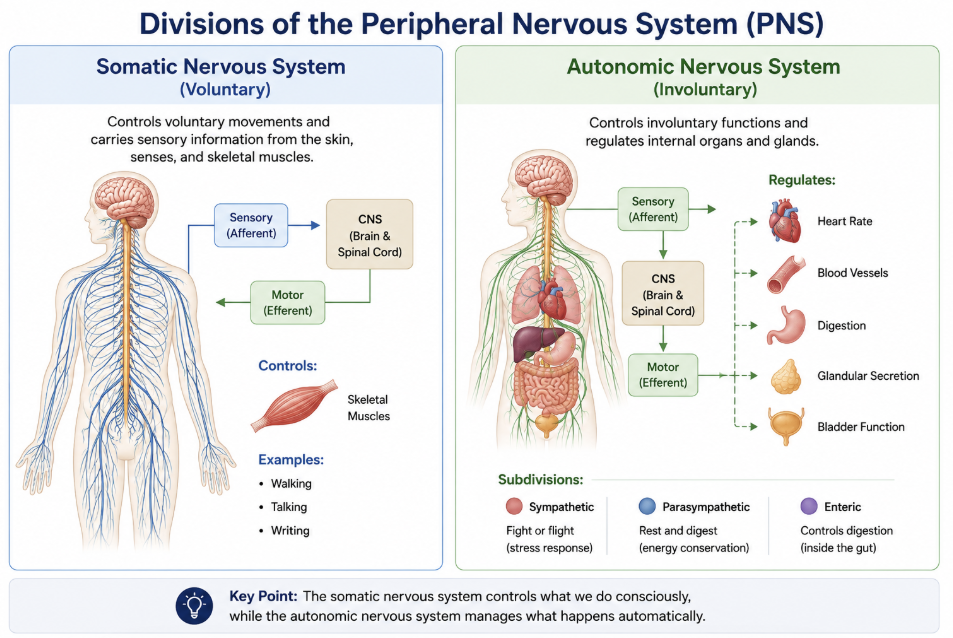
The peripheral nervous system is commonly divided into two major functional systems.
Somatic Nervous System
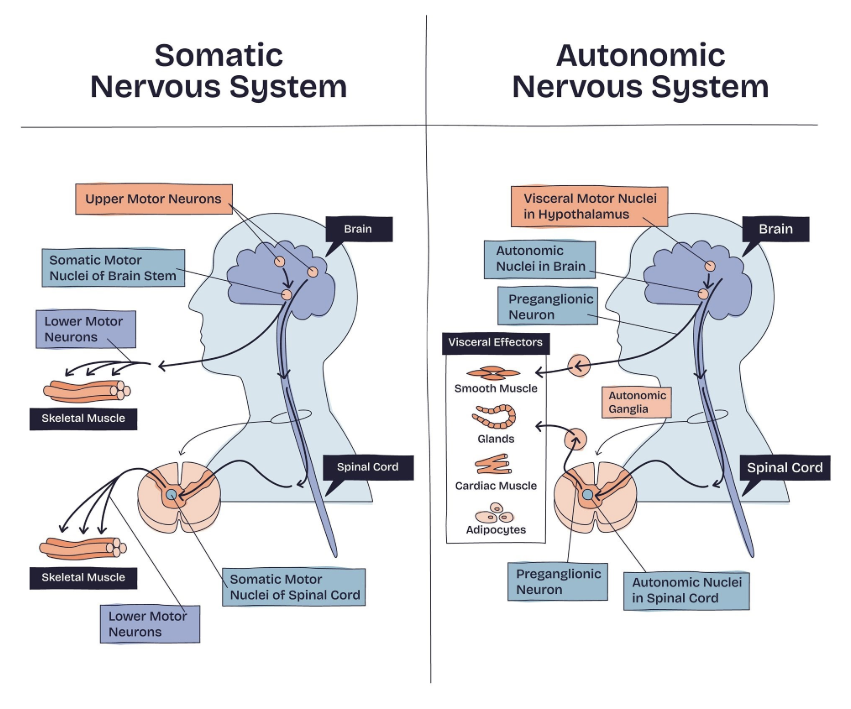
The somatic nervous system controls voluntary movement.
It carries sensory information from the skin, joints, and skeletal muscles and sends motor commands to skeletal muscles.
Examples include walking, writing, speaking, and picking up an object.
Autonomic Nervous System
The autonomic nervous system regulates involuntary body functions.
It controls smooth muscle, cardiac muscle, and glands without conscious effort.
Functions include:
- Heart rate
- Blood pressure
- Digestion
- Breathing
- Pupil size
- Sweating
The autonomic nervous system is further divided into the sympathetic, parasympathetic, and enteric nervous systems.
Why the Peripheral Nervous System Is Important
Without the peripheral nervous system, the brain would not receive information from the body, nor would it be able to control muscles or organs.
Every sensation, voluntary movement, and automatic body function depends on healthy communication through peripheral nerves.
The PNS is therefore essential for maintaining normal interaction between the body and the central nervous system.
Clinical Relevance
Many disorders affect the peripheral nervous system.
Common examples include:
- Peripheral neuropathy
- Carpal tunnel syndrome
- Bell’s palsy
- Guillain–Barré syndrome
- Sciatica
- Traumatic nerve injuries
These conditions may cause numbness, weakness, pain, tingling, or loss of normal muscle function depending on the nerves involved.
Common Misunderstandings
“The peripheral nervous system only controls movement.”
Not true.
The PNS carries both sensory information to the central nervous system and motor commands back to the body.
“Peripheral nerves are all voluntary.”
Incorrect.
While the somatic nervous system controls voluntary movement, the autonomic nervous system regulates involuntary functions such as heart rate, digestion, and blood pressure.
- The peripheral nervous system includes all nerves outside the brain and spinal cord.
- It connects the central nervous system with the rest of the body.
- Sensory nerves carry information to the CNS, while motor nerves carry commands to muscles and organs.
- The PNS includes both the somatic and autonomic nervous systems.
- Healthy peripheral nerves are essential for normal sensation, movement, and automatic body functions.
Related Articles
- What Is the Central Nervous System?
- What Is a Neuron?
- How Do Neurons Communicate?
- What Is a Reflex Arc?
- What Is the Autonomic Nervous System?
References
- Standring S, ed. Gray’s Anatomy: The Anatomical Basis of Clinical Practice. 42nd ed. Elsevier; 2020.
- Akinrodoye MA, Lui F. Neuroanatomy, Somatic Nervous System. StatPearls. Updated November 7, 2022.
- Anatomy, Autonomic Nervous System. StatPearls. NCBI Bookshelf.
Written by: MedMaru Editorial Team
Reviewed for medical accuracy by:
S. Chang, KMD