How Does the Brain Produce Fear?
Fear Doesn’t Wait for You to Notice It
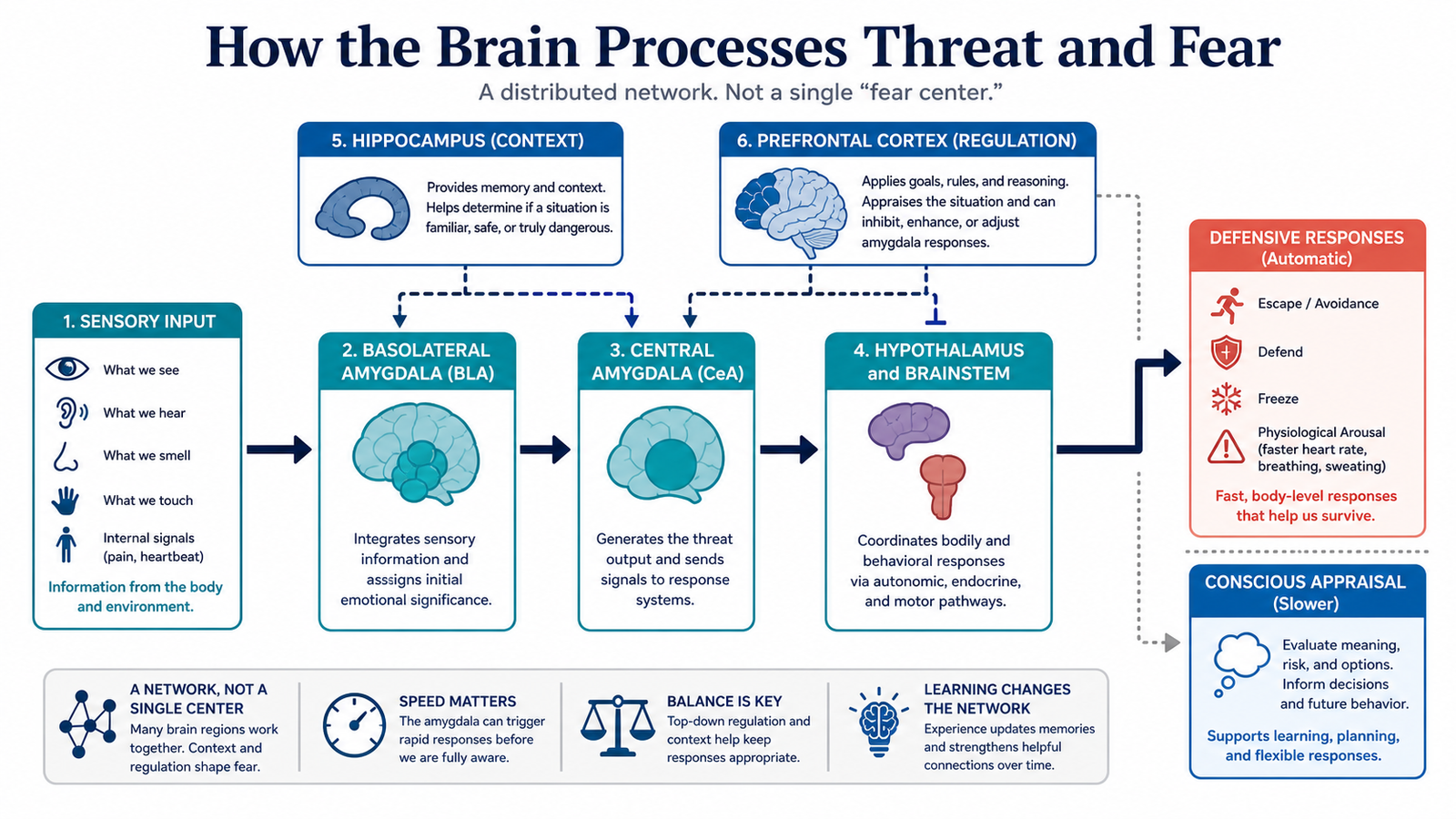
By the time you consciously register that something is dangerous, your body may already be reacting to it. That gap is a clue to how fear actually works: it isn’t produced by one “fear center,” but by threat-related sensory signals, memory, context, prediction, attention, and bodily state interacting across a network. Amygdala circuits are important for detecting learned threat significance and organizing defensive responses, the hippocampus contributes context, prefrontal regions regulate appraisal and extinction, and hypothalamic and brainstem pathways coordinate the autonomic, hormonal, and behavioral responses that follow.
Detecting and interpreting threat
Sensory systems first analyze sights, sounds, touch, smell, and internal signals, and that information can reach amygdala circuits through multiple cortical and subcortical routes. The basolateral amygdala helps associate cues with aversive outcomes, and central amygdala outputs influence hypothalamic and brainstem systems that change heart rate, breathing, vigilance, freezing, escape, and stress-hormone responses — some of which can begin before a person has fully identified what’s actually threatening, though simple “low road/high road” diagrams shouldn’t be mistaken for a complete account of how this works in humans.
Critically, the amygdala doesn’t work alone and isn’t equivalent to the conscious feeling of fear — that’s a common conflation worth correcting directly, since the amygdala is really an important network node rather than the seat of the feeling itself. The hippocampus helps distinguish contexts — whether a sound occurs in a safe place or a dangerous one, say — while prefrontal and cingulate regions contribute appraisal, attention, action selection, and regulation, and the insula helps represent bodily state. Conscious fear reports likely emerge from broader cortical processing, and scientists continue to debate how subjective feeling relates to these defensive circuits.
Learning, safety, and why fear can return
Threat conditioning occurs when a previously neutral cue comes to predict an aversive event, and later that cue alone can trigger defensive responses. Extinction — what happens when the cue stops predicting danger — is new safety learning layered on top of the original memory, not an erasure of it. Amygdala inhibitory circuits, hippocampal context signals, and medial prefrontal networks together determine whether threat or safety memory ends up controlling behavior in a given moment, which is exactly why a fear that seemed resolved can resurface in a different context or after time has passed — the underlying threat memory was never actually deleted.
Innate defensive predispositions and learned fear overlap but aren’t identical, and real-world fear depends on expectations, culture, prior experience, controllability, and current bodily condition on top of the circuitry itself. Not every strong fear is pathological.
When fear becomes a clinical concern
Persistent, disproportionate fear, avoidance, panic, or trauma symptoms can be genuinely disabling, but brain-circuit descriptions like this one can’t diagnose an anxiety disorder in any individual case — evidence-based assessment has to weigh symptoms, duration, impairment, medical factors, and context together. Immediate danger or thoughts of self-harm require urgent local help.
Related: How Does the Brain Create Emotions? · How Does the Brain Form Memories? · How Does the Brain Control the Autonomic Nervous System?
References
- Duvarci S, Paré D. Amygdala microcircuits controlling learned fear. Neuron. 2014;82:966-980.
- Marek R, Strobel C, Bredy TW, Sah P. The amygdala and medial prefrontal cortex: partners in the fear circuit. Journal of Physiology. 2013;591:2381-2391.
- LeDoux JE, Pine DS. Using neuroscience to help understand fear and anxiety: a two-system framework. American Journal of Psychiatry. 2016;173:1083-1093.
- Tovote P, Fadok JP, Lüthi A. Neuronal circuits for fear and anxiety. Nature Reviews Neuroscience. 2015;16:317-331.
Written by: MedMaru Editorial Team
Reviewed for medical accuracy by:
S. Chang, KMD