
Temporal Lobe: Location, Function, and Anatomy
Explore temporal lobe location, anatomy, auditory and language processing, memory functions, major pathways, and effects of temporal lobe injury.
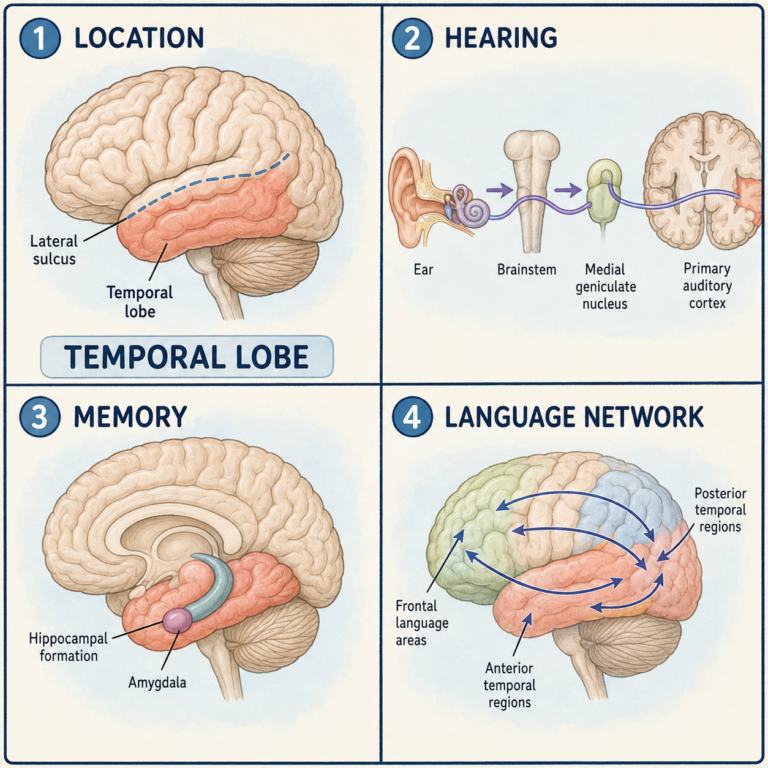
Explore temporal lobe location, anatomy, auditory and language processing, memory functions, major pathways, and effects of temporal lobe injury.
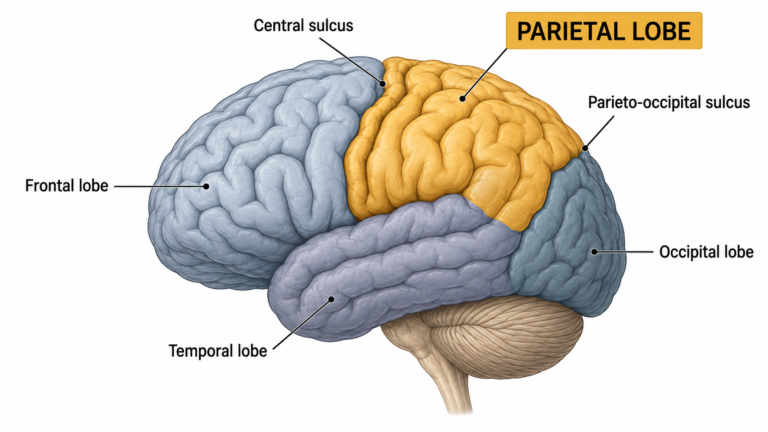
The parietal lobe sits under the top and back of your skull, between your ears and the back of your head. Its main job is taking in feelings from your body, such as touch, pressure, and where your limbs are in space, and combining them with what you see. That lets your brain build one…
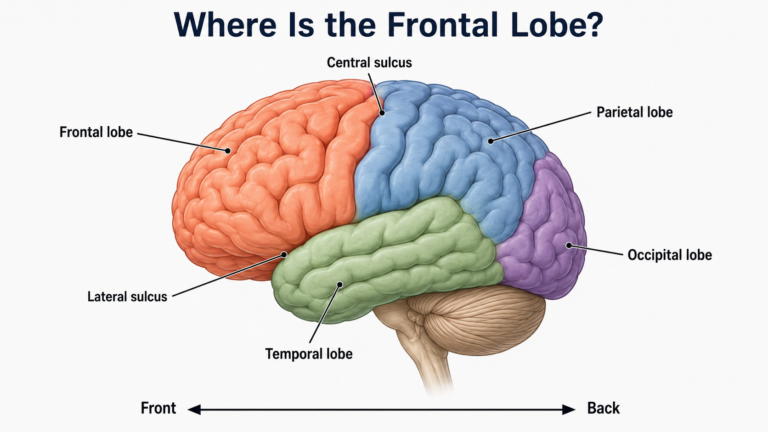
The frontal lobe is the front section of the brain, sitting roughly behind your forehead. It does two very different jobs at once. It moves your body on purpose, and it helps you plan, judge situations, and hold back impulses you’d regret acting on. Everyone has two frontal lobes, one behind each side of the…
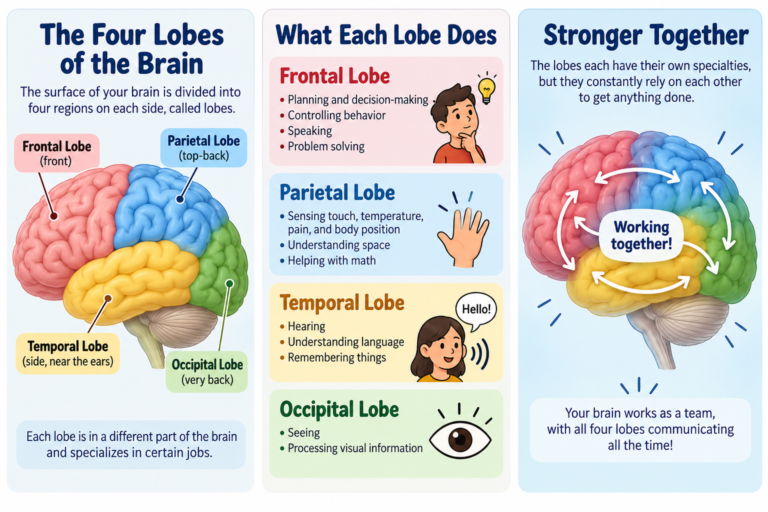
The surface of your brain is divided into four large regions on each side, called lobes. The frontal lobe sits at the front, the parietal lobe at the top and back, the temporal lobe at the side near the ears, and the occipital lobe at the very back. Each one specializes in certain jobs, a…
A single neuron can receive, process, and pass on a signal, but almost nothing the nervous system does can be achieved by one neuron alone. Seeing a face, taking a step, or remembering a phone number all emerge from groups of interconnected neurons working together. These groups are called neural circuits. A neural circuit is…
Neurons talk to each other with chemical messengers such as glutamate, GABA, dopamine, serotonin, and acetylcholine. But a chemical message is useless unless someone can read it. A messenger can only affect a cell that carries a receptor able to recognize it. Neural receptors are proteins that recognize neurotransmitters and other signaling molecules and turn…
“Balance” Doesn’t Mean Equal Amounts It’s tempting to picture excitation-inhibition balance as a scale with equal weight on both sides — half the signals pushing neurons to fire, half holding them back. That picture is wrong, and it matters that it’s wrong: real circuits don’t aim for a fixed 50/50 ratio anywhere in the brain….
A single neuron can receive thousands of signals from other cells at once. Some push it toward firing, while others hold it back or regulate how much the excitatory signals count. The neuron is constantly combining these inputs before it “decides” whether to send an action potential of its own. This process is called synaptic…
Neurons are constantly receiving signals from other cells, and those signals come in two broad flavors. An excitatory signal makes a neuron more likely to fire an action potential. An inhibitory signal makes it less likely. Excitatory inputs usually produce an excitatory postsynaptic potential, or EPSP, and inhibitory inputs usually produce an inhibitory postsynaptic potential,…