
What Is the Autonomic Nervous System? Functions and Divisions
What Is the Autonomic Nervous System?
Introduction
Your heart continues beating while you sleep. Your lungs keep breathing without conscious effort. Your stomach digests food, your pupils adjust to changes in light, and your blood pressure is continuously regulated.
These essential processes occur automatically because they are controlled by the autonomic nervous system (ANS).
The autonomic nervous system is a functional division of the peripheral nervous system that regulates the activity of internal organs, smooth muscle, cardiac muscle, and glands. Unlike the somatic nervous system, which controls voluntary movement, the autonomic nervous system operates largely outside conscious awareness to maintain the body’s internal balance.
Understanding the autonomic nervous system is essential for learning how the body responds to stress, conserves energy, regulates organ function, and maintains homeostasis.
The autonomic nervous system (ANS) is the division of the peripheral nervous system that automatically regulates cardiac muscle, smooth muscle, and glands. It maintains homeostasis by controlling functions such as heart rate, blood pressure, breathing, digestion, body temperature, and pupil size without conscious effort.
What Is the Autonomic Nervous System?
The autonomic nervous system is one of the two major functional divisions of the peripheral nervous system.
Its primary function is to regulate the body’s internal organs automatically.
Unlike the somatic nervous system, which innervates skeletal muscle, the autonomic nervous system supplies:
- Smooth muscle
- Cardiac muscle
- Glands
These tissues continue functioning whether we are awake or asleep.
Organization of the Autonomic Nervous System
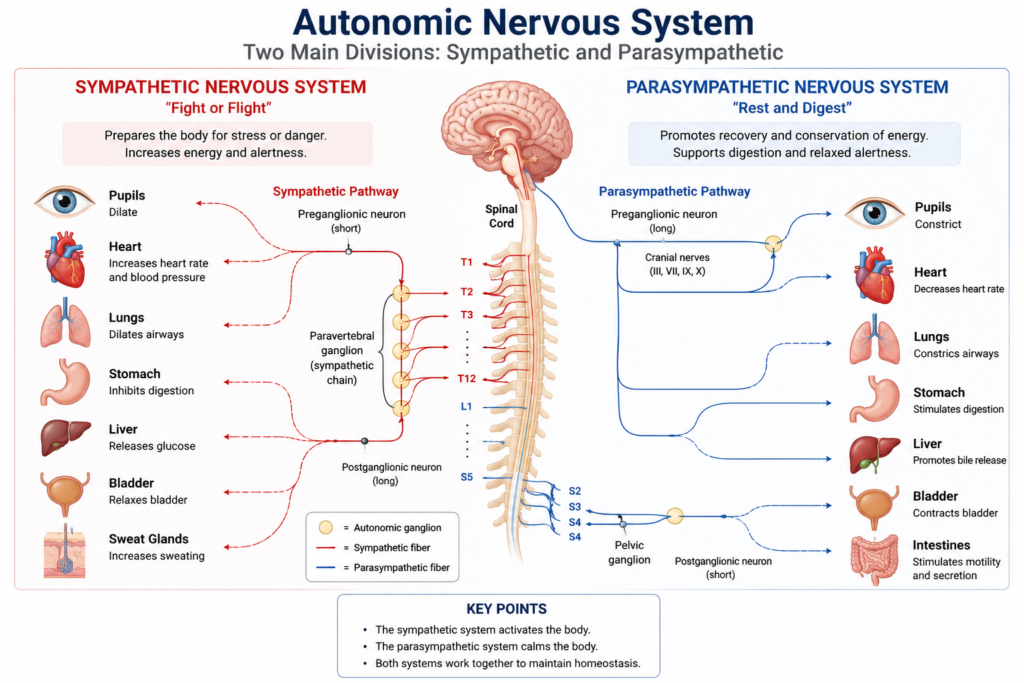
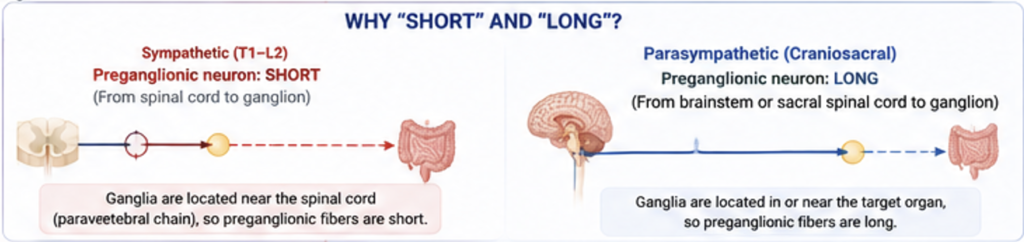
The autonomic nervous system consists of a two-neuron efferent pathway.
Preganglionic neuron
The first neuron originates in the brainstem or spinal cord.
Its axon travels to an autonomic ganglion, where it forms a synapse with the second neuron.
Postganglionic neuron
The second neuron begins within the autonomic ganglion.
Its axon extends to the target organ, where it regulates muscle contraction, gland secretion, or cardiac activity.
This two-neuron organization is one of the major features that distinguishes the autonomic nervous system from the somatic motor system.
Divisions of the Autonomic Nervous System
The autonomic nervous system has three functional divisions.
Sympathetic Nervous System
The sympathetic nervous system prepares the body for increased physical or mental activity.
It is commonly associated with the “fight-or-flight” response.
Typical effects include:
- Increased heart rate
- Increased blood pressure
- Dilated pupils
- Dilated bronchi
- Reduced gastrointestinal activity
- Increased glucose availability
These changes help the body respond rapidly to stress or danger.
Parasympathetic Nervous System
The parasympathetic nervous system promotes recovery and energy conservation.
It is often described as the “rest-and-digest” system.
Typical effects include:
- Decreased heart rate
- Constricted pupils
- Increased salivation
- Increased digestion
- Increased intestinal motility
- Bladder emptying
Its primary role is to support normal maintenance and restoration of body functions.
Enteric Nervous System
The enteric nervous system is a specialized neural network located within the wall of the gastrointestinal tract.
It regulates:
- Gastrointestinal motility
- Digestive enzyme secretion
- Blood flow within the gut
Although it communicates with both sympathetic and parasympathetic pathways, the enteric nervous system is capable of coordinating many digestive activities independently.
How the Autonomic Nervous System Maintains Homeostasis
The autonomic nervous system continuously adjusts organ function to maintain a stable internal environment.
Examples include:
- Maintaining blood pressure
- Regulating heart rate
- Controlling breathing
- Adjusting body temperature
- Regulating pupil diameter
- Controlling digestive activity
These adjustments occur automatically in response to changing internal and external conditions.
Neurotransmitters of the Autonomic Nervous System
The autonomic nervous system primarily uses two neurotransmitters.
Acetylcholine (ACh)
Acetylcholine is released by:
- All preganglionic autonomic neurons
- Most parasympathetic postganglionic neurons
It acts on nicotinic or muscarinic receptors depending on the target tissue.
Norepinephrine (Noradrenaline)
Most sympathetic postganglionic neurons release norepinephrine.
It binds to adrenergic receptors to regulate cardiovascular function, pupil diameter, and many other physiological responses.
Important exception: Most sympathetic fibers that innervate eccrine sweat glands release acetylcholine, not norepinephrine.
Autonomic Nervous System vs Somatic Nervous System
| Somatic Nervous System | Autonomic Nervous System |
|---|---|
| Controls skeletal muscle | Controls smooth muscle, cardiac muscle, and glands |
| Primarily voluntary | Primarily involuntary |
| Single motor neuron from CNS to muscle | Two-neuron pathway via autonomic ganglion |
| Neuromuscular junction | Neuroeffector junction |
Clinical Relevance
Many diseases affect autonomic function.
Examples include:
- Diabetic autonomic neuropathy
- Multiple system atrophy (MSA)
- Pure autonomic failure
- Parkinson disease with autonomic dysfunction
- Orthostatic hypotension
Patients may develop dizziness, abnormal sweating, constipation, urinary dysfunction, abnormal heart rate regulation, or impaired blood pressure control.
Common Misunderstandings
“The autonomic nervous system works completely independently of the brain.”
Not true.
Although many autonomic reflexes occur automatically, higher brain regions—including the hypothalamus, brainstem, insula, and anterior cingulate cortex—play essential roles in autonomic regulation.
“Sympathetic and parasympathetic systems always have opposite effects.”
Not always.
Many organs receive dual innervation with opposing influences, but some organs are predominantly controlled by one division, and in other cases the two systems may work together rather than simply oppose each other.
“The enteric nervous system is simply part of the parasympathetic nervous system.”
Incorrect.
The enteric nervous system is considered the third division of the autonomic nervous system. Although it receives input from both sympathetic and parasympathetic pathways, it contains intrinsic neural circuits capable of independently coordinating many gastrointestinal functions.
- The autonomic nervous system regulates involuntary body functions.
- It innervates smooth muscle, cardiac muscle, and glands.
- Its motor pathway consists of preganglionic and postganglionic neurons.
- The sympathetic, parasympathetic, and enteric nervous systems work together to maintain homeostasis.
- Most autonomic regulation occurs automatically without conscious awareness.
Related Articles
- What Is the Peripheral Nervous System?
- What Is the Somatic Nervous System?
- What Is the Sympathetic Nervous System?
- What Is the Parasympathetic Nervous System?
References
- Anatomy, Autonomic Nervous System. StatPearls. NCBI Bookshelf.
- Standring S, ed. Gray’s Anatomy: The Anatomical Basis of Clinical Practice. 42nd ed. Elsevier; 2020.
- Caire MJ, Reddy V, Varacallo MA. Physiology, Synapse. StatPearls. Updated March 27, 2023.
Written by: MedMaru Editorial Team
Reviewed for medical accuracy by:
S. Chang, KMD