Cerebellum: Function, Location, and Anatomy
What Is the Cerebellum?
Introduction
The cerebellum, often called the “little brain,” is one of the four major parts of the human brain. Although it accounts for only about 10% of the brain’s volume, it contains more than half of the brain’s neurons, making it one of the most densely organized structures in the nervous system.
For many years, the cerebellum was thought to control only balance and coordination. Today, neuroscience has shown that it also contributes to motor learning and may participate in certain cognitive and emotional processes through its connections with the cerebral cortex.
Its primary role, however, is to ensure that movements are smooth, accurate, well-timed, and properly coordinated.
The cerebellum is the part of the brain that coordinates movement, maintains balance and posture, and helps the body learn motor skills. Rather than initiating movement, it compares intended movements with actual movements and continuously corrects errors to produce smooth, accurate actions.
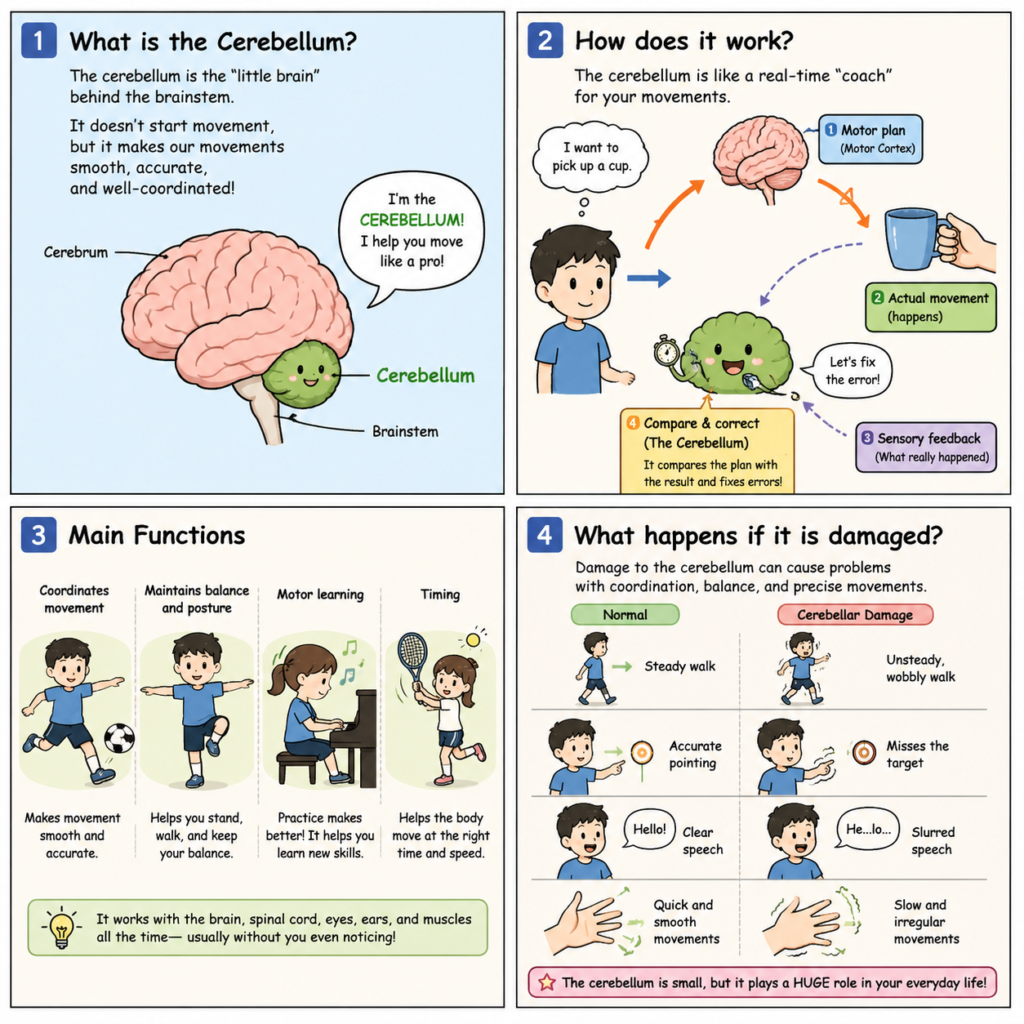
What Is the Cerebellum?
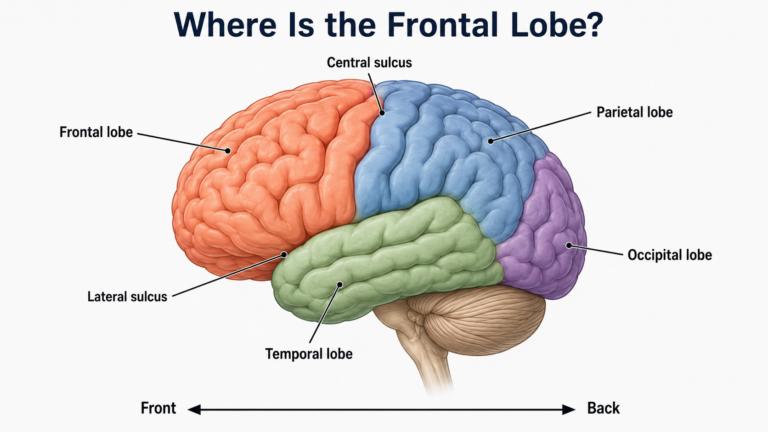
The cerebellum is located behind the brainstem and beneath the occipital lobes of the cerebrum.
It communicates continuously with the cerebral cortex, brainstem, spinal cord, and vestibular system.
Although it does not generate voluntary movement itself, it constantly monitors ongoing movement and makes rapid adjustments.
Without the cerebellum, even simple actions such as walking or reaching for an object become inaccurate and poorly coordinated.
Anatomy of the Cerebellum
The cerebellum consists of two cerebellar hemispheres connected by the vermis.
Like the cerebrum, it contains:
- Cerebellar cortex (outer gray matter)
- White matter
- Deep cerebellar nuclei
The cerebellum is also divided into three anatomical lobes:
- Anterior lobe
- Posterior lobe
- Flocculonodular lobe
These regions have different functional roles but work together continuously.
The Main Functions of the Cerebellum
1. Coordinating Movement
The cerebellum continuously compares:
- Intended movement
- Actual movement
If differences are detected, it rapidly adjusts muscle activity.
This process produces:
- Smooth movement
- Accurate movement
- Proper timing
- Precise coordination
2. Maintaining Balance and Posture
The cerebellum receives information from:
- The vestibular system
- Vision
- Proprioceptors
- The spinal cord
It integrates these signals to help maintain:
- Balance
- Upright posture
- Stable walking
3. Motor Learning
Repeated practice allows movements to become more accurate over time.
The cerebellum plays an essential role in:
- Learning new motor skills
- Improving movement accuracy
- Adapting movements after errors
Examples include:
- Riding a bicycle
- Playing the piano
- Throwing a ball
- Learning to type
4. Timing of Movement
Many movements require precise timing.
The cerebellum helps synchronize muscle activity so movements occur at the correct speed and in the proper sequence.
5. Cognitive and Emotional Functions
Research suggests that the cerebellum also participates in certain cognitive and emotional processes through extensive connections with the cerebral cortex.
These may include:
- Attention
- Language processing
- Working memory
- Emotional regulation
However, these functions remain an active area of neuroscience research and are generally considered secondary to the cerebellum’s well-established role in motor control.
How the Cerebellum Works
The cerebellum does not create movement commands.
Instead, it continuously receives:
- Motor plans from the cerebral cortex
- Sensory feedback from the body
It compares the intended movement with the actual movement.
If an error is detected, corrective signals are sent back to the motor system, allowing movements to become smoother and more accurate.
This process occurs continuously and usually without conscious awareness.
Why the Cerebellum Is Important
Everyday activities depend on normal cerebellar function.
Examples include:
- Walking
- Running
- Writing
- Speaking
- Maintaining posture
- Catching a ball
- Using tools
Even small cerebellar injuries can significantly affect movement accuracy.
Clinical Relevance
Damage to the cerebellum may produce:
- Ataxia
- Poor balance
- Intention tremor
- Dysmetria
- Dysdiadochokinesia
- Slurred speech (ataxic dysarthria)
- Abnormal eye movements (nystagmus)
Unlike disorders of the basal ganglia, cerebellar disorders typically produce poor coordination rather than abnormal movement initiation.
Common Misunderstandings
“The cerebellum starts movement.”
Incorrect.
The cerebellum does not initiate voluntary movement. The motor cortex generates movement commands, while the cerebellum refines and coordinates them.
“The cerebellum only controls balance.”
Incorrect.
Balance is one important function, but the cerebellum also coordinates movement, supports motor learning, regulates movement timing, and contributes to posture.
“The cerebellum only controls muscles.”
Not entirely.
The cerebellum is primarily a motor structure, but growing evidence suggests it also contributes to certain cognitive and emotional functions through cerebellar-cortical networks.
- The cerebellum is located behind the brainstem and below the cerebrum.
- It coordinates movement rather than initiating it.
- It maintains balance and posture.
- It is essential for motor learning and movement accuracy.
- It continuously compares intended and actual movements to correct errors.
- Damage to the cerebellum causes ataxia and poor coordination.
Related Articles
- What Are the Major Parts of the Brain?
- What Is the Brainstem?
- How Does the Brain Control Movement?
- What Is Proprioception?
References
- Standring S, ed. Gray’s Anatomy: The Anatomical Basis of Clinical Practice. 42nd ed. Elsevier; 2020.
- Jimsheleishvili S, Dididze M. Neuroanatomy, Cerebellum. StatPearls. NCBI Bookshelf.
- Manto M, et al. Consensus paper: roles of the cerebellum in motor control. Cerebellum. 2012;11(2):457-487. doi:10.1007/s12311-011-0331-9.
Written by: MedMaru Editorial Team
Reviewed for medical accuracy by:
S. Chang, KMD