What Are Excitatory and Inhibitory Signals? EPSP vs. IPSP
Neurons are constantly receiving signals from other cells, and those signals come in two broad flavors. An excitatory signal makes a neuron more likely to fire an action potential. An inhibitory signal makes it less likely. Excitatory inputs usually produce an excitatory postsynaptic potential, or EPSP, and inhibitory inputs usually produce an inhibitory postsynaptic potential, or IPSP. The brain needs both: excitation to carry information forward, and inhibition to keep that activity controlled and organized.
What happens at the synapse
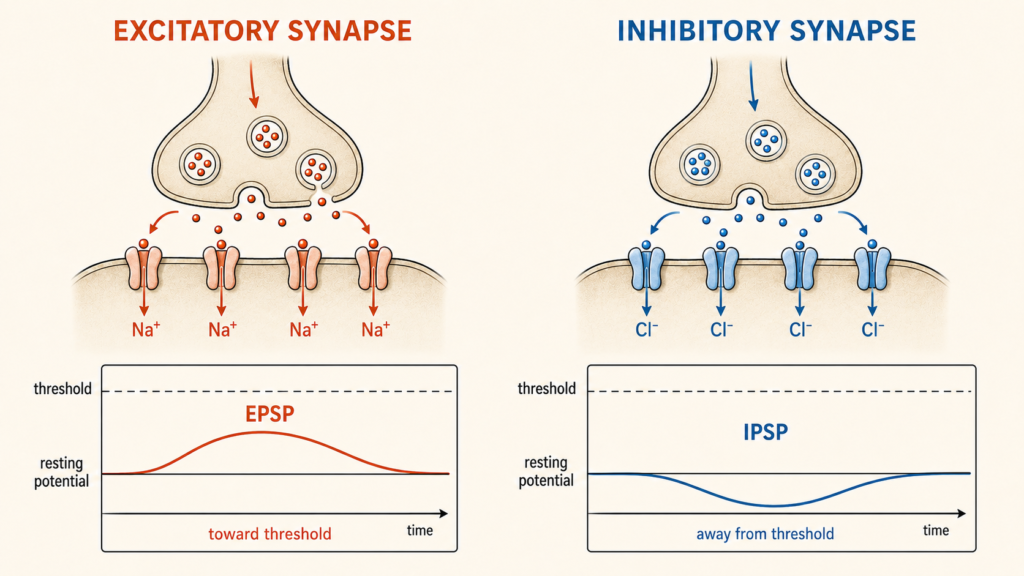
Both kinds of signal are electrical changes in a receiving cell, triggered when neurotransmitters bind to its receptors. At a typical chemical synapse, the sending neuron releases a neurotransmitter, which crosses the narrow gap called the synaptic cleft and binds to receptors on the receiving cell. Those receptors change the flow of ions across the membrane, and the resulting electrical change makes an action potential more or less likely. That change is called a postsynaptic potential.
A postsynaptic potential is different from an action potential in one key way: it is graded. Its size can vary with how much neurotransmitter is released, which receptors are activated, and how ions move across the membrane. An action potential, by contrast, is generally all-or-none.
Excitation: nudging toward threshold
At many excitatory synapses, activated receptors let positively charged ions, especially sodium, flow into the receiving neuron. This usually causes depolarization, meaning the inside of the membrane becomes less negative. Depolarization moves the neuron closer to the threshold for firing.
Think of it like pushing a heavy door. One push moves it a little, but it may take several pushes at once to swing it open. An EPSP works similarly: it raises the probability of firing but does not guarantee it, and a single EPSP is often too small to reach threshold by itself. Like any analogy, this one simplifies; real neurons also weigh timing and location when combining inputs.
Inhibition: holding steady
An inhibitory signal makes the receiving neuron less likely to fire. Inhibition commonly happens when activated receptors let chloride ions move through the membrane, let potassium ions leave the cell, hold the membrane below threshold, or blunt the effect of excitatory input arriving at the same time.
An IPSP may make the membrane potential more negative, a change called hyperpolarization. But inhibition doesn’t always require much hyperpolarization. It can also work by stabilizing the membrane and making excitatory input less effective. Nor does an inhibitory signal simply switch a neuron off. It lowers the chance of firing or changes its timing, and the neuron can still fire if other inputs are strong enough.
In short, EPSPs usually depolarize the cell, often through positive ions entering, and promote activity. IPSPs usually hyperpolarize or stabilize it, often through chloride movement or potassium exit, and limit activity. These are common patterns, not fixed rules. The actual effect depends on the receptor, the ions it lets through, and the concentrations of those ions inside and outside the cell.
The main messengers on each side
Glutamate is the principal excitatory neurotransmitter in the vertebrate central nervous system. When it activates certain receptors, positive ions can enter the receiving neuron, commonly producing an EPSP. Glutamate acts through several receptor types, and different types can produce different cellular effects. Acetylcholine can also be excitatory at some synapses. It excites skeletal muscle at the junction between a motor neuron and the muscle, for example. In the nervous system, though, its effects depend on the receptor and target cell, so it should not be called universally excitatory.
On the inhibitory side, GABA, or gamma-aminobutyric acid, is the principal inhibitory neurotransmitter in much of the mature vertebrate brain. It commonly activates receptors that increase chloride conductance or indirectly increase potassium conductance, both of which make firing less likely. Glycine is another important inhibitory neurotransmitter, especially prominent in the spinal cord and brainstem. Its receptors commonly open chloride channels.
Why the name of a neurotransmitter isn’t enough
A neurotransmitter is not excitatory or inhibitory by name alone. Its effect depends on which receptor it activates, the ion channels linked to that receptor, the ion concentrations inside and outside the cell, and the electrical state of the receiving neuron. Acetylcholine can be excitatory at one type of receptor and inhibitory at another. Glutamate is predominantly excitatory in the brain and GABA predominantly inhibitory in the mature brain, but these are general patterns with exceptions. It is more accurate to call a particular synaptic response excitatory or inhibitory than to label the molecule itself.
Why the brain needs both
Neurons usually receive both kinds of input at once. Excitation moves the membrane potential toward threshold, and inhibition reduces or controls that movement. Excitation lets information spread through neural pathways, while inhibition shapes when, where, and how strongly that activity happens. Together they help the nervous system select appropriate responses, time neuronal firing, filter out unnecessary information, refine sensory signals, coordinate movement, stop activity from spreading uncontrolled, and organize communication within circuits. Inhibition, in other words, is not just the absence of activity. It is an active part of how the brain processes information.
When excitatory or inhibitory signaling is disrupted, abnormal neural activity can result. Seizures are one example, but they may involve changes in synaptic transmission, ion channels, brain structure, metabolism, or neural networks, and cannot be explained by excitation or inhibition alone. How neurons add these signals up is covered in How Do Neurons Combine Excitatory and Inhibitory Signals?, and the wider network picture in What Is Excitation–Inhibition Balance in the Brain?.
Related: How Do Neurons Communicate? · What Are Neural Receptors and How Do They Work? · What Is a Neural Circuit? · How Do Neurons Combine Excitatory and Inhibitory Signals? · What Is Excitation–Inhibition Balance in the Brain?
References
- Purves D, Augustine GJ, Fitzpatrick D, et al., editors. Excitatory and Inhibitory Postsynaptic Potentials. In: Neuroscience. 2nd ed. Sinauer Associates; 2001. NCBI Bookshelf
- Purves D, Augustine GJ, Fitzpatrick D, et al., editors. Neurotransmitter Receptors and Their Effects. In: Neuroscience. 2nd ed. Sinauer Associates; 2001. NCBI Bookshelf
- Siegel GJ, Agranoff BW, Albers RW, et al., editors. Synaptic Transmission. In: Basic Neurochemistry: Molecular, Cellular and Medical Aspects. 6th ed. Lippincott-Raven; 1999. NCBI Bookshelf
Written by: MedMaru Editorial Team
Reviewed for medical accuracy by:
S. Chang, KMD