How Does the Brain Process Pain?
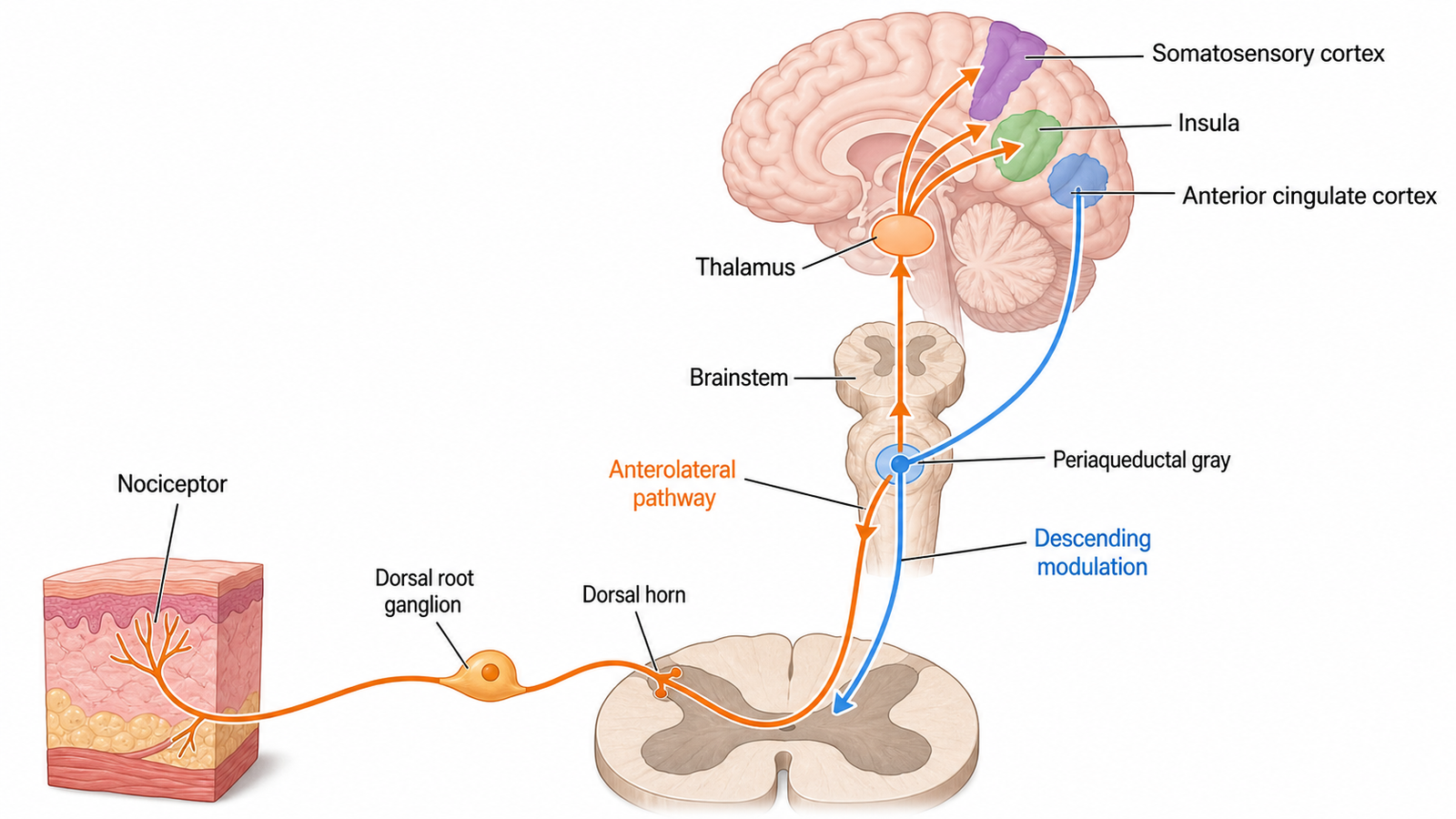
Pain starts with a warning, but the feeling of pain is built by the brain. Sensors called nociceptors detect events that threaten or might threaten tissue, such as strong pressure, extreme heat or cold, or irritating chemicals, and send signals into the spinal cord or brainstem. Rising pathways then relay this information to the brainstem, the thalamus, the somatosensory cortex, the insula, the cingulate cortex, and other networks. Together these systems shape where the pain is felt, how intense it is, how unpleasant it is, how much attention it grabs, what we learn from it, and how we protect ourselves. Pathways running back down from the brain can turn the signal up or down. Pain is a personal sensory and emotional experience. It is not the same thing as nociceptor activity, and it is not a direct measure of tissue damage.
Why pain and nociception are different things
The International Association for the Study of Pain defines pain as an unpleasant sensory and emotional experience associated with, or resembling that associated with, actual or potential tissue damage. Nociception is something narrower: the nervous system’s encoding of harmful or potentially harmful stimuli. The two usually travel together, but not always. Nociception can happen without conscious pain, and pain can happen without clear ongoing damage in the tissues.
Think of a smoke detector and the feeling of alarm it causes. The detector reports smoke, but how alarmed you feel depends on whether you are cooking dinner or asleep at night. The comparison is limited, because pain is not just an emotional reaction added on top of a signal, but it shows why the phrase “pain receptors send pain directly to the brain” is misleading. That is also why “nociceptor” is the more accurate name for these sensors. They encode potentially damaging stimuli, while conscious pain requires much broader processing.
From the tissue to the spinal cord
Nociceptors are free nerve endings in the skin, muscles, joints, and internal organs. They respond only to strong, high-threshold mechanical, thermal, or chemical stimuli. Two broad fiber types carry their signals. Thin myelinated A-delta fibers often contribute to relatively fast, sharp sensations, like the first jolt when you stub a toe. Unmyelinated C fibers often contribute to slower, more diffuse sensations, like the dull ache that follows. Real pain experiences don’t always divide neatly into these two categories.
The signal is not simply passed along at the spinal cord. Incoming fibers enter a region called the dorsal horn, where they connect with projection neurons that send signals upward and with local interneurons. Excitatory and inhibitory circuits there can change how much of the signal gets through before it ever rises toward the brain. Inflammation, nerve injury, and repeated activity can change how responsive these circuits are. That helps explain sensitization, where the system becomes more reactive; hyperalgesia, where a painful stimulus hurts more than expected; and allodynia, where something normally harmless, like light touch, becomes painful. These terms describe mechanisms and clinical findings. On their own they don’t identify a cause.
Many pathways, no single pain center
From the spinal cord, anterolateral pathways carry nociceptive information toward the brainstem and thalamus. Pathways through the ventral posterior thalamus to the somatosensory cortex contribute to sensory features such as location and intensity. The insula, cingulate cortex, limbic regions, and prefrontal networks contribute to the body’s state, how unpleasant the pain feels, how much it demands attention, what we expect, and what we do about it. There is no single, isolated pain center in the brain.
The brain also talks back. Descending circuits involving the cortex, the hypothalamus, a midbrain region called the periaqueductal gray, the rostral ventromedial medulla, and other brainstem systems can inhibit or amplify transmission in the spinal cord. Attention, expectation, prior learning, threat, sleep, mood, and context can all influence pain. None of this makes pain imaginary. Modulation is a normal biological property of the pain system. It is also why pain is not reliably proportional to tissue damage: the state of the tissue matters, but neural modulation and context shape the experience too.
Acute pain and chronic pain
Acute pain often serves protection and recovery. It makes you pull your hand away from a hot pan and keeps you from walking on a sprained ankle. Chronic pain persists or keeps returning beyond the expected healing time. It may involve ongoing disease, nerve injury, altered processing of nociceptive signals, or several interacting factors.
A common question is whether pain is all in the brain. Pain is experienced through the nervous system, but that does not make it unreal. Peripheral tissues, nerves, spinal circuits, brain networks, and context can all contribute. A neuroscience explanation should never be used to dismiss symptoms or to assume that persistent pain is purely psychological.
This educational article cannot assess an individual situation. New severe pain, pain after a major injury, chest pain, a sudden severe headache, worsening neurological symptoms, fever with severe illness, or pain together with bowel or bladder problems needs prompt professional evaluation.
Related: How Does the Brain Process Vision? · How Does the Brain Process Sensory Information? · How Does the Brain Maintain Balance?
References
- Raja SN, et al. The revised International Association for the Study of Pain definition of pain: concepts, challenges, and compromises. Pain. 2020;161(9):1976-1982. doi:10.1097/j.pain.0000000000001939.
- Kendroud S, Fitzgerald LA, Murray IV, Hanna A. Physiology, Nociceptive Pathways. StatPearls. Updated September 26, 2022.
- Chen JS, Kandle PF, Murray IV, Fitzgerald LA, Sehdev JS. Physiology, Pain. StatPearls. Updated July 24, 2023.
Written by: MedMaru Editorial Team
Reviewed for medical accuracy by:
S. Chang, KMD