What Are Neural Receptors and How Do They Work?
Neurons talk to each other with chemical messengers such as glutamate, GABA, dopamine, serotonin, and acetylcholine. But a chemical message is useless unless someone can read it. A messenger can only affect a cell that carries a receptor able to recognize it. Neural receptors are proteins that recognize neurotransmitters and other signaling molecules and turn that chemical contact into an electrical or biochemical response inside the target cell. Some receptors directly control ion channels, while others switch on signaling pathways inside the cell. That is why the same neurotransmitter can have quite different effects depending on the receptor subtype, where the receptor sits, and the state of the cell. In this article, neural receptors means mainly neurotransmitter receptors involved in chemical signaling in the nervous system.
A lock that recognizes its key
The molecule a receptor recognizes is called a ligand. Ligands that act on neural receptors include neurotransmitters, neuromodulators, neuropeptides, hormones, and medications. When a ligand binds, it changes what the receptor is doing. Ion movement across the membrane may change, signaling may start inside the cell, neurotransmitter release may be adjusted, or genes may be switched on or off.
The lock-and-key image is a common way to picture this. It works up to a point: receptors are selective, and the right key opens the lock. But receptors are not limited to a single key. Medications and closely related compounds can bind the same receptor, and some molecules adjust the lock rather than turning it. Note too that neural receptors are not the same as sensory receptors. Sensory receptors are specialized cells, nerve endings, or proteins that detect light, sound, pressure, temperature, or chemicals. The two ideas overlap in some sensory systems, but they are not interchangeable.
Location changes the job
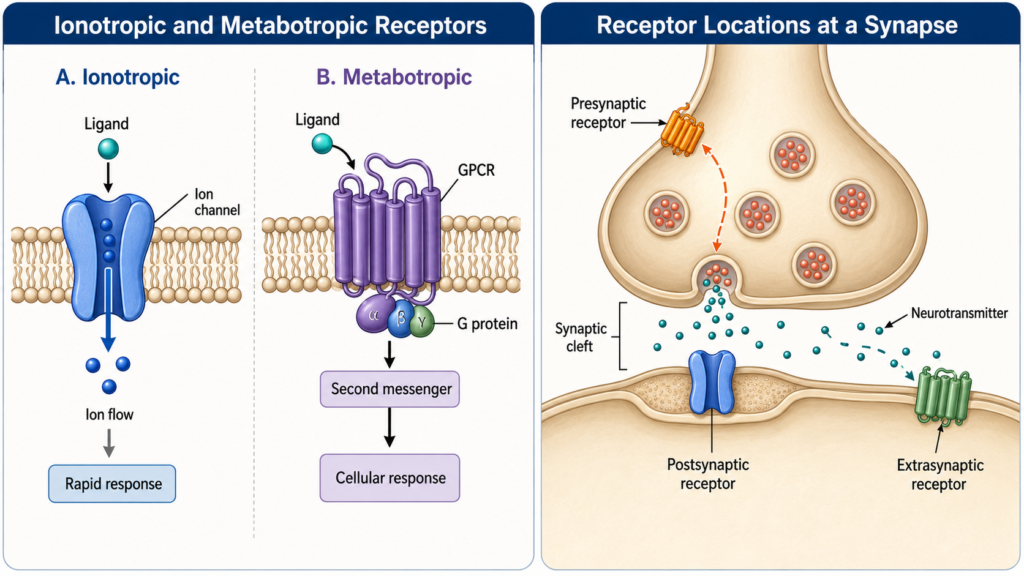
Where a receptor sits strongly shapes what it does. Postsynaptic receptors are on the receiving side of a synapse, and activating them can change the target cell’s membrane potential, excitability, metabolism, or gene expression. Presynaptic receptors sit on the terminals that release neurotransmitter and help regulate how much is released. When such a receptor responds to the neuron’s own neurotransmitter it is called an autoreceptor, a kind of self-monitoring thermostat. When it responds to a neurotransmitter from another neuron it is called a heteroreceptor.
Extrasynaptic receptors lie outside the main synaptic junction. They can respond to neurotransmitter that drifts beyond the synaptic cleft and may support more widespread or sustained signaling. Some signaling molecules cross the cell membrane altogether and bind receptors inside the cell. Steroid hormones, for example, can activate intracellular receptors that regulate gene transcription. So receptors are not all postsynaptic.
Fast channels and slower relays
Most neurotransmitter receptors fall into two broad families. Ionotropic receptors, also called ligand-gated ion channels, are themselves channels. When a neurotransmitter binds, the channel opens or closes, changing the flow of ions such as sodium, potassium, calcium, or chloride across the membrane. Because ion flow can shift quickly, these receptors often respond within milliseconds. Examples include the AMPA, NMDA, and kainate glutamate receptors, GABA-A receptors, glycine receptors, nicotinic acetylcholine receptors, and 5-HT3 serotonin receptors.
The electrical effect of an ionotropic receptor depends on which ions can pass and on their electrochemical gradients. AMPA receptor activation usually pushes the cell toward depolarization, making it more excitable. GABA-A receptors usually provide fast inhibition in the mature nervous system, though their effect depends on the cell’s chloride gradient.
Metabotropic receptors do not form a channel. Most are G protein-coupled receptors, or GPCRs. When activated, they start a chain of signaling inside the cell that can modify ion channels, produce second messengers, regulate enzymes, change neurotransmitter release, influence gene expression, and alter synaptic strength. If an ionotropic receptor is a doorbell that rings immediately, a metabotropic receptor is more like a message passed to an office that then sets several tasks in motion. The analogy is loose, but it captures the difference in style. Metabotropic responses usually begin more slowly, yet they can last longer and affect many processes at once. Examples include dopamine receptors, GABA-B receptors, muscarinic acetylcholine receptors, opioid receptors, adrenergic receptors, metabotropic glutamate receptors, and most serotonin receptors.
These are useful general distinctions rather than strict rules. How fast and how long a response lasts also depends on the receptor, the target cell, the signaling pathway, and how it is measured.
From binding to response
Receptor signaling can be followed in five steps. First, a neurotransmitter released into the synaptic cleft diffuses toward receptors on the target cell. Second, it binds, depending on how well the ligand and receptor fit chemically. A ligand’s tendency to bind is called its affinity. Third, the receptor becomes active: an ionotropic receptor changes ion flow directly, while a metabotropic receptor activates signaling proteins inside the cell. Fourth, the cell responds, which may mean a change in membrane potential, in the chance of firing an action potential, in neurotransmitter release, in enzyme activity, in synaptic strength, or in gene expression. Fifth, the signal fades. Neurotransmitters are removed by reuptake, enzymatic breakdown, or diffusion, and receptors may become less responsive or be temporarily pulled from the membrane.
One messenger, many receptors
Most neurotransmitters act through several receptor types and subtypes, so one neurotransmitter does not produce one effect. Acetylcholine activates both nicotinic receptors, which are ion channels, and muscarinic receptors, which are GPCRs. Glutamate acts through AMPA, NMDA, and kainate receptors as well as metabotropic glutamate receptors. Dopamine acts through five recognized receptor subtypes, broadly grouped into D1-like and D2-like families. This diversity lets the same messenger do different things in different cells and brain regions.
It also means a neurotransmitter alone does not decide whether a signal is excitatory. The outcome depends on the receptor subtype, the ions or pathways involved, the receptor’s location, the cell’s ion gradients, and the neuron’s current state. Glutamate is generally considered the main excitatory neurotransmitter in the mature central nervous system, and GABA the main inhibitory one, but the actual electrical effect still depends on receptor and cellular conditions. Acetylcholine makes the point clearly. It excites skeletal muscle through nicotinic receptors, yet it can slow the heart through M2 muscarinic receptors. It is more accurate to think in terms of the full neurotransmitter–receptor–cell combination.
How medications use receptors
Many medications act by changing receptor activity. An agonist binds to a receptor and activates it, as nicotine does at nicotinic acetylcholine receptors. An antagonist binds and reduces or prevents activation by an agonist. Naloxone, for example, blocks opioid receptors and can reverse opioid effects. An allosteric modulator binds at a different site from the main ligand and changes how the receptor responds. Benzodiazepines are positive allosteric modulators of certain GABA-A receptors: they enhance the receptor’s response to GABA rather than replacing GABA at its main binding site. Partial agonists and inverse agonists also exist, and their effects depend on the receptor system and the conditions.
Receptors are not fixed switches
Neurons constantly adjust their receptors’ number, location, sensitivity, and interactions with other proteins. During prolonged or repeated stimulation, a receptor may become less responsive, a process called desensitization. Receptors may also be temporarily pulled from the membrane into the cell, called internalization. Over longer periods, cells can increase or decrease how many receptors are available, known as upregulation and downregulation, during development, learning, disease, or prolonged drug exposure. Neurons can also move receptors into or out of particular synapses. Changing the number of AMPA receptors at a synapse, for example, changes the strength of excitatory transmission.
These processes are more complex than the idea that the brain simply runs out of receptors. Tolerance after repeated exposure does not necessarily mean receptors disappear permanently. Instead, sensitivity, signaling, trafficking, or expression may change, and how they change varies with the receptor, the medication, the dose, and the length of exposure.
Why receptors matter in medicine
Receptors let cells respond selectively to chemical signals, and their variety lets the nervous system produce fast and slow responses, excite, inhibit, or modulate activity, regulate transmitter release, adjust synaptic strength, support learning and memory, coordinate movement and sensation, and regulate sleep, mood, attention, and motivation. Without receptors, neurotransmitters could still be released but would carry no meaningful message.
Many neurological and psychiatric medications act on receptors. Benzodiazepines modulate certain GABA-A receptors. Many antipsychotic medications interact with dopamine D2 receptors. Opioid medications activate opioid receptors, while naloxone blocks them. Some migraine medications act on specific serotonin receptors. Receptor binding alone does not fully predict a medication’s clinical effect, however. Dose, receptor subtype, tissue distribution, metabolism, interactions with other targets, and individual physiology all matter. Changes in receptor genes, expression, location, or signaling have been studied in many neurological and psychiatric conditions, but most complex disorders cannot be explained by a single receptor imbalance.
This article is educational background and is not advice about any medication. Questions about specific treatments should go to a clinician or pharmacist.
Related: What Are Neurotransmitters? · How Do Neurons Communicate? · What Are Excitatory and Inhibitory Signals? · What Is Excitation–Inhibition Balance in the Brain? · What Is a Neural Circuit?
References
- Purves D, Augustine GJ, Fitzpatrick D, et al., editors. Two Families of Postsynaptic Receptors. In: Neuroscience. 2nd ed. Sunderland, MA: Sinauer Associates; 2001.
- Purves D, Augustine GJ, Fitzpatrick D, et al., editors. Excitatory and Inhibitory Postsynaptic Potentials. In: Neuroscience. 2nd ed. Sunderland, MA: Sinauer Associates; 2001.
- Rosenbaum DM, Rasmussen SGF, Kobilka BK. The structure and function of G-protein-coupled receptors. Nature. 2009;459(7245):356–363. doi:10.1038/nature08144.
- Traynelis SF, Wollmuth LP, McBain CJ, et al. Glutamate receptor ion channels: structure, regulation, and function. Pharmacological Reviews. 2010;62(3):405–496. doi:10.1124/pr.109.002451.
- Changeux JP, Christopoulos A. Allosteric modulation as a unifying mechanism for receptor function and regulation. Cell. 2016;166(5):1084–1102. doi:10.1016/j.cell.2016.08.015.
- Gainetdinov RR, Premont RT, Bohn LM, Lefkowitz RJ, Caron MG. Desensitization of G protein-coupled receptors and neuronal functions. Annual Review of Neuroscience. 2004;27:107–144. doi:10.1146/annurev.neuro.27.070203.144206.
Written by: MedMaru Editorial Team
Reviewed for medical accuracy by:
S. Chang, KMD