How Does the Brain Make Decisions?
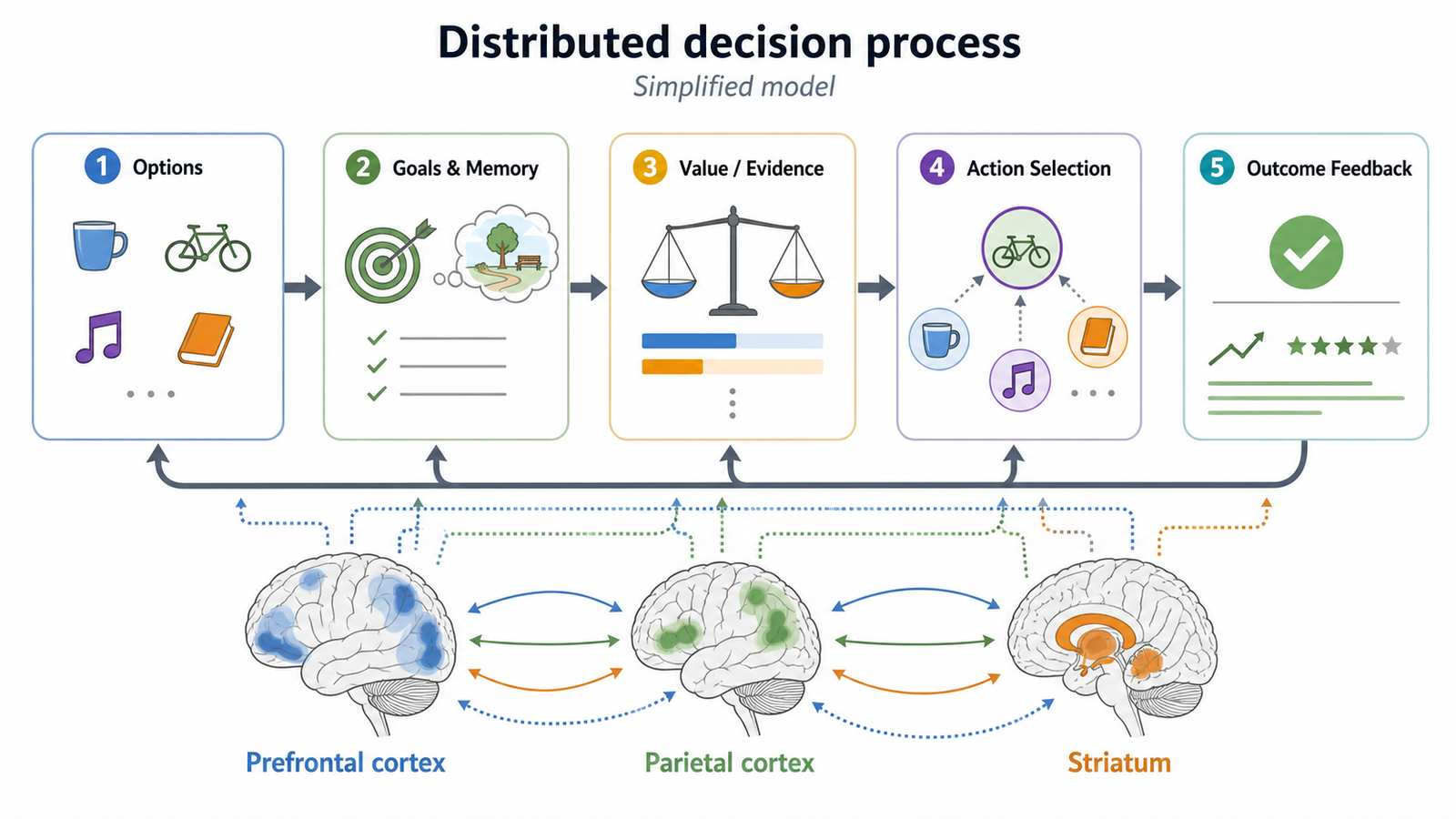
Your brain does not make decisions in a single decision center. When you choose between two options, many connected brain circuits share the work. They lay out the options, weigh your goals and memories against the expected costs and benefits, let the possible actions compete, and then use the outcome to adjust future choices. Several regions can contribute, depending on the kind of decision: the prefrontal cortex, the striatum, the parietal cortex, the insula, the anterior cingulate cortex, the amygdala, the hippocampus, and the brain’s dopamine systems.
Setting out the options
A decision starts when the brain represents what you could do and what is relevant to the choice. Picture a meeting where each participant brings different information. Your sensory systems describe the current situation. Memory brings in previous experience. Emotional and bodily signals change what matters right now, so the same snack looks different when you’re hungry than when you’re full. Attention and executive control keep your goals and rules in view so the meeting stays on topic. Like any analogy, this one oversimplifies: there is no chairperson, and the participants work at the same time rather than taking turns.
Many value-based decisions involve activity linked to subjective value in two areas, the ventromedial prefrontal cortex and the ventral striatum. Subjective value means how desirable an option is to you, in this context. It is not a fixed price stored in a neuron. Other prefrontal and parietal regions help represent rules, evidence, uncertainty, and action plans. The anterior cingulate cortex and the insula are often recruited when there is conflict, effort, risk, or an internal bodily state to take into account. These roles overlap, and no region acts alone.
Emotion is part of this process, not just a distraction from it. Emotion can bias a choice, but it also supplies useful information about what is important, what is risky, and what your body needs.
Comparing, acting, and learning
Once the options are on the table, neural activity changes over time as evidence builds up and the alternatives compete. When one action wins, circuits in the cortex and basal ganglia help pass the choice toward the motor systems that carry it out.
The process does not end there. After the outcome, the brain compares what happened with what it expected. The gap between the two is called a prediction error. Dopamine-related prediction-error signals are one important way the brain learns from that gap. Dopamine is often called a pleasure chemical, but that is not accurate. It modulates learning, motivation, and value-related signals rather than issuing a single command that forces a decision, and learning from decisions also depends on other chemical messengers and circuits.
Not every choice is weighed carefully. Some are deliberate, while others are fast or habitual. Fatigue, stress, time pressure, how a choice is framed, and prior learning can all bias decisions, but none of them removes personal agency. It is also worth knowing the limits of the research. Laboratory tasks isolate individual pieces of decision-making. That is useful for science, but it means a brain scan cannot read a person’s full reasons or predict a single real-life choice with certainty.
When decision circuits are disrupted
Damage or dysfunction in networks linking the frontal lobes and the striatum can change impulse control, how options are valued, mental flexibility, or the ability to learn from consequences. Similar changes in behavior can arise from quite different causes, though. Poor decisions on their own do not diagnose a neurological or psychiatric disorder.
This article is educational background, not individual medical advice. Marked new changes in judgment, impulse control, or behavior should be discussed with a clinician.
Related: What Is Executive Function? · How Does the Brain Create Emotions? · How Does the Brain Learn?
References
- Rangel A, Camerer C, Montague PR. A framework for studying the neurobiology of value-based decision making. Nature Reviews Neuroscience. 2008;9:545–556. doi:10.1038/nrn2357
- Ernst M, Paulus MP. Neurobiology of decision making: a selective review from a neurocognitive and clinical perspective. Biological Psychiatry. 2005;58:597–604. doi:10.1016/j.biopsych.2005.06.004
- Gleichgerrcht E, Ibáñez A, Roca M, Torralva T, Manes F. Decision-making cognition in neurodegenerative diseases. Nature Reviews Neurology. 2010;6:611–623. doi:10.1038/nrneurol.2010.148
- Schultz W, Dayan P, Montague PR. A neural substrate of prediction and reward. Science. 1997;275:1593–1599. doi:10.1126/science.275.5306.1593
Written by: MedMaru Editorial Team
Reviewed for medical accuracy by:
S. Chang, KMD