
What Is the Central Nervous System? Structure, Function
What Is the Central Nervous System?
Introduction
The human nervous system is responsible for receiving information, processing it, and coordinating responses throughout the body. At the center of this complex communication network is the central nervous system (CNS).
The central nervous system acts as the body’s control center. Every thought you have, every movement you make, and every sensation you experience depends on the brain and spinal cord working together.
Understanding the central nervous system is the foundation for learning neuroscience, neurology, and human physiology.
The central nervous system (CNS) consists of the brain and spinal cord. It receives information from the body, processes and interprets that information, and sends commands that control movement, sensation, thinking, memory, emotions, and many automatic body functions.
What Is the Central Nervous System?
The nervous system is divided into two major parts:
- Central Nervous System (CNS)
- Peripheral Nervous System (PNS)
The CNS includes only two organs:
- Brain
- Spinal cord
Although these organs make up only a small percentage of total body weight, they coordinate virtually every activity in the body.
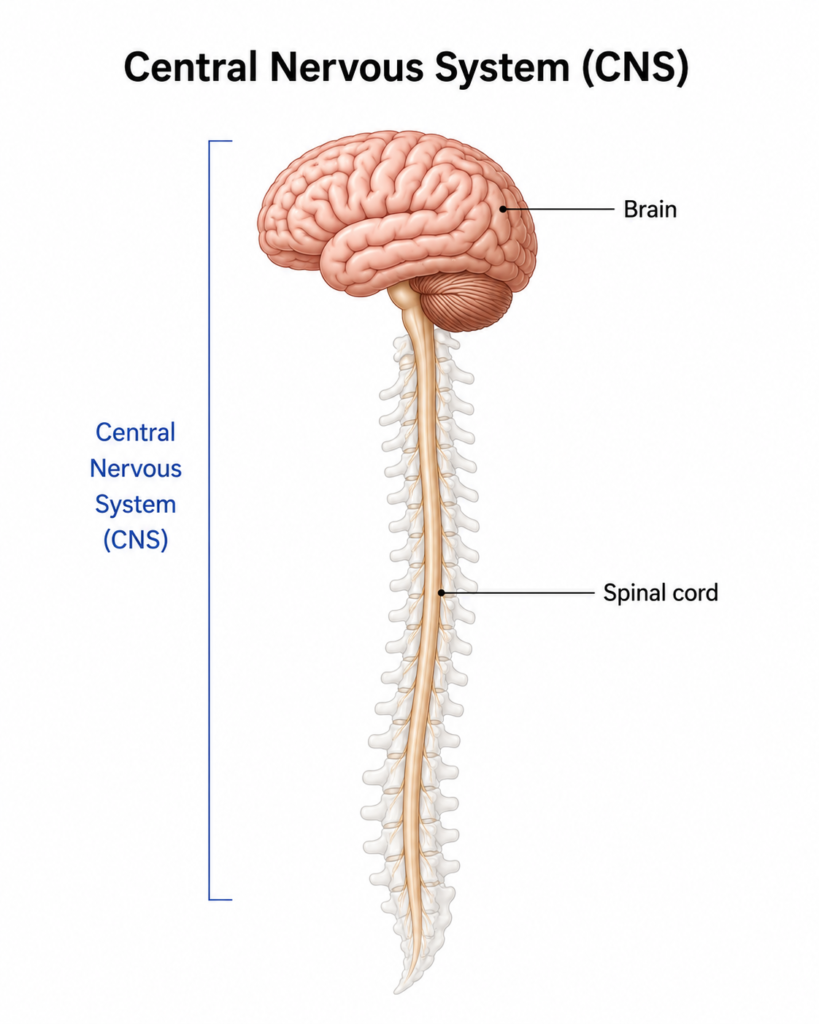
The Brain
The brain is the body’s primary control center.
It receives sensory information, processes complex data, stores memories, generates emotions, plans movement, and controls voluntary and involuntary behaviors.
Different regions of the brain perform specialized functions.
For example:
- The cerebral cortex is responsible for thinking, language, and conscious movement.
- The cerebellum coordinates balance and precise movements.
- The brainstem controls breathing, heart rate, and other life-sustaining functions.
Despite these specialized regions, the entire brain works as an integrated network.
The Spinal Cord
The spinal cord connects the brain to the rest of the body.
It serves two major functions.
First, it carries sensory information from the body to the brain.
Second, it carries motor commands from the brain to muscles and organs.
The spinal cord also contains neural circuits that produce rapid reflexes without requiring immediate input from the brain.
For example, quickly withdrawing your hand from a hot object is largely coordinated by spinal reflex pathways.
How the CNS Processes Information
The central nervous system constantly receives information from the body and the surrounding environment.
This process generally follows four steps.
1. Sensory Input
Specialized sensory receptors detect changes such as touch, temperature, pain, light, or sound.
These signals travel through peripheral nerves to the spinal cord and brain.
2. Information Processing
The brain analyzes incoming information by comparing it with stored memories, current goals, and other sensory inputs.
This processing allows us to recognize objects, make decisions, and plan actions.
3. Motor Output
After processing the information, the brain sends commands through the spinal cord and peripheral nerves to muscles and glands.
This allows us to move, speak, and respond appropriately to our environment.
4. Continuous Feedback
The nervous system constantly monitors the results of every movement.
This continuous feedback allows posture, balance, and movement to be adjusted in real time.
Functions of the Central Nervous System
The CNS performs numerous essential functions, including:
- Processing sensory information
- Controlling voluntary movement
- Regulating involuntary functions such as breathing and heart rate
- Learning and memory
- Language and communication
- Decision-making
- Emotional regulation
- Maintaining homeostasis
Nearly every function of the human body depends on the central nervous system.
Central Nervous System vs Peripheral Nervous System
Although they work closely together, the CNS and PNS have different roles.
| Central Nervous System | Peripheral Nervous System |
|---|---|
| Brain and spinal cord | All nerves outside the brain and spinal cord |
| Processes information | Carries information to and from the CNS |
| Makes decisions | Delivers sensory input and motor output |
| Coordinates body functions | Connects the CNS with the rest of the body |
A useful way to think about this relationship is that the CNS functions like a computer, while the PNS functions like the cables that connect the computer to the outside world.
Why the CNS Is Important
The central nervous system coordinates virtually every activity that keeps us alive.
Without it, we would not be able to think, move, remember, communicate, or maintain normal body functions.
Because the CNS integrates enormous amounts of information every second, it allows humans to interact successfully with an ever-changing environment.
Clinical Relevance
Many neurological diseases directly affect the central nervous system.
Examples include:
- Stroke
- Parkinson’s disease
- Alzheimer’s disease
- Multiple sclerosis
- Epilepsy
- Brain tumors
- Spinal cord injury
Although these conditions affect different parts of the CNS, they all interfere with normal communication between neurons.
Common Misunderstandings
“The brain alone is the central nervous system.”
Not exactly.
The central nervous system includes both the brain and the spinal cord.
“The spinal cord only carries signals.”
Although signal transmission is one of its major roles, the spinal cord also processes information and generates important reflexes independently of the brain.
- The central nervous system consists of the brain and spinal cord.
- The CNS is the body’s primary information-processing and control center.
- It receives sensory information, processes it, and sends motor commands throughout the body.
- The spinal cord is both a communication pathway and a processing center for reflexes.
- Nearly every thought, movement, sensation, memory, and emotion depends on the central nervous system.
Related Articles
- What Is the Peripheral Nervous System?
- What Is the Brain?
- What Is a Neuron?
- How Do Neurons Communicate?
- What Is a Reflex Arc?
References
- Standring S, ed. Gray’s Anatomy: The Anatomical Basis of Clinical Practice. 42nd ed. Elsevier; 2020.
- Basinger H, Hogg JP. Neuroanatomy, Brainstem. StatPearls. Updated July 4, 2023.
- Bui T, Das JM. Neuroanatomy, Cerebral Hemisphere. StatPearls. NCBI Bookshelf.
Written by: MedMaru Editorial Team
Reviewed for medical accuracy by:
S. Chang, KMD