How Does Attention Work in the Brain?
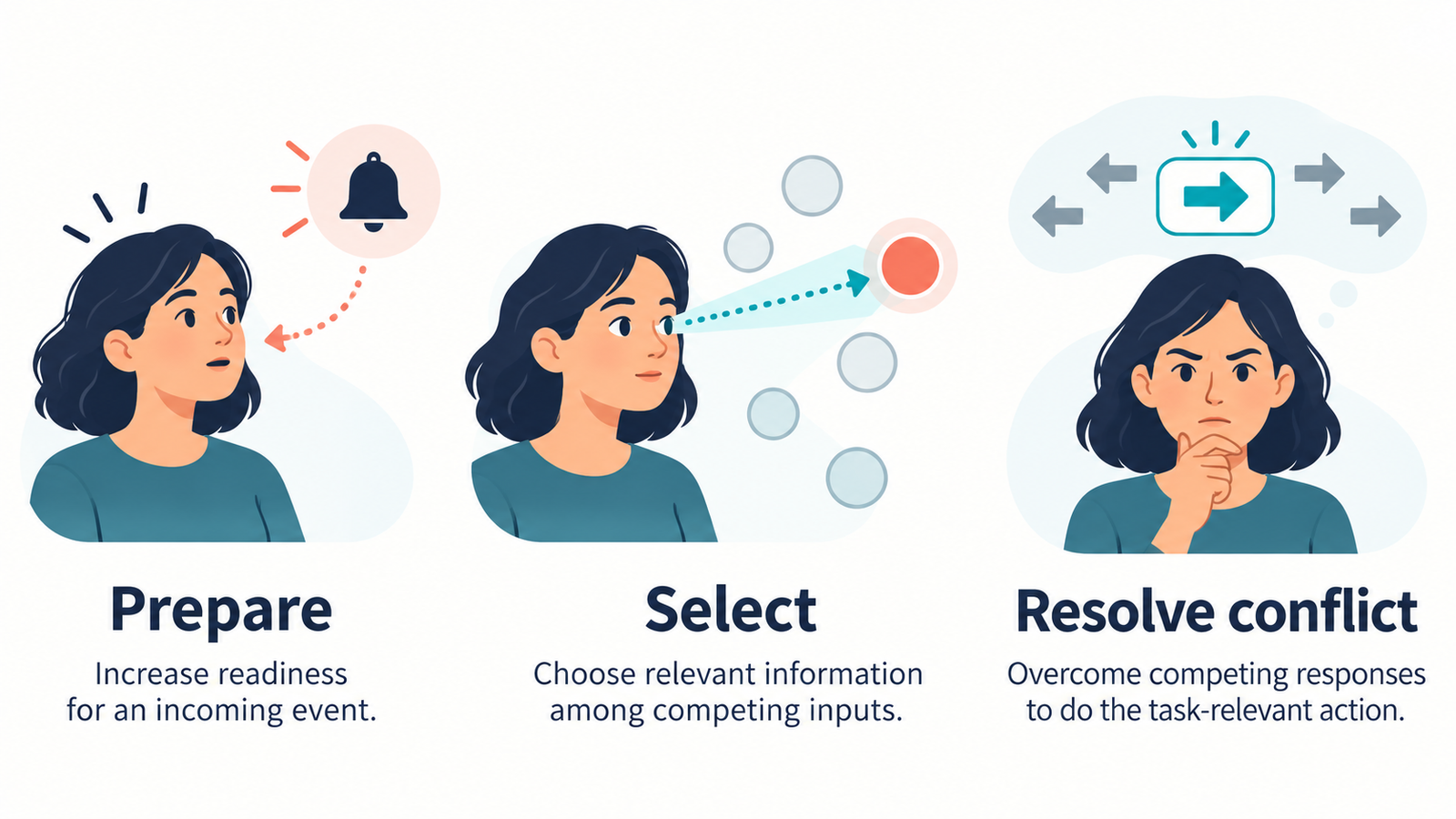
When we say we are “concentrating,” one core thing is happening in the brain. Out of the many signals arriving at once, the brain picks out what matters right now and processes it more strongly. Neuroscientists call this attention.
For this selection to work well, two more things are needed. Before selecting, the brain has to be awake and ready. After selecting, it has to hold back the urge to drift elsewhere. Staying ready, selecting, and holding back: when all three work together, we experience what everyday language calls “good concentration.”
Why the brain has to choose
Picture a student studying for an exam in a café. The hiss of the coffee machine, the conversation at the next table, the music, the people passing the window, and the feel of the chair all arrive at the same time.
The brain cannot process all of this in equal detail. Its processing capacity is limited. So it makes a choice. It gives more processing to what matters now, the sentences in the textbook, and handles the rest only lightly.
The core: selecting what matters and processing it more strongly
Information that is selected is processed more strongly in the brain, and it is also more likely to be remembered. When your mind wanders in class, you may hear the teacher’s voice but remember nothing, because those words were never selected.
One point is important. Information that is not selected is not completely switched off. It is only processed more weakly. That is why, even when you are absorbed in studying, you can still notice someone calling your name. Attention is often compared to a spotlight, but unlike a spotlight, it does not leave everything outside the beam in complete darkness.
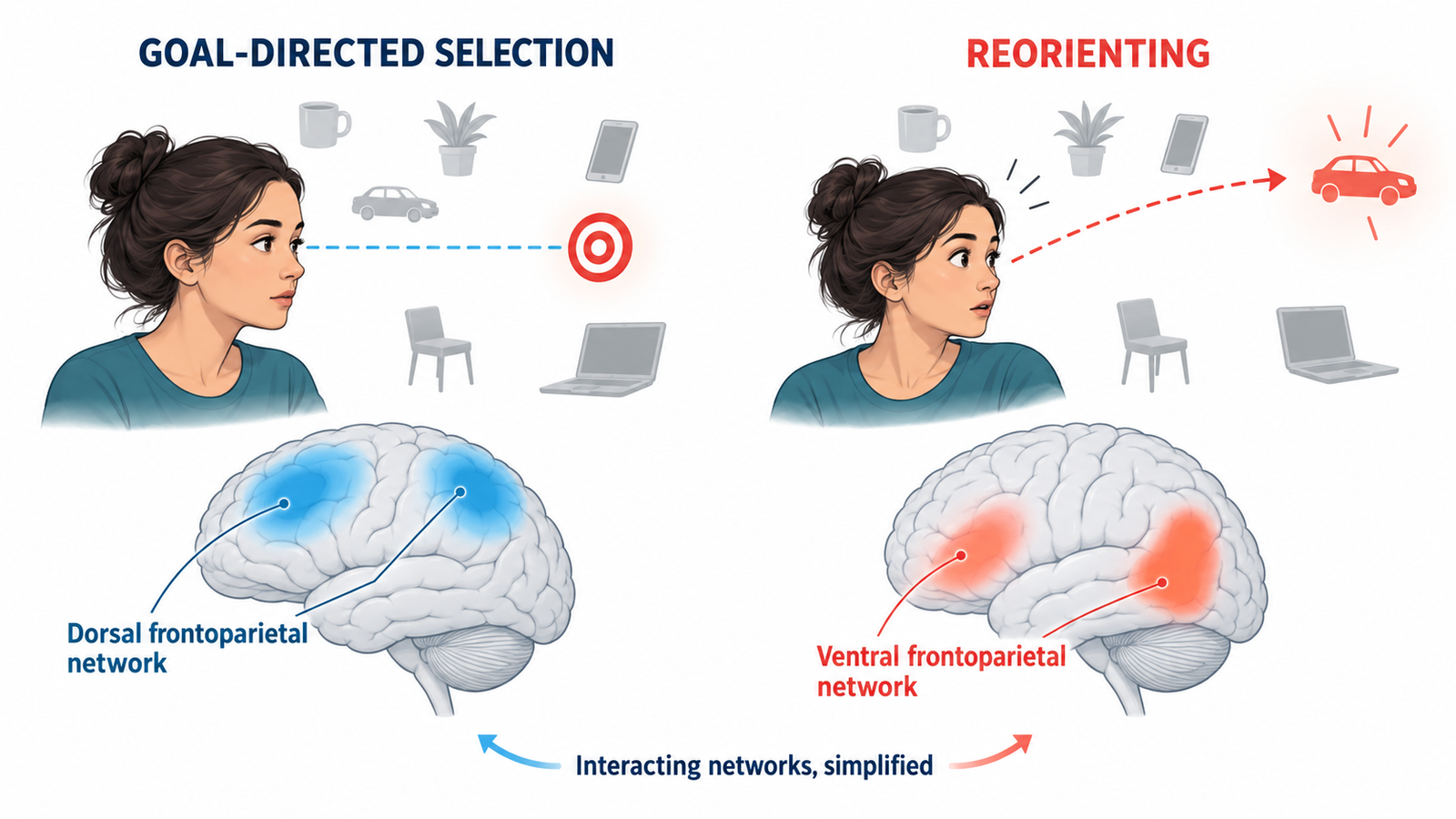
The brain selects in two main ways.
- Selecting on purpose: You decide, “Right now, I will focus on the book,” and keep that focus in place.
- Being pulled away: When a cup shatters nearby, your attention shifts toward the sound before you decide anything. This helps you avoid missing unexpected events that might be important.
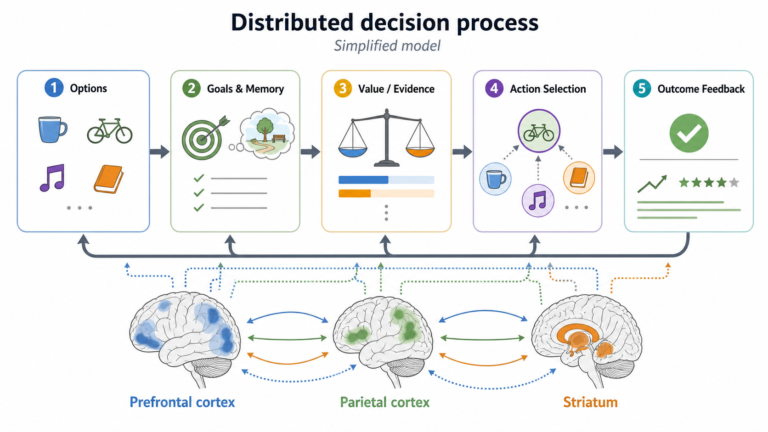
The first relies mainly on upper (dorsal) regions of the frontal and parietal lobes. The second relies mainly on lower (ventral) regions, largely on the right side of the brain. The two systems are not sharply separated, however. They interact closely.
Before selecting: staying ready
However hard you try to concentrate, selection works poorly when you are drowsy. Underneath selection lies a state of readiness to respond, called alerting.
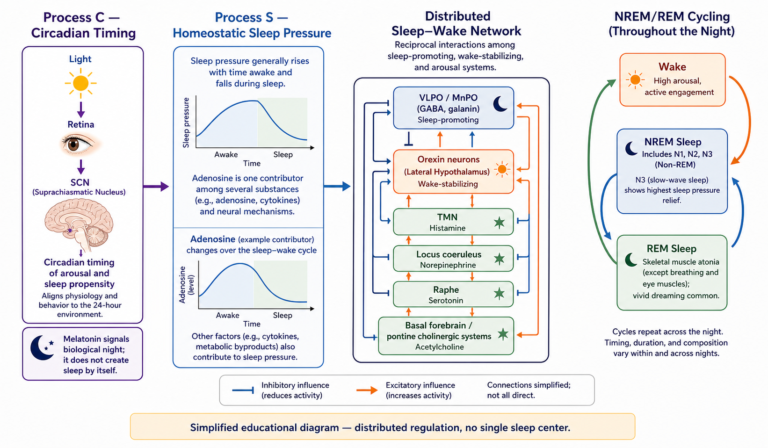
This readiness is supported by arousal systems that begin in the brainstem, the part of the brain that connects to the spinal cord. As a result, it is strongly affected by sleep, time of day, stress, medication, and physical health. When a student who stayed up all night opens a book and the words will not sink in, the problem lies in the step before selection: staying ready.
After selecting: holding back
The student has focused on the book, and then a phone notification goes off. The hand starts moving toward the phone almost by itself, but the task at hand is studying. Suppressing an automatic action and sticking to the original goal is “holding back.” The technical term is executive attention.
A well-known experiment shows this. If the word “RED” is printed in blue ink and people are asked to name the ink color, they hesitate. Reading the word happens automatically, so saying “blue” requires deliberately suppressing that response.
Several regions take part in this, including the anterior cingulate cortex, which lies deep on the inner surface of the frontal lobe, and the prefrontal cortex at the front of the brain.
Why multitasking rarely works well
Switching between a phone and a book can feel like doing two things at once. In reality, it is closer to moving rapidly back and forth between them. Each switch costs time spent finding your place again, and errors become more likely. This is one of the clearest everyday signs that the brain’s capacity for selection is limited.
When concentration is difficult
Concentration can break down if any of the three processes is disrupted. Lack of sleep weakens staying ready. A very noisy environment makes selecting harder. Anxiety or many pressing worries make holding back more difficult. Other possible causes include depression, pain, medication effects, vision or hearing problems, ADHD, and neurologic disease. Several factors can also overlap.
For this reason, the feeling that you “can’t concentrate” does not reveal its cause on its own. If concentration problems persist or interfere with school, work, or daily life, it is worth having them evaluated by a clinician.
This article is educational information about normal brain function and is not a substitute for diagnosis.
Related Articles
References
- Petersen SE, Posner MI. The Attention System of the Human Brain: 20 Years After. Annual Review of Neuroscience. 2012;35:73–89. doi:10.1146/annurev-neuro-062111-150525
- Vossel S, Geng JJ, Fink GR. Dorsal and Ventral Attention Systems. The Neuroscientist. 2014;20:150–159. doi:10.1177/1073858413494269
- Alves PN, Foulon C, Karolis V, et al. The subcortical and neurochemical organization of attention networks. Communications Biology. 2022;5:1343. doi:10.1038/s42003-022-04281-0
Written by: MedMaru Editorial Team
Reviewed for medical accuracy by:
S. Chang, KMD