
What Is the Somatic Nervous System? Functions & Examples
What Is the Somatic Nervous System?
Introduction
Every time you walk, write, speak, or pick up a cup, your nervous system is coordinating these actions. Most of these voluntary movements are controlled by the somatic nervous system (SNS).
The somatic nervous system is one of the two major functional divisions of the peripheral nervous system. It allows us to consciously interact with the world by carrying sensory information to the central nervous system and sending motor commands to skeletal muscles.
Understanding the somatic nervous system helps explain how the brain controls movement and how we perceive touch, temperature, pain, and body position.
The somatic nervous system (SNS) is the division of the peripheral nervous system responsible for voluntary movement and conscious sensation. It carries sensory information from the skin, muscles, and joints to the brain and spinal cord, and sends motor commands from the central nervous system to skeletal muscles.
What Is the Somatic Nervous System?
The somatic nervous system is a functional division of the peripheral nervous system (PNS).
Its primary role is to connect the central nervous system (brain and spinal cord) with skeletal muscles and sensory receptors throughout the body.
Unlike the autonomic nervous system, which regulates involuntary functions such as heart rate and digestion, the somatic nervous system primarily controls movements that can be initiated voluntarily.
However, it also participates in rapid spinal reflexes, which occur automatically without conscious control.
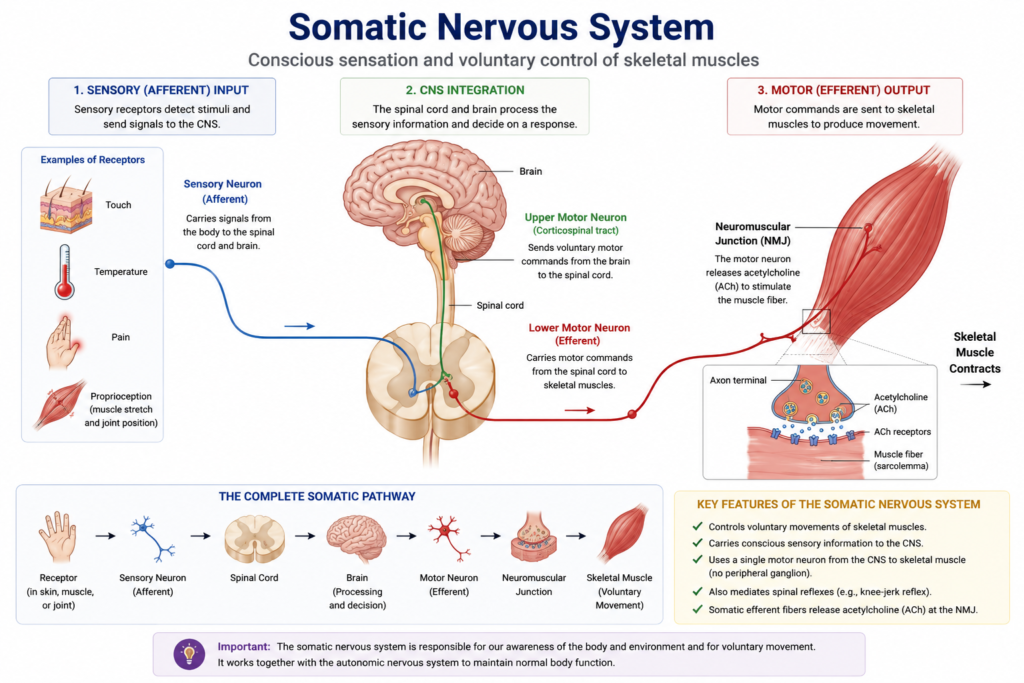
Major Components of the Somatic Nervous System
The somatic nervous system consists of two major functional pathways.
Sensory (Afferent) Pathway
Sensory receptors detect changes in the external and internal environment.
These receptors provide information such as:
- Touch
- Pressure
- Pain
- Temperature
- Vibration
- Proprioception (body position and movement)
Sensory neurons carry this information through peripheral nerves to the spinal cord and brain, where it is processed and interpreted.
Motor (Efferent) Pathway
After sensory information has been processed, the central nervous system sends motor commands to skeletal muscles.
These commands travel through somatic motor neurons and allow us to perform voluntary movements such as:
- Walking
- Writing
- Speaking
- Reaching
- Smiling
Each somatic motor neuron directly innervates skeletal muscle fibers at the neuromuscular junction.
Unlike the autonomic nervous system, the somatic motor pathway uses a single motor neuron to connect the central nervous system to skeletal muscle.
How the Somatic Nervous System Works
The somatic nervous system follows a continuous cycle of communication.
Step 1. Sensory Detection
Receptors in the skin, muscles, tendons, and joints detect external stimuli or changes in body position.
↓
Step 2. Signal Transmission
Sensory neurons carry these signals to the spinal cord and brain.
↓
Step 3. Information Processing
The central nervous system integrates sensory information and determines the appropriate response.
↓
Step 4. Motor Output
Motor neurons transmit commands from the spinal cord to skeletal muscles, producing voluntary movement.
This cycle occurs continuously whenever we interact with our environment.
Voluntary Movement and Reflexes
A common misconception is that the somatic nervous system controls only voluntary movement.
This is not entirely correct.
The somatic nervous system also mediates somatic reflexes, such as the patellar (knee-jerk) reflex and the withdrawal reflex.
These reflexes are processed primarily within the spinal cord and occur rapidly without conscious awareness, although the sensory and motor pathways involved belong to the somatic nervous system.
Why the Somatic Nervous System Is Important
The somatic nervous system allows us to consciously perceive our surroundings and intentionally move our bodies.
Without it, we could not:
- Walk or run
- Hold objects
- Speak
- Maintain posture
- Sense pain or touch
- Detect body position during movement
It plays an essential role in everyday activities, athletic performance, fine motor control, and coordinated movement.
Clinical Relevance
Disorders affecting the somatic nervous system can impair movement or sensation.
Examples include:
- Peripheral nerve injury
- Radiculopathy
- Peripheral neuropathy
- Amyotrophic lateral sclerosis (ALS) affecting somatic motor neurons
- Poliomyelitis affecting lower motor neurons
Depending on the location of the injury, patients may experience muscle weakness, paralysis, numbness, reduced sensation, or loss of reflexes.
Common Misunderstandings
“The somatic nervous system controls every muscle.”
Not true.
The somatic nervous system controls skeletal muscles only.
Smooth muscle, cardiac muscle, and glands are controlled primarily by the autonomic nervous system.
“Reflexes belong to the autonomic nervous system.”
Incorrect.
Many common reflexes, including the knee-jerk reflex and withdrawal reflex, are somatic reflexes involving skeletal muscles.
“Voluntary means every movement is consciously planned.”
Not always.
Many learned movements, such as walking or typing, become highly automatic through repeated practice, but they are still mediated by the somatic nervous system because they involve skeletal muscles and can be voluntarily initiated or modified.
- The somatic nervous system is a division of the peripheral nervous system.
- It controls voluntary movement and conscious sensation.
- Sensory neurons carry information to the central nervous system.
- Motor neurons send commands from the central nervous system to skeletal muscles.
- The somatic nervous system also mediates spinal reflexes involving skeletal muscles.
Related Articles
- What Is the Peripheral Nervous System?
- What Is the Autonomic Nervous System?
- What are Motor Neuron?
- What Is a Reflex Arc?
References
- Akinrodoye MA, Lui F. Neuroanatomy, Somatic Nervous System. StatPearls. Updated November 7, 2022.
- Neuroanatomy, Motor Neuron. StatPearls. NCBI Bookshelf.
- Neuroanatomy, Spinal Cord Myotatic Reflex. StatPearls. NCBI Bookshelf.
Written by: MedMaru Editorial Team
Reviewed for medical accuracy by:
S. Chang, KMD