
What Is a Sensory Neuron? Structure, Function, and Pathway
What Is a Sensory Neuron?
Introduction
Every sensation you experience—whether it is the warmth of sunlight, the pain of a pinprick, the sound of music, or the position of your arm—begins with a sensory neuron.
Sensory neurons continuously collect information from specialized sensory receptors throughout the body and transmit these signals to the brain and spinal cord. Without sensory neurons, the central nervous system would have no information about the external environment or the body’s internal condition.
Understanding sensory neurons is essential for learning how the nervous system detects, processes, and responds to the world around us.
A sensory neuron, also called an afferent neuron, is a nerve cell that carries information from sensory receptors to the central nervous system (brain and spinal cord). Sensory neurons detect stimuli such as touch, temperature, pain, vibration, and body position, allowing the brain to perceive and interpret sensory information.
What Is a Sensory Neuron?
Sensory neurons are one of the three major functional classes of neurons.
They form the afferent pathway, carrying sensory information toward the central nervous system.
Unlike motor neurons, which transmit commands from the brain and spinal cord to muscles, sensory neurons bring information into the central nervous system for processing.
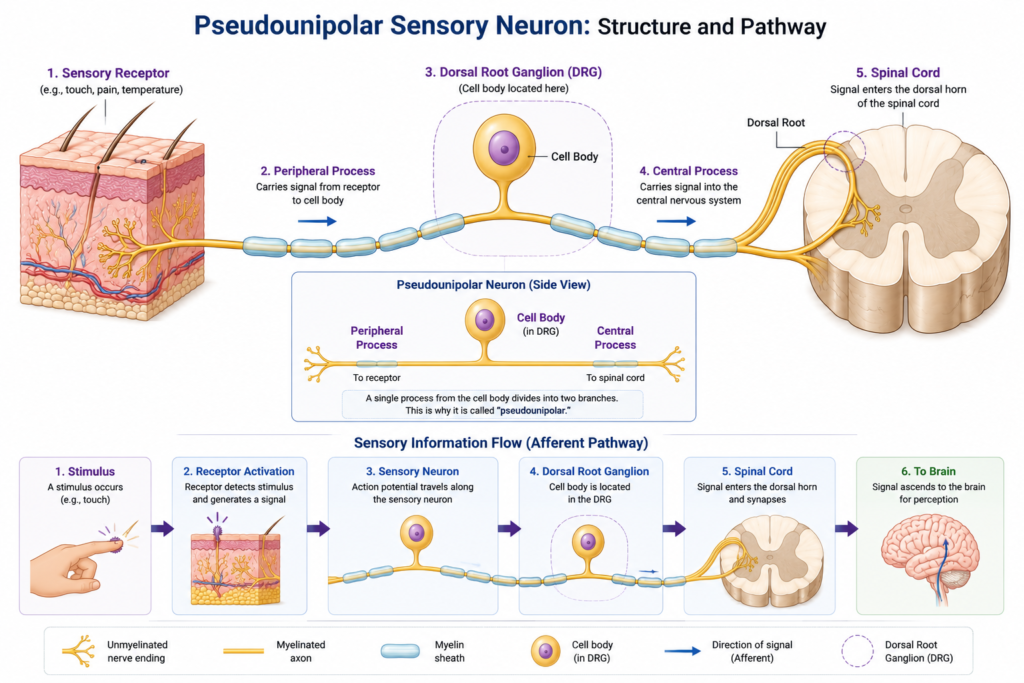
Structure of a Sensory Neuron
Most sensory neurons that carry information from the body are pseudounipolar neurons.
A pseudounipolar neuron has a single process that quickly divides into two branches:
- Peripheral process — extends to a sensory receptor in the skin, muscles, joints, or internal organs.
- Central process — enters the spinal cord or brainstem and carries the signal into the central nervous system.
Unlike most neurons, the cell body is located off to the side rather than lying directly in the path of signal transmission.
For most somatic sensory neurons, the cell body is located in the dorsal root ganglion (DRG).
How Sensory Neurons Work
The sensory pathway generally follows four steps.
Step 1. Detection
Specialized sensory receptors detect a stimulus, such as touch, pressure, temperature, pain, vibration, or muscle stretch.
↓
Step 2. Signal Generation
The receptor converts the stimulus into an electrical signal (a receptor potential). If the receptor potential reaches threshold, an action potential is generated in the sensory neuron.
↓
Step 3. Signal Transmission
The action potential travels along the sensory neuron through peripheral nerves toward the spinal cord or brainstem.
↓
Step 4. CNS Processing
The signal enters the central nervous system, where interneurons and higher brain centers process and interpret the sensory information.
Types of Sensory Information
Sensory neurons carry many different types of information.
General Somatic Sensation
- Touch
- Pressure
- Vibration
- Pain
- Temperature
- Proprioception (body position and movement)
Visceral Sensation
Sensory neurons also monitor the internal organs.
Examples include:
- Blood pressure
- Blood oxygen and carbon dioxide levels
- Bladder filling
- Stomach distension
- Visceral pain
These signals help regulate autonomic reflexes and maintain homeostasis.
Special Sensation
Special sensory pathways are responsible for:
- Vision
- Hearing
- Balance
- Taste
- Smell
These systems use specialized receptor organs and dedicated neural pathways rather than the typical dorsal root ganglion pathway.
Dorsal Root Ganglion
The dorsal root ganglion (DRG) is a collection of sensory neuron cell bodies located just outside the spinal cord.
It serves as the entry point for most sensory information from the body before signals enter the central nervous system.
Importantly, no synapses normally occur within the dorsal root ganglion. The action potential passes through the pseudounipolar neuron without synapsing in the ganglion.
Why Sensory Neurons Are Important
Sensory neurons provide the central nervous system with continuous information about both the external environment and the body’s internal state.
Without sensory input, the brain would be unable to:
- Detect injury
- Maintain balance
- Coordinate movement
- Recognize objects by touch
- Monitor body position
- Regulate many autonomic reflexes
Every voluntary movement depends on continuous sensory feedback.
Clinical Relevance
Damage to sensory neurons or their pathways may result in:
- Numbness
- Tingling (paresthesia)
- Reduced vibration sense
- Loss of proprioception
- Impaired balance
- Neuropathic pain
Common disorders include:
- Peripheral neuropathy
- Diabetic neuropathy
- Herpes zoster affecting the dorsal root ganglion
- Sensory neuronopathy (ganglionopathy)
Common Misunderstandings
“Sensory neurons only detect touch.”
Incorrect.
Sensory neurons detect many different forms of sensory information, including pain, temperature, vibration, body position, and signals from internal organs.
“The dorsal root ganglion is a relay station.”
Not exactly.
Although the dorsal root ganglion contains sensory neuron cell bodies, it is not a synaptic relay station. Under normal conditions, action potentials pass through the neuron without synapsing inside the ganglion.
“All sensory neurons are pseudounipolar.”
Not true.
Most somatic sensory neurons are pseudounipolar. However, the sensory neurons involved in vision, hearing, smell, taste, and balance have different anatomical organizations.
- Sensory neurons carry information from sensory receptors to the central nervous system.
- They are also called afferent neurons.
- Most somatic sensory neurons are pseudounipolar neurons.
- Their cell bodies are located in the dorsal root ganglia.
- Sensory neurons detect touch, pain, temperature, vibration, proprioception, and visceral stimuli.
Related Articles
- What Is a Reflex Arc?
- What Is a Motor Neuron?
- What Is an Interneuron?
- What Is the Somatic Nervous System?
References
- Physiology, Sensory System. StatPearls. NCBI Bookshelf.
- Raju H, Tadi P. Neuroanatomy, Somatosensory Cortex. StatPearls. Updated November 7, 2022.
- Grider MH, Jessu R, Kabir R. Physiology, Action Potential. StatPearls. Updated May 8, 2023.
Written by: MedMaru Editorial Team
Reviewed for medical accuracy by:
S. Chang, KMD