How Does the Brain Control Hunger and Thirst?
Hunger Isn’t Just Low Blood Sugar
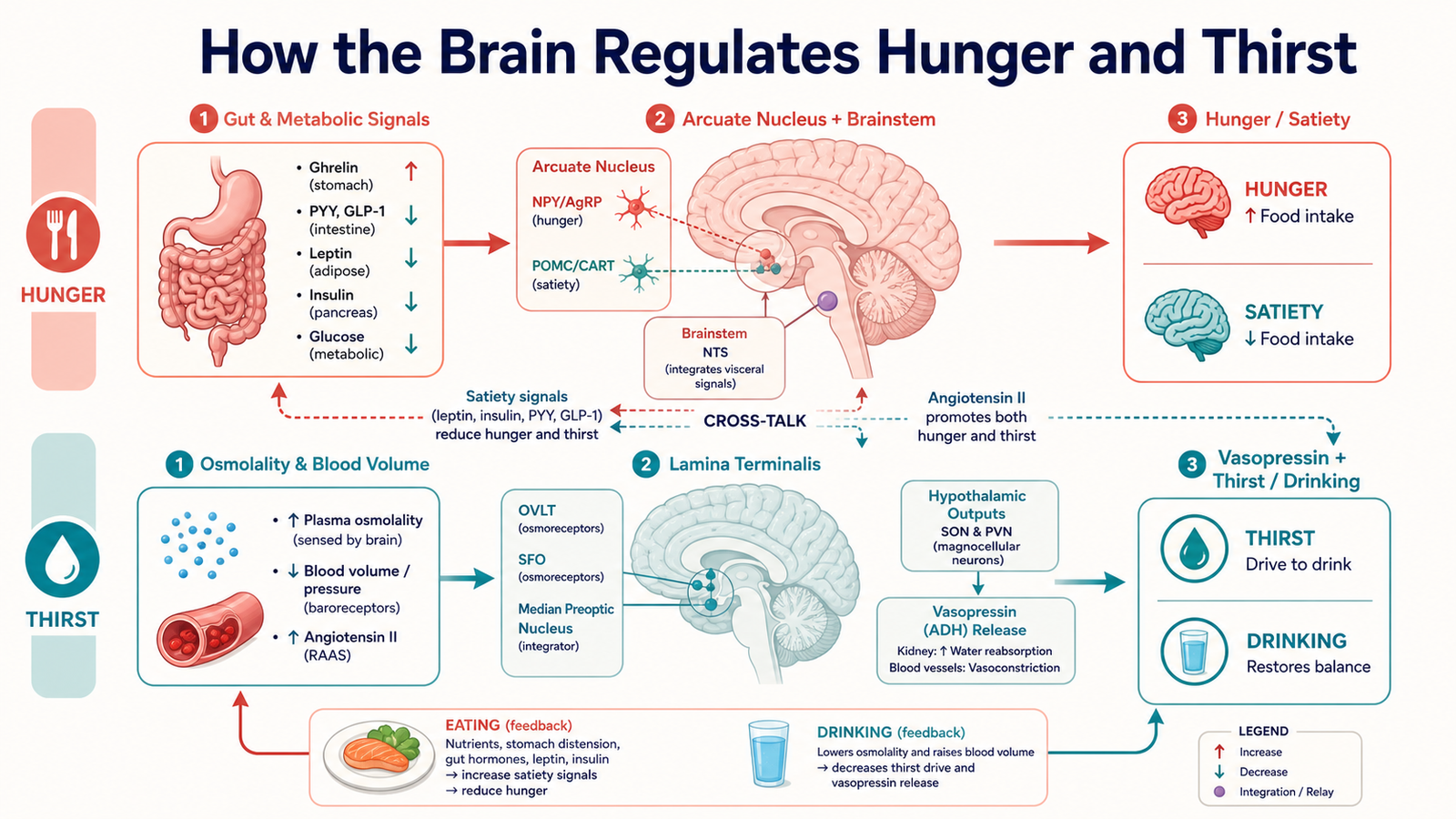
It’s tempting to reduce hunger to one signal — blood glucose drops, you feel hungry, you eat, the number goes back up. That’s one input among many, not the whole mechanism. Hunger and thirst are coordinated by overlapping but distinct networks: the hypothalamus and brainstem integrate signals about nutrients, hormones, gut filling, blood volume, and osmolality, with lamina terminalis circuits playing an especially important role for thirst specifically. On top of all that biology, reward, memory, sensory cues, social context, and learned habits can start or stop eating and drinking well before any internal deficit is actually corrected.
There’s no single hunger switch
The arcuate nucleus of the hypothalamus contains neuron populations that respond to signals like leptin, insulin, ghrelin, and circulating nutrients — AgRP-related pathways generally push toward food-seeking, while POMC-related pathways contribute to satiety and energy-balance signaling. These populations talk constantly with other hypothalamic and brainstem regions, and vagal sensory pathways separately report gut stretch and meal-related signals to the nucleus of the solitary tract. Calling this a “hunger center versus satiety center” oversimplifies what’s really a distributed, interacting system — food smell, taste, availability, stress, sleep, reward learning, culture, and medications can all shift intake, and the brain doesn’t even wait for nutrients to arrive: sensory cues alone can rapidly change relevant neurons’ activity before a bite of food has been digested at all.
Thirst runs on a similar layered logic
Osmosensory neurons near the lamina terminalis detect rising extracellular osmolality, while separate pathways detect falling blood volume or pressure, including signals tied to angiotensin II. Together these circuits drive thirst, salt appetite when appropriate, and vasopressin release — and vasopressin, in turn, helps the kidneys conserve water. What’s genuinely striking is how fast drinking quiets these circuits: thirst starts easing before swallowed water has even fully entered the bloodstream, because signals from the mouth, throat, and gastrointestinal tract offer a rapid prediction of incoming fluid, while the slower confirmation from actual blood changes catches up afterward. That layered feedback is what keeps drinking from either lagging dangerously behind need or overshooting it.
What changes in appetite or thirst actually mean
Persistent excessive thirst, very frequent urination, an inability to drink adequately, confusion, or signs of dehydration all need medical assessment. Appetite and thirst changes have a wide range of possible causes, and on their own they can’t diagnose a hormonal, hypothalamic, metabolic, or psychiatric condition — the same symptom can point in very different directions depending on what else is happening. It’s also worth noting that more isn’t always safer: excess water intake can be dangerous in its own right.
Related: How Does the Brain Control Body Temperature? · How Does the Brain Control the Autonomic Nervous System? · How Does the Brain Create Emotions?
References
- Augustine V, Lee S, Oka Y. Neural control and modulation of thirst, sodium appetite, and hunger. Cell. 2020;180:25-32.
- Andermann ML, Lowell BB. Toward a wiring diagram understanding of appetite control. Neuron. 2017;95:757-778.
- Zimmerman CA, Leib DE, Knight ZA. Neural circuits underlying thirst and fluid homeostasis. Nature Reviews Neuroscience. 2017;18:459-469.
- Zimmerman CA et al. Thirst neurons anticipate the homeostatic consequences of eating and drinking. Nature. 2016;537:680-684.
Written by: MedMaru Editorial Team
Reviewed for medical accuracy by:
S. Chang, KMD