Frontal Lobe: Function, Location, and What Happens When It’s Damaged
What Is the Frontal Lobe?
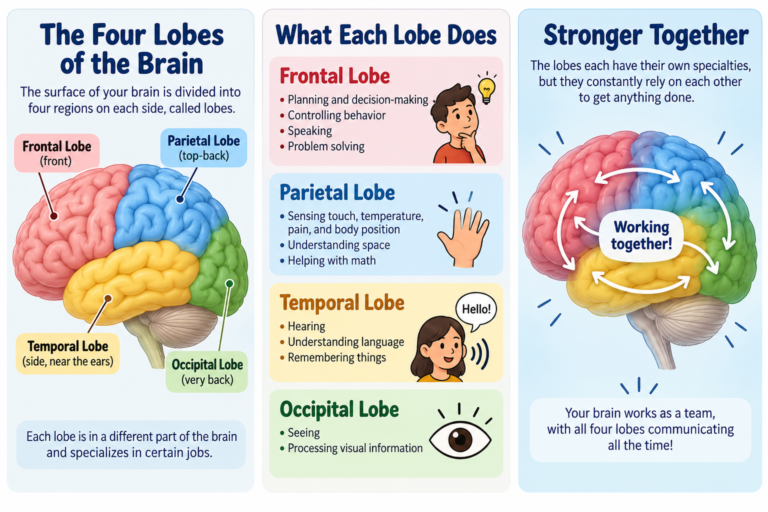
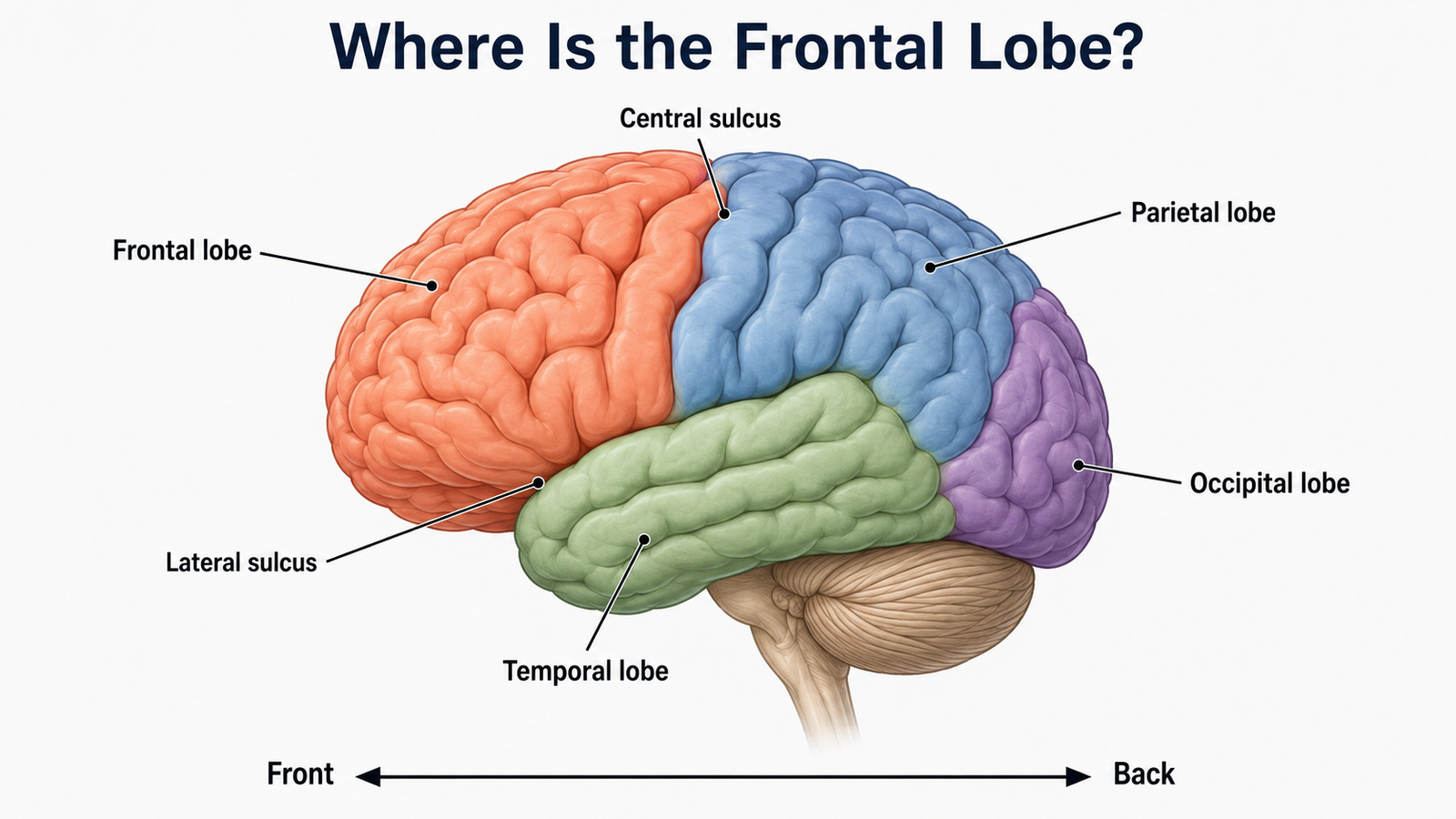
The frontal lobe is the front section of the brain, sitting roughly behind your forehead. It does two very different jobs at once: it moves your body on purpose, and it helps you plan, judge situations, and hold back impulses you’d regret acting on. Every person has two, one behind each side of the forehead, together making up an estimated 25–40% of the cerebral cortex (the brain’s outer surface) — experts give a range rather than one fixed number because there’s no single agreed-upon anatomical line marking exactly where the frontal lobe ends and its neighbors begin.
Not One Piece of Tissue, But Two Very Different Ones
The frontal lobe isn’t uniform. A narrow strip along its back edge sends electrical signals straight into your muscles. A much larger region in front of that strip never touches a muscle directly — instead, it shapes the decision before any movement happens. Think of the back strip as a light switch wired straight to a lamp, and the front two-thirds as the person deciding whether the room even needs light: the switch is fast and mechanical, the deciding part is slower, weighs options, and can get it wrong. The comparison breaks down in one way — that “deciding” region never works alone. It’s constantly fed information from emotion, memory, and the other lobes, so it’s closer to an ongoing conversation than a single decision-maker.
Where It Sits
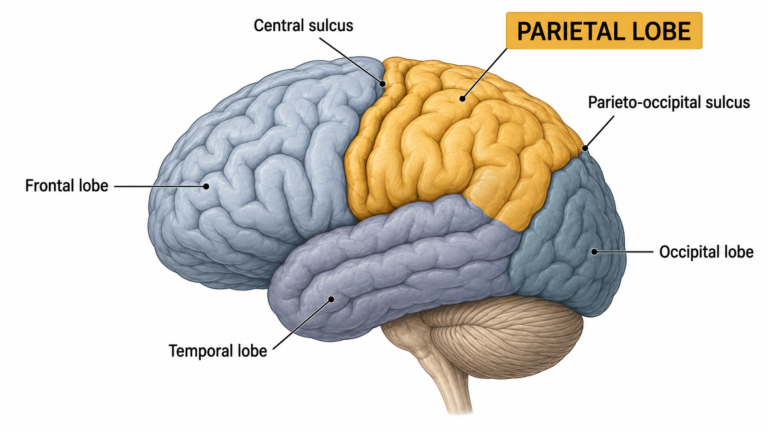
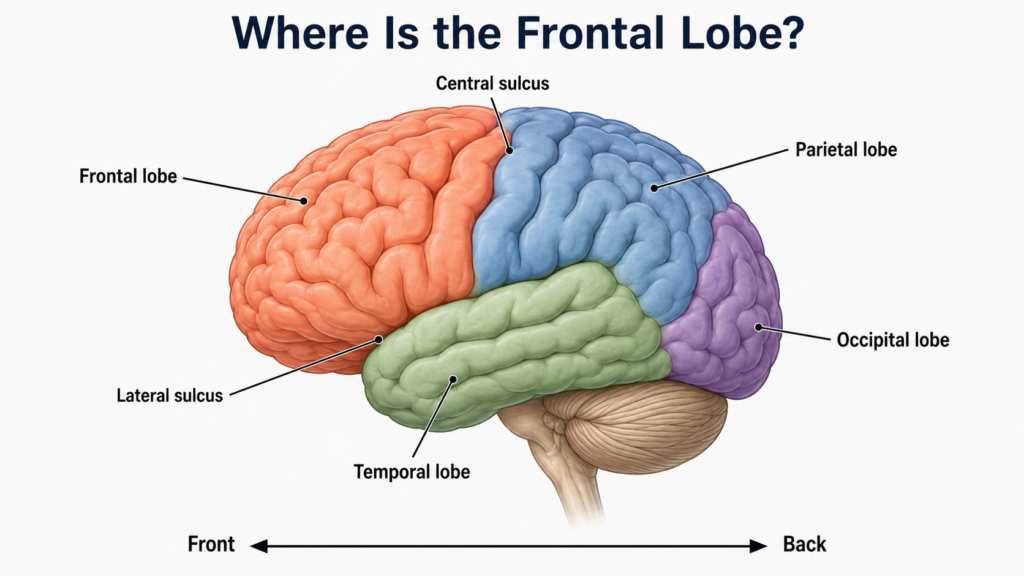
The frontal lobe occupies the most forward part of each cerebral hemisphere, under the forehead bone. Behind it, the central sulcus marks the border with the parietal lobe (which handles touch and body sensation); below and to the side, the lateral sulcus — also called the Sylvian fissure — marks the border with the temporal lobe (hearing and memory). It connects to the rest of the brain through white matter tracts, bundles of nerve fibers that work like insulated cables carrying signals over distance, and it gets its blood from two arteries: the anterior cerebral artery (top and inner surface) and the middle cerebral artery (outer and lower surface). That distinction matters clinically — a stroke in one of those arteries damages a different part of the frontal lobe than a stroke in the other.
The Four Regions That Do Different Jobs
The frontal lobe’s surface folds into ridges called gyri. Four of them matter most:
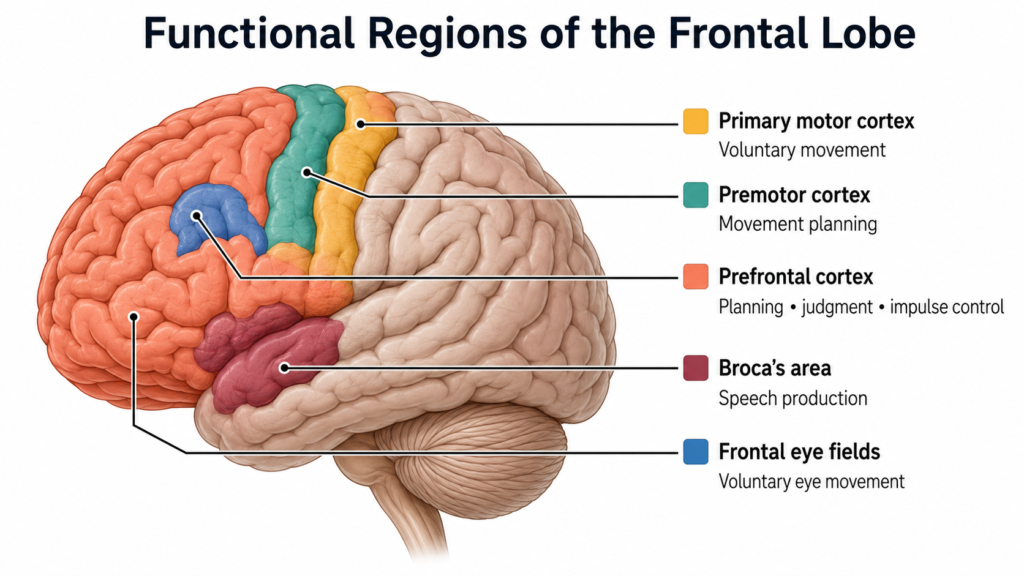
| Region | Where it is | What it does |
|---|---|---|
| Precentral gyrus | Right in front of the central sulcus | Contains the primary motor cortex — sends the signals that trigger voluntary muscle movement, arranged so the leg, arm, and face are controlled in a predictable top-to-bottom order (the “motor homunculus”) |
| Superior frontal gyrus | Uppermost of the three long frontal gyri | Working memory and spatial processing; its inner surface holds the supplementary motor area, which helps plan sequences of movement |
| Middle frontal gyrus | Between the other two, usually the largest | Attention, and in the language-dominant hemisphere, aspects of reading and writing; contains the frontal eye fields, which direct voluntary eye movement |
| Inferior frontal gyrus | Lowest of the three | Its back portion, on the language-dominant side, is classically called Broca’s area and is tied to producing speech |
These are tendencies seen across research and clinical practice, not fixed rules — the same region can behave a little differently from one person to the next, and the exact borders of a region like Broca’s area vary between anatomical descriptions.
What Happens When It’s Damaged
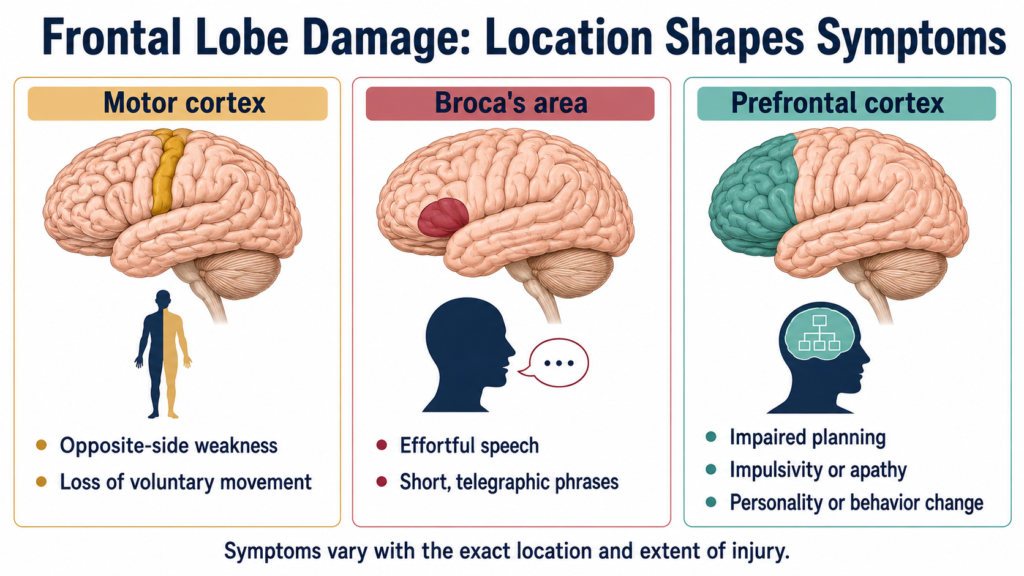
Damage to the precentral gyrus (the motor strip) typically causes weakness or paralysis on the opposite side of the body, roughly following the same top-to-bottom order as the homunculus — a stroke near the top of the strip tends to affect the leg, one lower down tends to affect the face and hand. This is a clinical tendency, not an exact rule, since the blood vessels feeding this strip vary between people and strokes rarely respect anatomical lines precisely.
Damage to the back of the inferior frontal gyrus, on the language-dominant side, can produce Broca’s aphasia: speech becomes effortful and grammatically stripped down — sometimes described as “telegraphic,” using mostly nouns and verbs — while understanding what others say usually stays relatively intact. In most people this dominant side is the left hemisphere: roughly 85–90% of people are left-hemisphere dominant for language overall, and that split runs closer to 90–95% among right-handed people and 70–85% among left-handed people, meaning a meaningful minority of people — left-handers especially — have language control on the right side or split between both.
Damage to the prefrontal cortex (the larger front two-thirds) shows up differently — usually as a change in personality or behavior rather than movement or speech. Some people become disinhibited, impulsive, or emotionally unpredictable; others go the opposite direction, becoming apathetic and withdrawn, or seem outwardly unchanged while struggling specifically with planning and organizing. Which pattern shows up depends on which specific frontal circuit was hit — orbitofrontal, dorsolateral, or the one connecting to the anterior cingulate — so there’s no single, predictable outcome from frontal lobe injury.
One pattern worth knowing on its own: some people with real frontal lobe injury still perform normally on standard in-office memory and thinking tests, yet struggle significantly with holding a job or running a household. This gap between test results and daily life is sometimes called the frontal lobe paradox, and it’s a reminder that a clean test score doesn’t rule out meaningful frontal lobe damage.
Common Myths
“The frontal lobe is the personality center.” Personality changes after frontal lobe injury are real and well documented, but they come from disrupted circuits connecting the frontal lobe to deeper brain structures — not damage to one isolated “personality organ.”
“A small lesion always causes one predictable problem.” Two people with damage in roughly the same spot can look completely different — one mostly weak, one mostly changed in personality, one showing both, and one showing little on a standard exam despite real day-to-day difficulty.
“Broca’s area is identical in every brain.” The classic description places it in the back of the inferior frontal gyrus on the language-dominant side, but the exact boundaries differ between anatomical studies, and not everyone’s language control sits where the textbook picture suggests.
Sudden weakness on one side of the body, sudden trouble speaking or understanding speech, a sudden severe headache, sudden confusion, or a sudden personality change can signal a stroke or other emergency. Don’t wait to see if it passes — seek emergency care right away.
Key Terms
- Central sulcus — the groove separating the frontal lobe from the parietal lobe.
- Lateral sulcus (Sylvian fissure) — the groove separating the frontal lobe from the temporal lobe.
- Gyrus (plural: gyri) — a ridge on the brain’s folded surface.
- Primary motor cortex — the strip of tissue on the precentral gyrus that sends signals directly to muscles.
- Prefrontal cortex — the front two-thirds of the frontal lobe, tied to planning, judgment, and impulse control.
- Broca’s area — the back part of the inferior frontal gyrus, on the language-dominant side, classically linked to speech production.
- Aphasia — a disruption of the ability to produce or understand language, caused by brain injury.
- Dominant hemisphere — the side of the brain that handles most language production in a given person (commonly the left).
FAQ
Is the frontal lobe the “personality center” of the brain?
Not on its own. The prefrontal cortex is heavily involved, but personality comes from circuits linking the frontal lobe to deeper brain structures, not one isolated area.
What happens if the frontal lobe is damaged?
It depends on which part. Motor strip damage tends to cause weakness on the opposite side of the body; prefrontal damage tends to affect judgment and impulse control; damage to the language-dominant inferior frontal gyrus can affect speech production.
Is Broca’s area always on the left?
In most people, yes — but not everyone. Left-handed people in particular are meaningfully more likely to have atypical language lateralization.
Can someone have frontal lobe damage and still pass a memory test?
Yes — this mismatch between normal test results and real daily struggle is known as the frontal lobe paradox.
Related Reading
References
- StatPearls, “Neuroanatomy, Frontal Cortex” — https://www.ncbi.nlm.nih.gov/books/NBK554483/
- StatPearls, “Neuroanatomy, Prefrontal Cortex” — https://www.ncbi.nlm.nih.gov/books/NBK499919/
- StatPearls, “Frontal Lobe Syndrome” — https://www.ncbi.nlm.nih.gov/books/NBK532981/
- Kenhub, “Frontal Lobe: Anatomy, Function and Clinical Relations” — https://www.kenhub.com/en/library/anatomy/frontal-lobe
- Cleveland Clinic, “Frontal Lobe” — https://my.clevelandclinic.org/health/body/24501-frontal-lobe
Written by: MedMaru Editorial Team
Reviewed for medical accuracy by:
S. Chang, KMD