What Is the Brainstem? Structure and Function
What Is the Brainstem?
Introduction
The brainstem is one of the most essential parts of the human brain. Although it is much smaller than the cerebrum, it performs many of the body’s most fundamental functions. Every breath you take, every heartbeat, and your ability to remain awake depend on the brainstem.
The brainstem serves as the main communication pathway between the brain and the spinal cord. It carries sensory information from the body to the brain and motor commands from the brain to the muscles. It also contains numerous nuclei that regulate vital automatic functions and houses the nuclei of most cranial nerves.
Because of these critical roles, severe damage to the brainstem can be life-threatening.
Quick Answer
The brainstem is the lower part of the brain that connects the cerebrum and diencephalon to the spinal cord. It consists of the midbrain, pons, and medulla oblongata and controls breathing, heart rate, blood pressure, swallowing, eye movements, consciousness, and many automatic body functions.
What Is the Brainstem?
The brainstem is one of the four major anatomical divisions of the brain.
It is located below the diencephalon, in front of the cerebellum, and above the spinal cord.
Unlike the cerebral cortex, which is responsible for conscious thought, the brainstem primarily regulates automatic functions that are essential for life.
It also serves as the primary pathway through which nerve fibers travel between the brain and the rest of the body.
Anatomy of the Brainstem
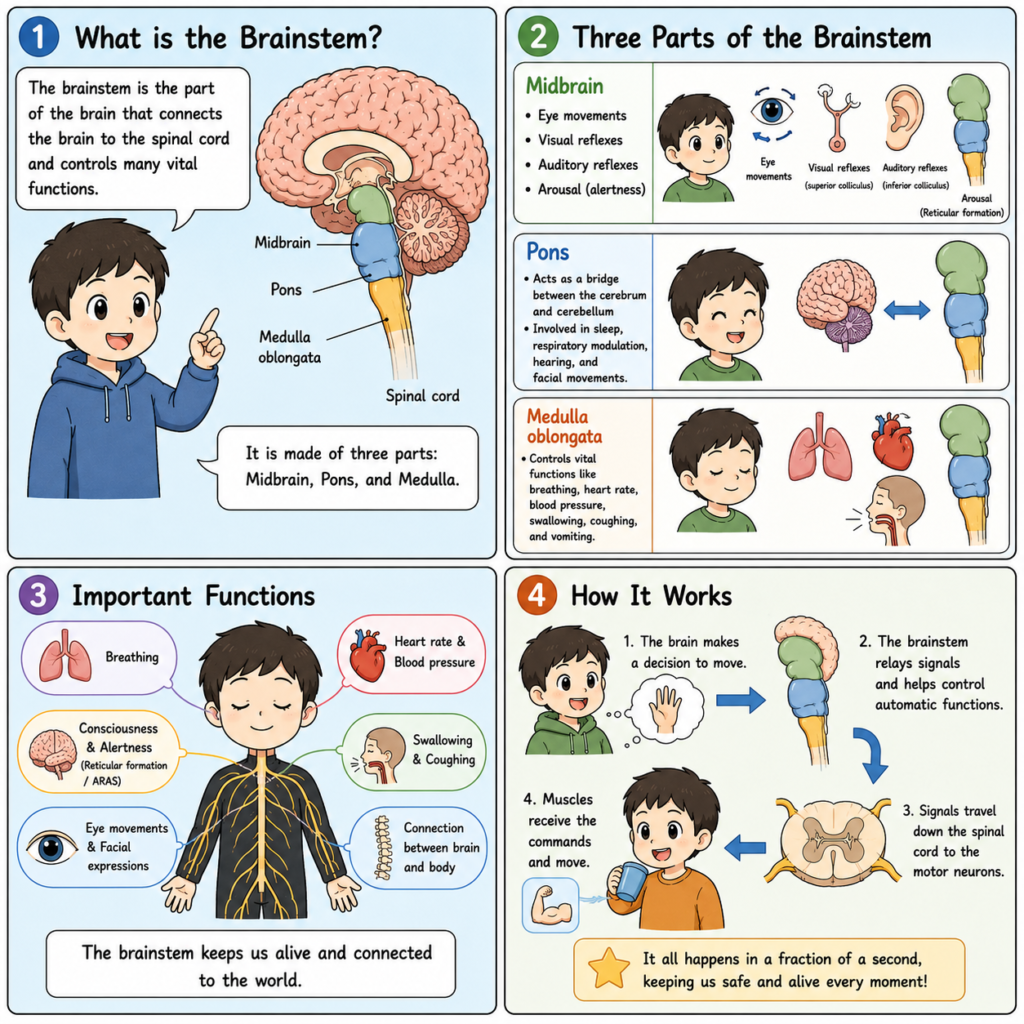
The brainstem consists of three major regions.
- Midbrain (Mesencephalon)
- Pons
- Medulla Oblongata
Although each region has specialized functions, they continuously work together.
1. Midbrain
The midbrain is the uppermost portion of the brainstem.
It contributes to:
- Eye movements
- Visual reflexes
- Auditory reflexes
- Motor control
- Arousal
The midbrain contains important structures such as the superior colliculus, inferior colliculus, substantia nigra, and red nucleus.
2. Pons
The pons lies between the midbrain and the medulla.
It serves as a major communication center between the cerebrum and the cerebellum.
Its functions include:
- Facial sensation
- Facial movement
- Hearing
- Balance
- Sleep regulation
- Respiratory modulation
Several cranial nerve nuclei are located within the pons.
3. Medulla Oblongata
The medulla oblongata is the lowest part of the brainstem.
It contains vital autonomic centers responsible for:
- Breathing
- Heart rate
- Blood pressure
- Swallowing
- Coughing
- Sneezing
- Vomiting
These functions operate automatically without conscious effort.
Cranial Nerves and the Brainstem
The brainstem contains the nuclei of 10 of the 12 cranial nerves.
Only the olfactory nerve (CN I) and the optic nerve (CN II) do not arise from the brainstem.
The cranial nerve nuclei control functions such as:
- Eye movements
- Facial expression
- Hearing
- Balance
- Taste
- Swallowing
- Tongue movement
The Reticular Formation
Running throughout the brainstem is a network of neurons called the reticular formation.
Rather than being a single structure, it is a diffuse network involved in:
- Maintaining consciousness
- Regulating the sleep-wake cycle
- Controlling attention and alertness
- Modulating pain
- Coordinating autonomic functions
Part of this network, known as the ascending reticular activating system (ARAS), is essential for maintaining wakefulness.
How the Brainstem Works
The brainstem acts as a communication hub.
For example, when you touch a hot object:
- Sensory signals travel through the spinal cord.
- The information passes through the brainstem.
- The cerebrum processes the sensation.
- Motor commands descend through the brainstem.
- The spinal cord activates muscles to withdraw the hand.
At the same time, the brainstem continuously regulates breathing and cardiovascular function without conscious awareness.
Why the Brainstem Is Important
The brainstem is essential for survival.
It continuously regulates:
- Breathing
- Heart rate
- Blood pressure
- Consciousness
- Sleep
- Eye movements
- Swallowing
- Protective reflexes
Without normal brainstem function, life cannot be sustained.
Clinical Relevance
Because the brainstem contains many critical pathways and nuclei, even small lesions can produce significant neurological deficits.
Examples include:
- Brainstem stroke
- Multiple sclerosis
- Brainstem tumors
- Traumatic brain injury
- Locked-in syndrome
- Cranial nerve disorders
Symptoms may include:
- Double vision
- Difficulty swallowing
- Facial weakness
- Loss of balance
- Respiratory failure
- Altered consciousness
Common Misunderstandings
“The brainstem only connects the brain to the spinal cord.”
Incorrect.
Although it serves as the main communication pathway, the brainstem also regulates breathing, cardiovascular function, consciousness, sleep, cranial nerve activity, and protective reflexes.
“All cranial nerves originate from the brainstem.”
Incorrect.
The olfactory nerve (CN I) and optic nerve (CN II) are not brainstem cranial nerves.
The remaining cranial nerves have nuclei within the brainstem.
“The brainstem only controls automatic functions.”
Not entirely.
The brainstem participates in automatic regulation, but it also contributes to eye movements, motor control, sensory processing, attention, and coordination with the cerebellum.
Key Takeaways
- The brainstem connects the brain to the spinal cord.
- It consists of the midbrain, pons, and medulla oblongata.
- It regulates breathing, heart rate, blood pressure, and consciousness.
- The brainstem contains the nuclei of most cranial nerves.
- The reticular formation helps regulate wakefulness and autonomic function.
- Damage to the brainstem can be life-threatening.
Related Articles
- What Are the Major Parts of the Brain?
- What Is the Cerebrum?
- What Is the Diencephalon?
- What Is the Midbrain?
- What Is the Pons?
- What Is the Medulla Oblongata?
- What Is the Reticular Formation?
- What Are Cranial Nerves?
What Is the Brainstem? Structure and Function
Meta Description
Learn what the brainstem is, how the midbrain, pons, and medulla work together, and why the brainstem controls breathing, heart rate, consciousness, and survival.
What Is the Brainstem?
Introduction
The brainstem is one of the most essential parts of the human brain. Although it is much smaller than the cerebrum, it performs many of the body’s most fundamental functions. Every breath you take, every heartbeat, and your ability to remain awake depend on the brainstem.
The brainstem serves as the main communication pathway between the brain and the spinal cord. It carries sensory information from the body to the brain and motor commands from the brain to the muscles. It also contains numerous nuclei that regulate vital automatic functions and houses the nuclei of most cranial nerves.
Because of these critical roles, severe damage to the brainstem can be life-threatening.
Quick Answer
The brainstem is the lower part of the brain that connects the cerebrum and diencephalon to the spinal cord. It consists of the midbrain, pons, and medulla oblongata and controls breathing, heart rate, blood pressure, swallowing, eye movements, consciousness, and many automatic body functions.
What Is the Brainstem?
The brainstem is one of the four major anatomical divisions of the brain.
It is located below the diencephalon, in front of the cerebellum, and above the spinal cord.
Unlike the cerebral cortex, which is responsible for conscious thought, the brainstem primarily regulates automatic functions that are essential for life.
It also serves as the primary pathway through which nerve fibers travel between the brain and the rest of the body.

Anatomy of the Brainstem
The brainstem consists of three major regions.
- Midbrain (Mesencephalon)
- Pons
- Medulla Oblongata
Although each region has specialized functions, they continuously work together.
1. Midbrain
The midbrain is the uppermost portion of the brainstem.
It contributes to:
- Eye movements
- Visual reflexes
- Auditory reflexes
- Motor control
- Arousal
The midbrain contains important structures such as the superior colliculus, inferior colliculus, substantia nigra, and red nucleus.
2. Pons
The pons lies between the midbrain and the medulla.
It serves as a major communication center between the cerebrum and the cerebellum.
Its functions include:
- Facial sensation
- Facial movement
- Hearing
- Balance
- Sleep regulation
- Respiratory modulation
Several cranial nerve nuclei are located within the pons.
3. Medulla Oblongata
The medulla oblongata is the lowest part of the brainstem.
It contains vital autonomic centers responsible for:
- Breathing
- Heart rate
- Blood pressure
- Swallowing
- Coughing
- Sneezing
- Vomiting
These functions operate automatically without conscious effort.
Cranial Nerves and the Brainstem
The brainstem contains the nuclei of 10 of the 12 cranial nerves.
Only the olfactory nerve (CN I) and the optic nerve (CN II) do not arise from the brainstem.
The cranial nerve nuclei control functions such as:
- Eye movements
- Facial expression
- Hearing
- Balance
- Taste
- Swallowing
- Tongue movement
The Reticular Formation
Running throughout the brainstem is a network of neurons called the reticular formation.
Rather than being a single structure, it is a diffuse network involved in:
- Maintaining consciousness
- Regulating the sleep-wake cycle
- Controlling attention and alertness
- Modulating pain
- Coordinating autonomic functions
Part of this network, known as the ascending reticular activating system (ARAS), is essential for maintaining wakefulness.
How the Brainstem Works
The brainstem acts as a communication hub.
For example, when you touch a hot object:
- Sensory signals travel through the spinal cord.
- The information passes through the brainstem.
- The cerebrum processes the sensation.
- Motor commands descend through the brainstem.
- The spinal cord activates muscles to withdraw the hand.
At the same time, the brainstem continuously regulates breathing and cardiovascular function without conscious awareness.
Why the Brainstem Is Important
The brainstem is essential for survival.
It continuously regulates:
- Breathing
- Heart rate
- Blood pressure
- Consciousness
- Sleep
- Eye movements
- Swallowing
- Protective reflexes
Without normal brainstem function, life cannot be sustained.
Clinical Relevance
Because the brainstem contains many critical pathways and nuclei, even small lesions can produce significant neurological deficits.
Examples include:
- Brainstem stroke
- Multiple sclerosis
- Brainstem tumors
- Traumatic brain injury
- Locked-in syndrome
- Cranial nerve disorders
Symptoms may include:
- Double vision
- Difficulty swallowing
- Facial weakness
- Loss of balance
- Respiratory failure
- Altered consciousness
Common Misunderstandings
“The brainstem only connects the brain to the spinal cord.”
Incorrect.
Although it serves as the main communication pathway, the brainstem also regulates breathing, cardiovascular function, consciousness, sleep, cranial nerve activity, and protective reflexes.
“All cranial nerves originate from the brainstem.”
Incorrect.
The olfactory nerve (CN I) and optic nerve (CN II) are not brainstem cranial nerves.
The remaining cranial nerves have nuclei within the brainstem.
“The brainstem only controls automatic functions.”
Not entirely.
The brainstem participates in automatic regulation, but it also contributes to eye movements, motor control, sensory processing, attention, and coordination with the cerebellum.
Key Takeaways
- The brainstem connects the brain to the spinal cord.
- It consists of the midbrain, pons, and medulla oblongata.
- It regulates breathing, heart rate, blood pressure, and consciousness.
- The brainstem contains the nuclei of most cranial nerves.
- The reticular formation helps regulate wakefulness and autonomic function.
- Damage to the brainstem can be life-threatening.
Related Articles
- What Are the Major Parts of the Brain?
- What Is the Cerebrum?
- What Is the Diencephalon?
- What Is the Midbrain?
- What Is the Pons?
- What Is the Medulla Oblongata?
- What Is the Reticular Formation?
- What Are Cranial Nerves?