
What Is the Nervous System? Parts, Divisions, and How It Works
Touch a hot pan and your hand jerks away before you have even registered the pain. Only a moment later does the burning sensation arrive, followed by the thought that you should have used an oven mitt. Those three steps, a reflex, a feeling, and a thought, happen in that order because they are handled by different parts of the same system.
That system is the nervous system: the network of the brain, the spinal cord, and the nerves that carries information around the body and decides what to do with it. It senses what is happening inside and outside you, processes that information, and sends commands that move muscles and adjust organs. Following that hot-pan moment is one of the clearest ways to see how it is built.
Two divisions, one system
Anatomists split the nervous system into two main divisions. The central nervous system (CNS) is made up of the brain and the spinal cord. It sits in the middle of the body, protected by the skull and the spine, and it is where information is processed and decisions are made.
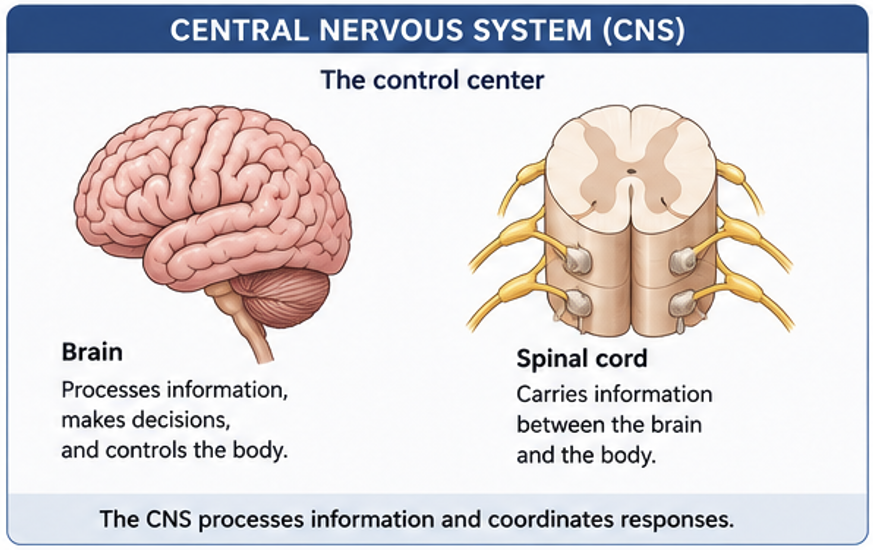
The peripheral nervous system (PNS) is everything else: the nerves that branch out from the brain and spinal cord to reach the skin, muscles, and organs. Twelve pairs of cranial nerves leave the brain directly, serving mostly the head and neck, and 31 pairs of spinal nerves leave the spinal cord to reach the rest of the body.
The division is useful, but it describes one continuous network. A single sensory neuron can have one end in the skin of your fingertip and the other end inside the spinal cord, so it belongs to both divisions at once.
Signals travel in and out
Information in the nervous system flows in two directions. Sensory signals travel inward. Sensory neurons carry messages about heat, pressure, sound, light, and the position of your limbs from the body toward the CNS. Motor signals travel outward. Motor neurons carry commands from the CNS to muscles and glands.
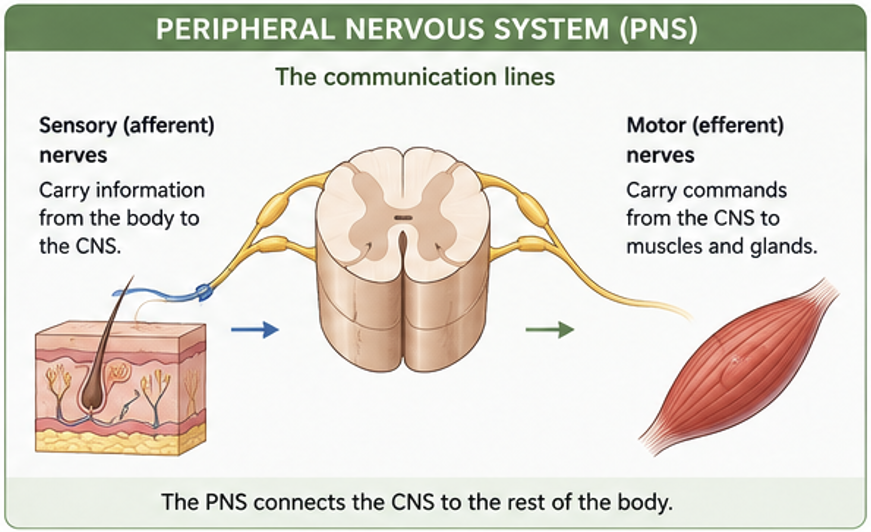
Between the two sit interneurons, which make up the vast majority of neurons in the brain and spinal cord. They connect incoming and outgoing signals and do most of the processing in between. Every one of these cells passes its message along the same way, with electrical and chemical signals.
Why the spinal cord is more than a cable
Back to the hot pan. The pain signal from your fingers travels along sensory nerves into the spinal cord. There, before the message has even reached the brain, interneurons pass it straight to motor neurons that pull your arm away. This shortcut is called a reflex arc, and it is why the withdrawal comes first.
At the same time, the signal continues up the spinal cord to the brain, which is where the sensation of pain is actually experienced and where you decide what to do next. So the spinal cord is not just a cable connecting the brain to the body. It also processes some information on its own.
This is also why the brain alone is not the nervous system. Without the spinal cord and peripheral nerves, the brain would have no way to learn what the body is feeling or to act on it.
The part you control and the part you do not
The peripheral nervous system is also divided by the kind of work it does. The somatic nervous system handles what you can sense and control consciously, such as feeling the texture of a table or deciding to lift your arm.
The autonomic nervous system runs the body in the background. It adjusts heart rate, blood pressure, digestion, sweating, and pupil size without asking you. It has two main branches that often work in opposite directions. The sympathetic nervous system prepares the body for action, and the parasympathetic nervous system supports rest and digestion. A third network, the enteric nervous system, is built into the wall of the gut and can manage much of digestion locally.
What happens when part of it is damaged
The two main divisions respond very differently to injury. Peripheral nerves can often regrow after being cut or crushed, although slowly, typically on the order of a millimeter a day, so recovery of a long nerve can take months. Damage within the brain or spinal cord is much harder to repair, because the environment there tends to block nerve fibers from regrowing. That is one reason spinal cord injuries are so often permanent.
Where the damage happens also shapes the symptoms. An injury to one peripheral nerve might cause numbness or weakness in a single hand, while an injury to the spinal cord can affect everything below that level. Understanding which part of the nervous system is involved is often the first step in making sense of a neurological problem. From here, a natural next step is how the brain works at the level of individual signals.
This article is for general education and does not replace advice from a qualified clinician.
References
- Standring S, ed. Gray’s Anatomy: The Anatomical Basis of Clinical Practice. 42nd ed. Elsevier; 2020.
- National Institutes of Health. Information about the Brain. NIH Curriculum Supplement Series. NCBI Bookshelf — https://www.ncbi.nlm.nih.gov/books/NBK20367/
- Akinrodoye MA, Lui F. Neuroanatomy, Somatic Nervous System. StatPearls. NCBI Bookshelf — https://www.ncbi.nlm.nih.gov/books/NBK556027/
- Purves D, Augustine GJ, Fitzpatrick D, et al., editors. Neuroscience. 2nd ed. Sinauer Associates; 2001. NCBI Bookshelf — https://www.ncbi.nlm.nih.gov/books/NBK10799/
Written by: MedMaru Editorial Team
Reviewed for medical accuracy by:
S. Chang, KMD